

The Best Crypto-Friendly Jurisdictions in 2026 (Ranked)
A ranking of the best crypto-friendly jurisdictions in 2026, comparing the top locations for DAOs, token projects, and Web3 companies based on legal frameworks, governance flexibility, tax structures, compliance requirements, and suitability for different blockchain use cases.
PwC's Global Crypto Regulation Report 2026 makes the stakes explicit: jurisdictions with more transparent crypto rules will lead the industry, while those with unclear frameworks will see institutional participants take a cautious stance. Crypto regulation, the report finds, is no longer a constraint. It is actively reshaping which markets attract capital and which projects can legally scale.
Key takeaways
- The ranking evaluates jurisdictions on legal recognition for DAO entities, regulatory clarity on token governance, and compliance overhead.
- Cayman Islands lost its FATF grey list designation in October 2023, removing a stigma that had complicated banking relationships.
- Wyoming's 2021 DAO LLC law was the first such legislation in the United States, later followed by the 2024 DUNA statute.
- A DAO LLC is a legal designation, not an identity requirement, so protocol teams and token projects use the same structures without calling themselves a DAO.
That shift means jurisdiction selection is no longer a legal formality for Web3 founders. It is a strategic decision that determines what your project can legally do, who is exposed to liability, what it costs to operate, and whether regulators have jurisdiction over your token. Choose the wrong jurisdiction, and you build your project on a foundation that creates friction at every interaction with banks, exchanges, investors, and regulators.
This article ranks the six best crypto-friendly jurisdictions in 2026 for DAOs, token projects, and Web3 organizations, with honest assessments of what each one actually offers and where it falls short.
What Makes a Jurisdiction Crypto-Friendly in 2026?
A crypto-friendly jurisdiction in 2026 is one that provides a defined legal home for blockchain-native projects, not just a tax break. The bar has risen significantly from the early days when "crypto-friendly" simply meant a low-tax offshore haven with no enforcement capacity.
Three criteria actually matter for project selection:
- Legal recognition for the entity type: Does the jurisdiction have a legal entity designed for DAOs, token projects, or algorithmic governance, or does it require projects to adapt traditional structures that were never built for them?
- Regulatory clarity on tokens and governance: Does the jurisdiction provide predictable treatment of governance tokens, utility tokens, and on-chain voting, or does your project's legal standing depend on informal guidance that can change without notice?
- Tax structure and compliance overhead: What is the effective all-in cost of operating in this jurisdiction, including formation, annual maintenance, required professional appointments, and tax obligations?
The six jurisdictions ranked below are the most commonly used and most seriously considered options for Web3 projects in 2026. The ranking reflects suitability for decentralized, token-native organizations, not for traditional fintech companies, which have a different set of priorities.

The Best Crypto-Friendly Jurisdictions in 2026, Ranked
1. Marshall Islands: Best Jurisdiction for DAO-Native Organizations
The Marshall Islands ranks first because it was the first sovereign nation to adopt a legal entity designed specifically for how DAOs actually work. The DAO Act of 2022 created a new class of LLC built around token-based membership, on-chain governance, and algorithmic management.
No directors, officers, or named managers are required. Smart contracts are the legal governance authority. Non-profit governance tokens with no economic rights are explicitly not treated as securities under RMI statute.
300+ DAOs and web3 projects have signed up through MIDAO's government-authorized program, including Pyth Network, MoonDAO, ApeCoin Governance DAO, GMX, and Gnosis Guild.
If your project is still weighing whether to incorporate, our article on why unincorporated DAOs are legally exposed to personal liability explains what is at stake.
Key advantages:
- Token-based membership; only beneficial owners holding 25% or more of governance rights provide KYC information
- Algorithmic management explicitly authorized by statute, not just permitted by workaround
- 0% tax for non-profit structures; 3% Gross Revenue Tax for for-profit
- Securities law carve-out for non-profit governance tokens
- Under 30 days to form; $9,500 all-inclusive, as low as $3,000 for smaller projects
- Offshore sovereign jurisdiction; not subject to US regulatory authority
- Delaware-based corporate law framework familiar to lawyers globally
Best for: Protocol DAOs, decentralized governance projects, token launches, AI agent projects, investment DAOs, and any Web3 organization where community governance and on-chain authority are the operational model. For the deeper case for the jurisdiction itself, see The Marshall Islands: A Crypto-First Haven for DAOs and Web3 Projects.
2. Cayman Islands: Established Jurisdiction for Crypto Foundations and Institutional Projects
The Cayman Islands ranks second as the legacy offshore standard for serious DeFi protocols and institutional blockchain projects. Before the RMI DAO LLC existed, the Cayman Foundation was where high-budget projects went for offshore legal recognition, and many still do.
Its removal from the FATF grey list in October 2023 removed a compliance stigma that had complicated banking relationships for some projects.
Key advantages:
- Zero corporate income, capital gains, and withholding taxes
- Mature legal ecosystem with deep crypto expertise and established service providers
- Sophisticated banking relationships familiar with digital asset projects
- Strong institutional recognition among counterparties unfamiliar with newer jurisdictions
- Flexible foundation structure for grant-making and long-term ecosystem stewardship
Limitations:
- Board of directors required with fiduciary duties that can override community governance
- Directors are not legally required to execute token holder votes
- Formation runs $15,000-$50,000; annual maintenance adds $10,000-$40,000
- No native token membership or algorithmic governance framework
Best for: High-budget protocols requiring institutional recognition, grant-making foundations, projects where the director layer adds governance accountability that counterparties value, and established DeFi protocols with existing Cayman structures.
See our full breakdown of how the Cayman Foundation compares to the RMI DAO LLC for a deeper side-by-side analysis.
3. Switzerland: Leading European Crypto Hub for Protocol Foundations
Switzerland ranks third as the most prestigious European jurisdiction for blockchain foundations, with a track record that includes Ethereum, Solana, Polkadot, Cardano, and Cosmos. Crypto Valley in Zug and FINMA's relatively clear regulatory framework made Switzerland the default for foundational L1 protocols from 2015 to 2022, and its institutional credibility in European markets remains unmatched.
Key advantages:
- Political stability and a sophisticated civil-law legal system
- Strong institutional banking with established crypto expertise
- Deep familiarity among European institutional investors and law firms
- FINMA's regulatory framework provides relative clarity for blockchain foundations
- Prestige track record: Ethereum, Solana, Polkadot, Cardano, and Cosmos all used Swiss foundations
Limitations:
- Board of trustees (Stiftungsrat) of at least three members required, one domiciled in Switzerland
- Foundation purpose locked at formation; changes require cantonal supervisory approval
- Formation runs $15,000-$50,000; annual maintenance $10,000-$30,000+
- MiCA compliance has added complexity for EU-facing operations
- No native mechanism for on-chain governance to serve as legal authority
Best for: Long-term protocol foundations, grant-making institutions, projects needing European institutional recognition, and established L1 ecosystems where the foundation serves a stewardship rather than governance function.
See our full comparison of Swiss Foundation and Marshall Islands DAO LLC for a deeper side-by-side analysis.
4. UAE: Fastest-Growing Offshore Destination for Web3 Projects
The UAE ranks fourth and is the fastest-growing offshore jurisdiction for crypto projects, with two distinct structures targeting different needs. ADGM's DLT Foundations Framework explicitly supports token voting and smart contract governance under English Common Law, while Dubai's VARA provides one of the clearest licensing regimes for exchanges and VASP operators.
The Avalanche Foundation incorporated an ADGM DLT Foundation in December 2025; RAK DAO offers a lighter-touch entry point from around $1,700, though it functions more as a DevCo structure than a governance wrapper.
Key advantages:
- Zero tax in ADGM and RAK DAO free zones
- ADGM explicitly supports token voting and smart contract governance in its DLT Foundation framework
- English Common Law applied in ADGM, familiar to international lawyers
- Dubai's VARA framework provides clear licensing for exchanges and VASP operators
- Growing Web3 ecosystem with increasing institutional presence in MENA
- UAE residency available alongside entity formation
Limitations:
- Both ADGM and RAK DAO structures still require a governance board; no manager-less option
- Newer jurisdiction with less established track record than RMI or Cayman for DAOs
- ADGM setup runs $5,000-$15,000 with $3,000-$10,000 annual fees
Best for: Crypto exchanges, VASP operators, Web3 service providers, projects with MENA market ambitions, and founders who want UAE residency alongside their entity.
5. Singapore: Regulatory Clarity and Global Financial Infrastructure
Singapore ranks fifth as the premier Asia-Pacific hub for crypto operating companies, offering clear digital asset regulations and access to one of the world's most sophisticated financial systems.
MAS has developed a comprehensive licensing framework for digital asset service providers, and Singapore's rule of law, English-language legal system, and strong banking infrastructure make it the natural APAC hub. Formation costs are $1,500-$3,000.
Key advantages:
- MAS provides one of the most comprehensive and clearly defined digital asset licensing frameworks in Asia
- English-language legal system with strong rule of law and contract enforcement
- Access to sophisticated APAC financial infrastructure and institutional banking
- Pro-business environment with a fast, efficient company formation process
- Strong reputation with Asian institutional investors, exchanges, and technology companies
Limitations:
- No DAO-specific legal structure; Pte Ltd and foundation structures were not built for token governance
- Corporate tax applies at 17%, one of the higher rates among the jurisdictions on this list
- Not suitable as a standalone governance structure for decentralized protocols
Best for: APAC-focused crypto operating companies, exchange operations, DeFi protocols needing Asian institutional access, and projects structured with Singapore as the commercial layer alongside an offshore governance wrapper.
6. Wyoming, USA: Strongest US Jurisdiction for DAO-Friendly Structures
Wyoming ranks sixth as the most DAO-aware US jurisdiction, notable for pioneering DAO-specific legislation and for the Wyoming DUNA, which Uniswap adopted in September 2025.
The 2021 DAO LLC law was the first such legislation in the US, and the 2024 DUNA statute, championed by a16z, added a nonprofit-only structure with explicit smart contract governance support. For projects that need to stay within US regulatory jurisdiction, Wyoming offers the most sophisticated domestic framework.
Key advantages:
- DAO-specific legislation; one of the few US states with a purpose-built structure for decentralized organizations
- No Wyoming state income tax
- DUNA explicitly supports smart contract governance and member-driven decision-making
- Domestic US legal recognition familiar to US courts, institutions, and counterparties
- Low state filing fees ($200-$500 for DUNA registration)
Limitations:
- Subject to full US federal regulatory jurisdiction: SEC, CFTC, IRS, and FinCEN all have authority
- DUNA is nonprofit only; cannot distribute profits to token holders
- Requires at least 100 members to maintain DUNA status
- Legal setup typically runs $5,000-$25,000+ beyond state filing fees
- Two years after enactment, adoption remains minimal; only Uniswap is a notable example
Best for: US-centric DAOs that need domestic legal recognition, nonprofit protocols with 100+ members, and projects where US regulatory engagement is a deliberate strategic choice rather than a constraint.
For a detailed feature-by-feature breakdown, see our complete comparison of the Marshall Islands DAO LLC and Wyoming DUNA.
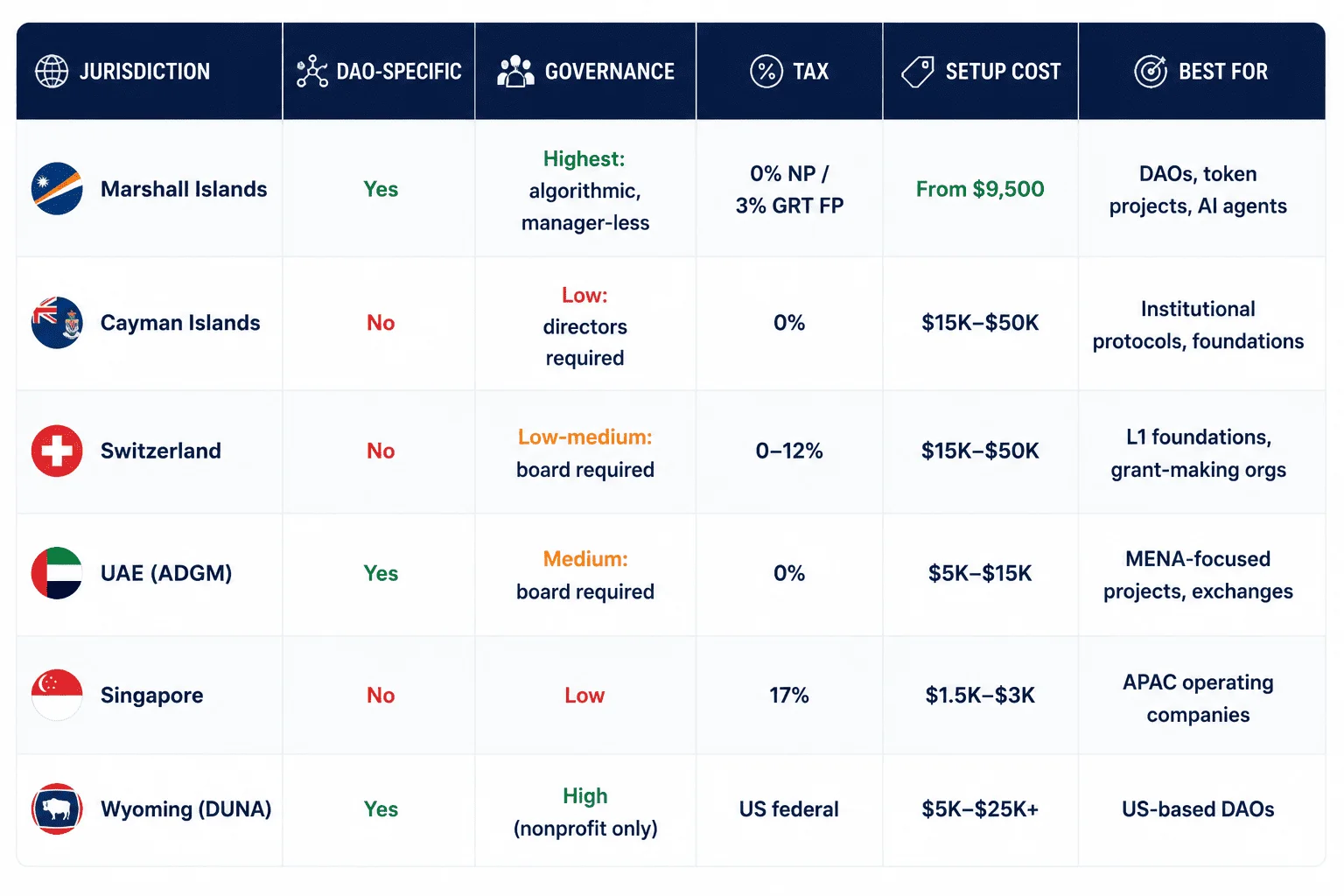
How Do the Top Crypto Jurisdictions Compare?
Which Jurisdiction Should Your Crypto Project Choose?
The most important insight from this ranking: jurisdiction is not just about tax. It determines what your entity can legally do, who controls governance, and how much that governance is actually worth.
A DAO LLC is a legal designation, not an identity requirement. Protocol teams, token projects, meme coin teams, and tokenized funds use the same structures; nothing about the entity requires your project to call itself a DAO.
The Marshall Islands stands alone for projects where decentralization is real, not cosmetic. It is the jurisdiction where on-chain governance is most fully recognized as the legal authority, where token holders govern without a board override mechanism, and where the legal structure was designed for your operating model rather than adapted from one that wasn't.
Every other jurisdiction on this list either requires a human governance layer that can override community decisions, carries full US regulatory jurisdiction, or imposes compliance costs that only make sense for high-budget institutional projects. For most Web3 projects in 2026, the question is not which offshore jurisdiction is best. It is which structure matches how the project actually governs itself.
If you are ready to move forward, our step-by-step guide to incorporating a token project in 2026 walks through every decision from entity type to treasury setup.
Ready to incorporate in the first sovereign jurisdiction purpose-built for DAOs? Start your Marshall Islands DAO LLC registration with MIDAO, the only government-authorized program for RMI DAO LLCs, and get your entity registered in under 30 days.
Frequently Asked Questions
Why are some crypto projects choosing offshore jurisdictions instead of traditional startup locations?
Globally distributed projects choose a jurisdiction to match how they actually operate. A project with contributors and token holders worldwide needs an entity built for that reality: a statutory carve-out for non-profit governance tokens with no economic rights, workable banking access, and a compliance framework of KYC/KYB, beneficial ownership reporting, and sanctions screening that counterparties recognize. Offshore structures like the RMI DAO LLC do not remove US obligations for US participants; they give international projects a legal home whose rules were written for token-based organizations.
How do crypto regulations affect token launches and decentralized protocols?
Jurisdiction determines whether governance tokens issued by the project face securities classification, what disclosure obligations apply, and whether token holders could face personal liability as governance participants. A non-profit RMI DAO LLC provides a statutory carve-out: governance tokens with no economic rights are explicitly not treated as securities under RMI law. Most other jurisdictions offer no equivalent statutory protection, leaving token classification dependent on case-by-case legal analysis.
What legal structure do most successful DAOs use today?
The most common structure among active DAOs in 2026 is a non-profit RMI DAO LLC as the governance and treasury layer, often paired with a Delaware C-Corp as the operating company for VC fundraising, team employment, and commercial contracts. Notable examples using RMI DAO LLC structures include Pyth Network, ApeCoin Governance DAO, MoonDAO, GMX, and Gnosis Guild. The hybrid model keeps governance decentralized and tax-efficient while giving the operating team a traditional US entity for commercial activity.