
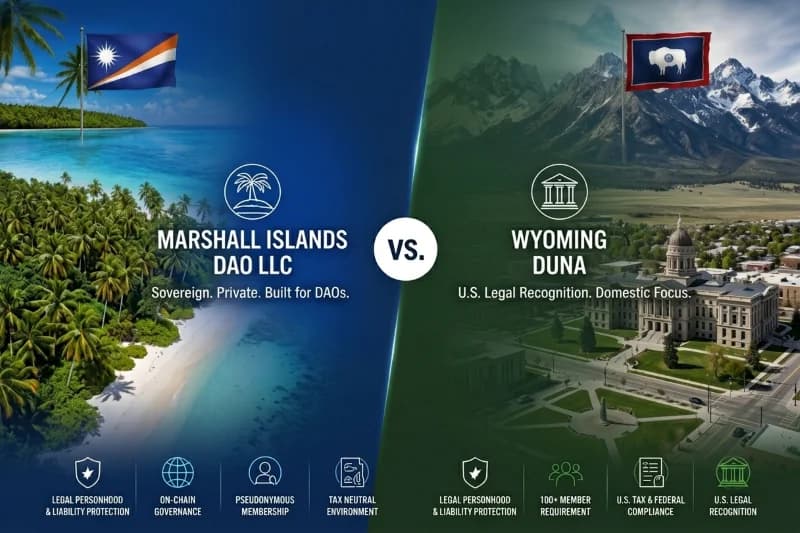
Marshall Islands DAO LLC vs. Wyoming DUNA: Complete Comparison
A comparison of the Marshall Islands DAO LLC and Wyoming DUNA, focusing on their differences in governance, tax structure, formation costs, and global accessibility to help DAOs select the best legal framework for their needs.
According to the DAO Development Market Outlook Report, Intel Market Research, Q3 2024, the global DAO development market was valued at $170 million in 2024 and is projected to reach $333 million by 2031, at a compound annual growth rate of 9.3%.
Key takeaways
- The Marshall Islands DAO LLC was introduced under the DAO Act of 2022, while the Wyoming DUNA took effect on July 1, 2024.
- Most DAOs without a formal legal structure default to unincorporated general partnerships, exposing every participant to joint and several liability.
- A Wyoming DUNA must maintain at least 100 members or it automatically converts to a standard nonprofit association, losing its decentralized legal protections.
- Ongoing obligations for a non-profit RMI DAO LLC stay light: no annual tax return, and no corporate income, capital gains, or withholding taxes.
- Uniswap's DUNI elected corporate taxation and has committed to engaging the IRS on tax liabilities from before its DUNA conversion, with a private letter ruling still pending.
That growth is real, and so is the legal risk that comes with it. Most DAOs operating without a formal structure are classified as unincorporated general partnerships by default, exposing every participant to joint and several liability. That single fact pushes founders toward legal wrappers, and increasingly toward two jurisdictions: the Republic of the Marshall Islands (RMI) and the state of Wyoming.
Both provide legal personhood and liability protection. But they are built on different philosophies, with different tax implications, operational requirements, and global reach.
What Are the Two Main DAO Legal Structures?
The two leading DAO legal frameworks are the Marshall Islands DAO LLC, introduced under the DAO Act of 2022, and the Wyoming DUNA, which took effect on July 1, 2024. Each grants DAOs legal personhood and liability protection, but through structurally different approaches suited to different types of projects.
The Marshall Islands DAO LLC
The Marshall Islands became the first sovereign nation to formally recognize DAOs as legal entities in February 2022, and later that year, passed the DAO Act of 2022: a dedicated framework allowing DAOs to incorporate as limited liability companies. A 2023 Amendment added Series DAO LLC capability, and the 2024 Regulations clarified KYC thresholds and on-chain monitoring standards.
The RMI structure was built from scratch for decentralized entities, not retrofitted from an existing corporate model. There is no requirement for a board of directors, physical office, or local representative. Governance can run entirely on-chain, smart contracts are recognized as legally binding governing documents, and most members can remain pseudonymous; KYC applies to beneficial owners under the 2024 RMI Regulations.
The Wyoming DUNA
Wyoming introduced an entirely new entity type with the Decentralized Unincorporated Nonprofit Association Act, signed into law on March 7, 2024, and effective July 1, 2024. The DUNA adapts Wyoming's existing Unincorporated Nonprofit Association Act for blockchain-native governance, giving DAOs the capacity to sign contracts, open bank accounts, hold property, appear in court, and pay taxes.
Crucially, the "nonprofit" label is not a profit restriction. Wyoming law permits DUNAs to engage in for-profit activities, provided proceeds serve the organization's governing purpose. That said, the DUNA is a U.S.-only entity type, and its cross-border recognition is still developing.
The DUNA model is also no longer Wyoming-only: Alabama and West Virginia enacted DUNA statutes in April 2026, effective October and July 2026 respectively. Production adoption is a different story. The named DUNAs in operation remain a handful, all formed in Wyoming, with the highest-profile example being Uniswap's DUNI.
Side-by-Side: Marshall Islands DAO LLC vs. Wyoming DUNA
The table below compares both structures across all key factors.
| Factor | Marshall Islands DAO LLC | Wyoming DUNA |
|---|---|---|
| Entity type | LLC (for-profit or non-profit) | Unincorporated nonprofit association |
| Legal personhood | Yes | Yes |
| Member liability protection | Full LLC shield | Full separation from entity obligations |
| Token and governance support | Explicitly recognized; tokens supported | Recognized via "governing principles"; token treatment less defined |
| Required managers or directors | None required | Administrators may be appointed; structural ambiguity for fully on-chain DAOs |
| Member privacy | Most members pseudonymous; one KYC required | Member identity requirements less clear under U.S. law |
| Cost and tax burden | 0% tax (non-profit); minimal compliance costs | U.S. federal tax rates; annual reporting required |
| Minimum membership | None | 100 members |
| International access | No U.S. nexus | U.S. legal entity only |
| Formation timeline | ~30 days | Varies |
| Series/sub-DAO capability | Yes (Series DAO LLC) | Not explicitly provided |
How Do the Key Legal Features Compare?
The Marshall Islands DAO LLC and the Wyoming DUNA share the fundamentals: legal personhood, liability protection, and on-chain governance support. The meaningful differences show up in governance design, tax treatment, and practical accessibility for global teams.
Legal Personhood and Liability Protection
Both structures make the DAO itself, not its members, the holder of obligations and legal exposure. Under the RMI framework, members are shielded by LLC-style limited liability. Wyoming's statute is equally clear: a member is not liable for a DUNA's contractual breaches or tortious acts simply because of their membership.
The core liability shield is comparable. What differs is global recognition. An LLC is an entity type that banks, counterparties, and foreign jurisdictions already understand. The DUNA is newer and recognized only in the handful of US states that have adopted it.
Governance and Decentralization
Marshall Islands DAO LLC governance flows through three constitutional documents: the Certificate of Incorporation, the Operating Agreement, and the Charter. The operating agreement can point directly to on-chain governance smart contracts, as Pyth DAO does with its Marshall Islands DAO LLC. Governance tokens and on-chain voting are explicitly supported. No minimum member count is required.
Wyoming DUNA governance is codified through "governing principles," a flexible concept covering smart contracts, consensus algorithms, enacted governance proposals, and written agreements. Administrators can be appointed with limited authority. One firm constraint: a DUNA must maintain at least 100 members. If membership drops below that threshold, the entity automatically converts to a standard Wyoming Unincorporated Nonprofit Association, removing its decentralized legal protections.
Taxation and Reporting Requirements
This is where the two jurisdictions diverge most sharply. The Marshall Islands offers a tax-neutral environment for non-profits. Wyoming DUNAs are fully subject to U.S. federal tax law.
Uniswap's DUNI, the flagship DUNA, shows what that means in practice: it elected corporate taxation, prepares a federal corporate return through its Wyoming administrator, has committed to engaging the IRS on tax liabilities from the years before the wrap, and holds a $16.5 million reserve for tax and legal defense, with a private letter ruling still pending. A nonprofit association under U.S. law is not the same thing as a tax-exempt one.
Non-profit Marshall Islands DAO LLCs pay zero corporate income, capital gains, or withholding taxes, with no mandatory annual tax filings. For-profit DAO LLCs pay a 3% gross revenue levy, excluding capital gains and dividends. Wyoming DUNAs, as U.S.-based entities, fall under IRS reporting requirements and applicable federal rates, a material compliance burden for internationally distributed teams.
How Do Formation and Ongoing Operations Differ?
Formation in the Marshall Islands is faster and has no minimum community size requirement. The Wyoming DUNA has a simpler filing process but requires at least 100 active members and carries heavier ongoing U.S. compliance obligations.
Formation and Compliance
Forming a Marshall Islands DAO LLC typically takes under 30 days through MIDAO's government-authorized incorporation program. Founding members complete KYC, draft the core documents, and submit to the RMI Registrar. No minimum capital, no local director, no physical presence required.
Steps to form a Marshall Islands DAO LLC:
- Define the DAO's name, purpose, and governance model
- Draft the Operating Agreement, Certificate of Incorporation, and Charter
- Complete KYC for founding members and any party with 25% or more of governance rights
- Submit founding documents to the RMI Registrar
- Receive registration confirmation, typically within 30 days
Ongoing compliance for non-profit DAO LLCs is minimal: UBO reporting, AML/CTF compliance, and a smart contract logic summary, with no tax filings required. The published cost on the RMI side is flat and all-inclusive: $9,500 standard setup, as low as $3,000 when treasury and funding total under $250,000, then an annual fee of $2,000 to $5,000 tiered by treasury and funding size. See MIDAO's pricing page for the full breakdown. Wyoming DUNAs require annual state reporting and full federal tax compliance, including potential FBAR filings and FinCEN obligations for treasury activity touching digital assets.
International Accessibility
The Marshall Islands is a sovereign nation not subject to U.S. federal law. A Marshall Islands DAO LLC does not create U.S. tax exposure by virtue of its existence, making it accessible to globally distributed teams without importing federal compliance overhead. A Wyoming DUNA, as a U.S. legal entity, brings international participants into the orbit of U.S. federal law, with implications for KYC, AML, securities compliance, and tax exposure.

Which Jurisdiction Fits Your DAO?
The Marshall Islands DAO LLC is the stronger fit for globally distributed DAOs seeking tax neutrality, privacy, and on-chain governance flexibility. The Wyoming DUNA suits U.S.-anchored projects that need domestic legal recognition and already have a large, established member base.
A Marshall Islands DAO LLC fits better when:
- The team or community is internationally distributed
- The DAO wants minimal tax and filing obligations
- On-chain governance and token voting are the primary decision-making tools
- Privacy for most members is a priority
A Wyoming DUNA fits better when:
- Operations, contributors, and counterparties are primarily U.S.-based
- The DAO already has 100 or more active members
- Domestic U.S. legal recognition is essential for banking or contracts
- Federal regulatory engagement is part of the roadmap
Marshall Islands DAO LLC vs. Wyoming DUNA: Final Verdict
Jurisdiction selection shapes the governance model, not just the legal paperwork. The structure you choose determines your tax burden, your members' regulatory exposure, your privacy defaults, and the flexibility of your token governance.
The Marshall Islands DAO LLC provides a sovereign, tax-neutral framework built for decentralized organizations from the ground up. Zero tax for non-profits, no required managers, pseudonymous membership, explicit token governance support, and a formation timeline under 30 days make it the practical choice for most globally distributed DAOs.
The Wyoming DUNA is a genuine innovation for U.S.-native projects, offering domestic legal recognition that U.S. courts and institutions understand. But it carries U.S. federal tax obligations, a 100-member floor, and less defined treatment of token governance and member privacy. For most DAOs building internationally, the Marshall Islands DAO LLC delivers a stronger combination of protection, flexibility, and cost efficiency.
Ready to incorporate your DAO? Book a free consultation with the MIDAO team, the only government-authorized DAO LLC program in the Marshall Islands, and get expert guidance on the structure that fits your project.
Frequently Asked Questions
1. What are the tax benefits of a Marshall Islands DAO LLC versus a Wyoming DUNA?
A Marshall Islands non-profit DAO LLC pays zero corporate income tax, capital gains tax, or withholding tax, with no mandatory annual filing. A Wyoming DUNA is a U.S. entity subject to federal tax obligations and IRS reporting requirements. For globally distributed DAOs, the Marshall Islands framework offers a significantly lower tax and compliance burden.
2. Is it possible to form a DAO LLC in the Marshall Islands if I am not based there?
Yes. The framework does not require founders, members, or directors to be based in the RMI, and there is no local office or residency requirement. Beneficial owners who complete KYC can be located anywhere in the world. MIDAO handles remote incorporation for international teams.
3. Which jurisdiction offers the most robust legal protections for DAO members?
Both provide strong liability shields: members are not personally liable for the DAO's contractual obligations or tortious acts in either structure. The Marshall Islands additionally protects members from liability for use of open-source software, and offers Series DAO LLC capability for sub-DAOs with segregated assets and liabilities.