
How to Incorporate a Token Project in 2026: A Step-by-Step Guide
A step-by-step guide to incorporating a token project in 2026, explaining why legal entities are now essential for DAOs and crypto projects, how to choose the right structure and jurisdiction, and how to set up governance, treasury, and compliance before launch.
The DAO Development Market Outlook Report, Intel Market Research, Q3 2024, values the global DAO development market at $170 million in 2024, projected to reach $333 million by 2031. Behind that growth is a hard truth most founders only discover after the fact: token projects are no longer experimental communities. They are regulated economic systems.
Key takeaways
- A token's legal and economic role determines its structure: governance-only tokens carry no economic claim and face the lightest securities scrutiny.
- Three legal structures cover most token projects: the DAO LLC, the Digital LLC for algorithmically managed systems, and a hybrid DAO LLC paired with a C-Corp.
- Members of a Marshall Islands DAO LLC, including token holders, are not personally liable for the entity's debts or legal claims.
- Beneficial owners holding 25 percent or more of governance tokens must be reported to MIDAO and the RMI registry under the 2024 Regulations.
- Registration through MIDAO's government-authorized program for a token project's legal entity typically completes in under 30 days.
And regulated economic systems need legal infrastructure. Not at some future milestone, but before the token launches. The "structure first, launch safely" model has replaced "launch first, figure out legal later" for one simple reason: exchange listings, institutional onboarding, banking access, and liability protection all require a recognized legal entity. Without one, the project runs on founder goodwill and personal exposure.
This guide walks through the ten steps to incorporate a token project correctly in 2026, in the order they need to happen.
Why Does a Token Project Need Its Own Legal Entity?
A token project needs a legal entity because, without one, participants risk being held personally responsible for its obligations. A group that operates toward a common goal without forming an entity can be treated as a general partnership, and general partners are jointly and severally liable.
This is not theoretical. The CFTC sued Ooki DAO as an unincorporated association of its voting token holders in 2022 and won a default judgment against the DAO in June 2023. In November 2024, a California federal court found the plaintiff had plausibly alleged Lido DAO is a general partnership and let claims proceed against venture capital firms alleged to have taken part in its governance. Courts are moving in one direction.
Incorporation solves three things at once: it creates legal personhood so the entity can sign contracts and open bank accounts; it establishes a corporate veil that separates organizational liabilities from personal assets; and it gives exchanges, regulators, and institutional investors a counterparty they can actually transact with.
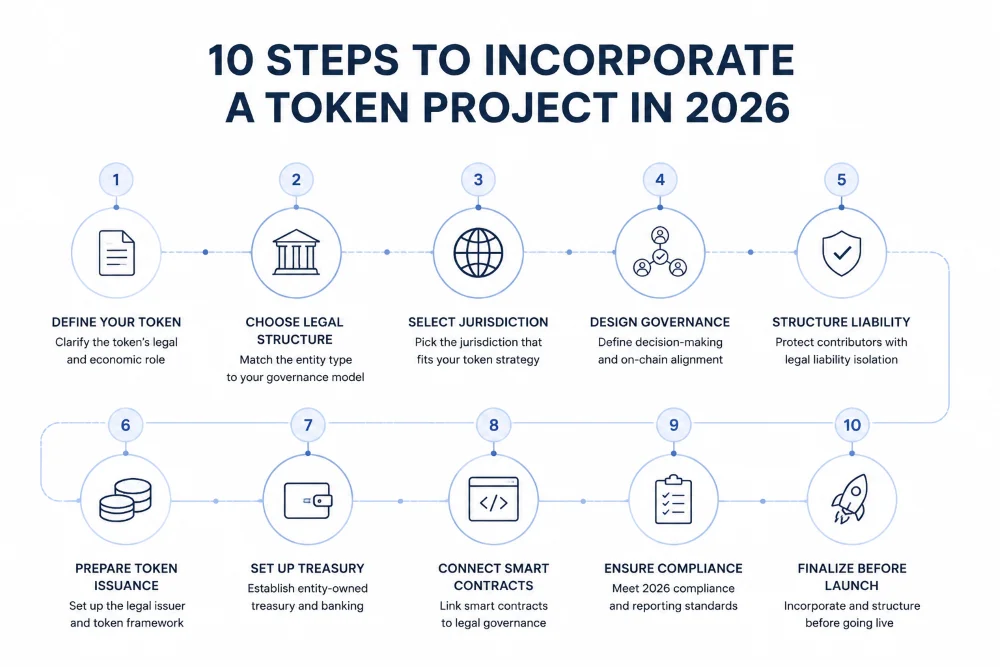
How to Incorporate a Token Project: 10 Steps
Step 1: Define Your Token's Legal and Economic Role
Before choosing any entity or jurisdiction, clarify what the token actually represents. This single decision determines everything that follows.
- Governance only: Token grants voting rights with no economic claim on assets or distributions. This is the cleanest structure under securities law and the most compatible with non-profit entity treatment.
- Utility access: A token unlocks access to a product or service. Classification depends heavily on whether holders expect profit from others' efforts.
- Revenue-linked or investment exposure: Token holders receive distributions or have a claim on protocol revenue. This requires a for-profit entity and carries significantly higher securities law scrutiny.
The most common mistake is designing tokenomics before deciding on legal structure. The token's economic role determines the entity type, the jurisdiction, and the securities risk profile. Getting this sequence wrong means restructuring later, at much higher cost.
Step 2: Choose the Right Legal Structure
The entity type must match how the project actually governs itself. Three structures cover the majority of token projects in 2026:
- DAO LLC (token-governed systems). The Marshall Islands DAO LLC is the only purpose-built structure for token-native governance. It supports token-based membership, smart contract governance recognized as legally valid authority, and manager-less operation with no required directors. Non-profit governance tokens with no economic rights are explicitly not treated as securities under RMI law. This is the right choice for decentralized governance protocols.
- Digital LLC (AI and autonomous systems). The same RMI DAO LLC framework is applied to AI agent projects or algorithmically governed systems. The RMI Act explicitly authorizes algorithmic management as a valid governance structure, making it the only jurisdiction where an AI agent can serve as the operational manager of a legal entity.
- Hybrid: DAO LLC plus C-Corp. The most common structure for projects that need both community governance and venture capital. The RMI DAO LLC is the governance layer: it holds the treasury, issues governance tokens, and owns intellectual property. The Delaware C-Corp is the operating company: it raises VC, employs the core team, and handles exchange contracts and commercial operations.
Step 3: Select Jurisdiction Based on Token Strategy
For most globally distributed token projects, offshore incorporation is the correct choice. A US-incorporated entity is subject to SEC, CFTC, IRS, and FinCEN jurisdiction. Launching tokens from a US entity puts the issuance directly in the SEC's field of view. Offshore structures reduce the US nexus significantly without eliminating obligations for US-facing participants.
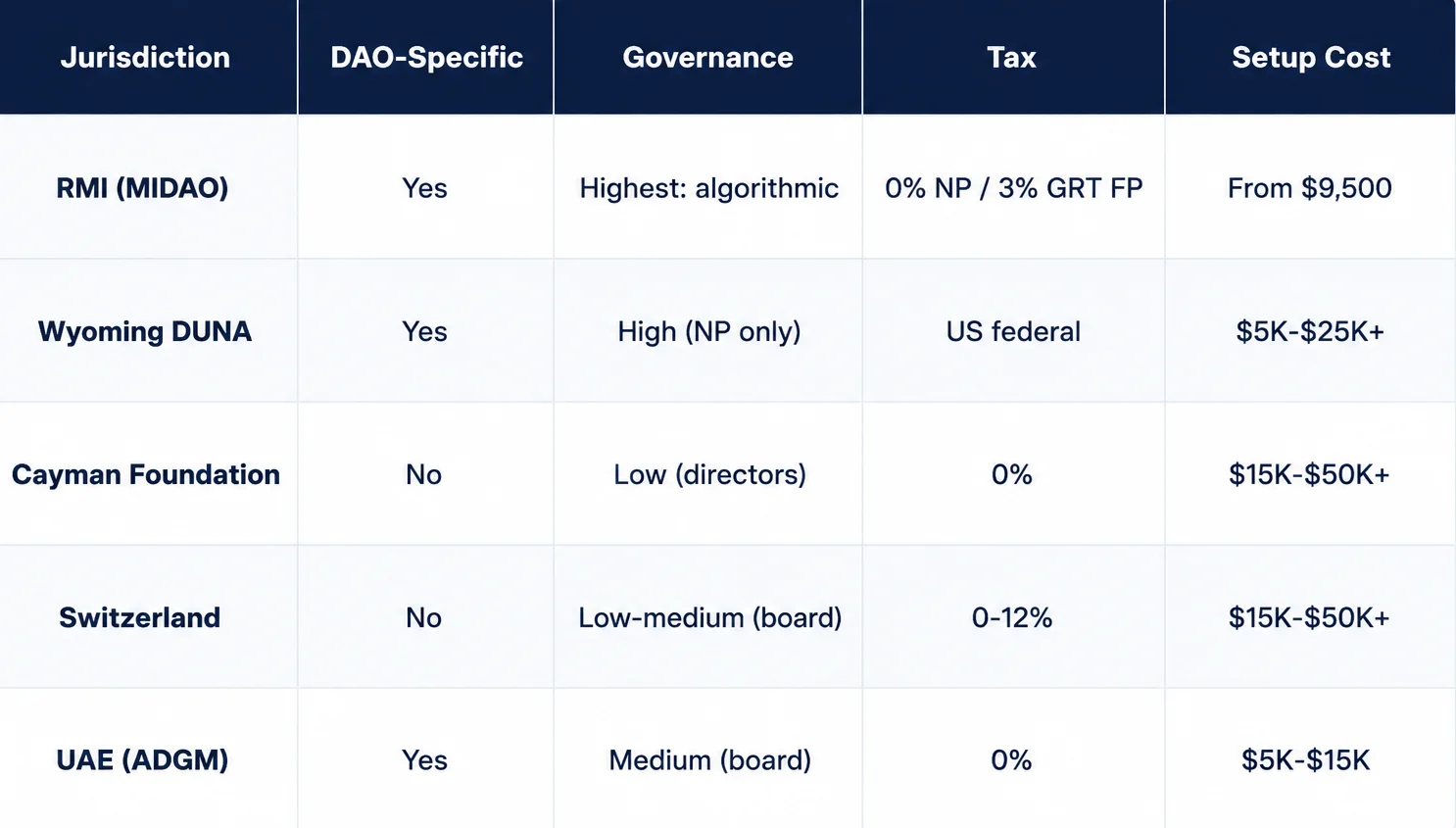
The RMI DAO LLC is the only purpose-built DAO entity with algorithmic governance, token membership, and no required directors. Cayman and Switzerland have institutional prestige but cost 2-5x more and require governance boards with fiduciary override authority over community decisions.
Step 4: Design Governance Before Incorporation
The governance structure must be designed before the operating agreement is drafted. The operating agreement is the legal backbone of the entity, and under the RMI framework, it can reference smart contracts directly, allowing on-chain governance to carry legal weight without a separate off-chain approval process.
Define how decisions are made:
- Token voting, with community votes weighted by balance
- Multisig, with a threshold of designated signers required
- Hybrid models combining token votes with multisig execution
- Algorithmic or AI-driven management for autonomous systems
The critical requirement is alignment between the code and the legal documents. If the operating agreement says governance runs through Contract A but the protocol runs through Contract B, the legal structure and the on-chain reality are disconnected. This gap has created liability problems for projects during protocol upgrades.
Step 5: Structure Liability and Participant Protection
Incorporation creates a corporate veil between the organization's obligations and its participants' personal assets. Without it, every founder, core contributor, and governance participant potentially faces unlimited personal exposure.
The specific protections the incorporation provides:
- Limited liability for founders, contributors, and governance participants
- Clear separation between personal assets and project assets
- A defined "who is responsible" that protects individuals and gives regulators a counterparty
- Governance participants protected from being treated as general partners
Under the RMI DAO LLC, the entity is the responsible party. Members, including token holders, are not personally liable for the entity's debts or legal claims by virtue of their participation.
Step 6: Prepare the Token Issuance Structure
The legal entity becomes the issuer of record for the token. Issuing tokens without a legal entity means there is no clear accountability, no defined relationship between the project and its token holders, and no mechanism for resolution when something goes wrong.
A legal entity behind the issuance provides:
- A clear issuer of record for exchange listings and regulatory inquiry
- A framework for vesting schedules, allocation structures, and distribution agreements
- The non-profit securities carve-out, where applicable, that keeps governance tokens out of securities classification under RMI law
- A documented governance relationship between the entity and token holders
Centralized exchanges require a counterparty before listing. They need KYC on the entity, a signed agreement, and an ongoing relationship for compliance purposes. Without a legal entity, there is no counterparty to provide.
Step 7: Set Up Treasury and Asset Control
A crypto wallet is not sufficient treasury infrastructure. Wallets hold assets, but they do not provide legal ownership, accountability frameworks, or audit trails that institutional counterparties expect.
Entity-level treasury ownership means:
- The DAO LLC holds the crypto wallet as a named legal asset of the entity
- Fiat banking access becomes available through the entity's legal identity
- Treasury management is connected to legal accountability, enabling formal audits
- Institutional investors and service providers have a clear counterparty for due diligence
MIDAO accepts annual fees in crypto, so DAO treasuries holding primarily on-chain assets can manage their registered agent relationship without converting to fiat.
Step 8: Connect Smart Contracts to the Legal Structure
Smart contracts are the execution layer. The operating agreement is the legal authority. This distinction matters because immutable or difficult-to-upgrade code creates governance risk if the legal documents cannot flex around it.
The RMI DAO LLC operating agreement can reference on-chain contracts directly. When those contracts are updated or upgraded, the governance mechanism updates accordingly, and the legal structure follows the on-chain reality rather than constraining it. Include provisions in the operating agreement for:
- Smart contract upgrades and the governance process for approving them
- Protocol changes that affect member rights or token economics
- Emergency governance mechanisms and human override conditions
Step 9: Ensure Compliance Readiness for 2026 Standards
The regulatory expectation in 2026 is an identifiable legal entity behind every project with user-facing activity. Compliance readiness is not a separate workstream from incorporation; it is built into the entity structure from day one.
Key compliance touchpoints to address at formation:
- Beneficial ownership: Any holder of 25% or more of governance tokens must be reported to MIDAO and the RMI registry under the 2024 Regulations. For most token projects with distributed supply, this is a non-issue.
- Exchange due diligence: CEX listings require KYC on the entity, AML confirmation, and a signed relationship agreement. The legal entity is the answer to every item on that checklist.
- Member privacy: General token holders below the 25% threshold provide no personal information. The RMI structure preserves pseudonymous participation for the community while meeting FATF compliance standards.
Step 10: Finalize Structure Before Token Launch
Incorporate before the token launches, not after. Registration through MIDAO's government-authorized program typically completes in under 30 days. If a token launch or first governance vote is 60 days out, the registration process should begin now. The entity needs to be in place before the first governance action, not scrambled together afterward.
Prepare the following before submitting:
- Governance structure decision: token voting, multisig, hybrid, or algorithmic
- For-profit or non-profit determination: this is permanent and cannot be reversed after filing
- Entity name: must be distinguishable in the RMI registry and include a DAO-specific descriptor
- Beneficial ownership information for any party holding 25% or more at launch
- Token structure: a deployed contract is not required, but the membership model must be described
The Conclusion: Structure Is the Foundation, Not the Formality
The most important insight from this guide is timing. Incorporation is not a compliance checkbox to tick before an exchange listing. It is the legal infrastructure that determines what the project can do, who is protected, and how governance decisions carry weight in the real world.
The ten steps in this guide map the complete path from token design to a compliant, incorporated entity. Each step builds on the previous one, and skipping any creates a gap that costs significantly more to fix after the fact than it would have cost to address at formation.
For globally distributed token projects with on-chain governance, the RMI DAO LLC provides the most complete alignment between legal structure and how the project actually works. See the full breakdown of structure options on MIDAO's pricing page before making a final decision.
Ready to incorporate your token project before launch? Start your RMI DAO LLC registration with MIDAO, the only government-authorized program for Marshall Islands DAO LLCs, and get your entity in place in under 30 days.
Frequently Asked Questions
Can a token project operate legally before launching its token, or must incorporation happen first?
A token project can operate before its token launches, but incorporation should happen before the first governance activity, treasury management, or external agreements, not just before the token itself goes live. The legal risk begins when participants start making collective decisions and managing shared assets, not when the token is minted. Incorporating before any governance activity eliminates the window during which participants are exposed as an unincorporated general partnership.
How does incorporation affect early community contributors who are not formal founders?
Incorporation protects early contributors by creating a corporate veil between the organization's obligations and their personal assets. Without a legal entity, any contributor who participates in governance, manages treasury funds, or makes decisions on behalf of the project carries personal liability exposure. With an incorporated entity in place, liability is contained at the entity level, which is the protection the unincorporated DAOs in CFTC v. Ooki DAO and Samuels v. Lido DAO did not have.
Can a token project change its jurisdiction after the token is already live?
Yes, but restructuring an active token project is significantly more complex than incorporating correctly from the start. Migration involves transferring entity-held assets, reassigning intellectual property, novating or renegotiating contracts with exchanges and service providers, and potentially addressing tax consequences depending on the jurisdictions involved. The token itself may also require governance votes to update issuer records. The cost and complexity of restructuring a live project is generally 5-10x the cost of choosing the right structure at formation.