
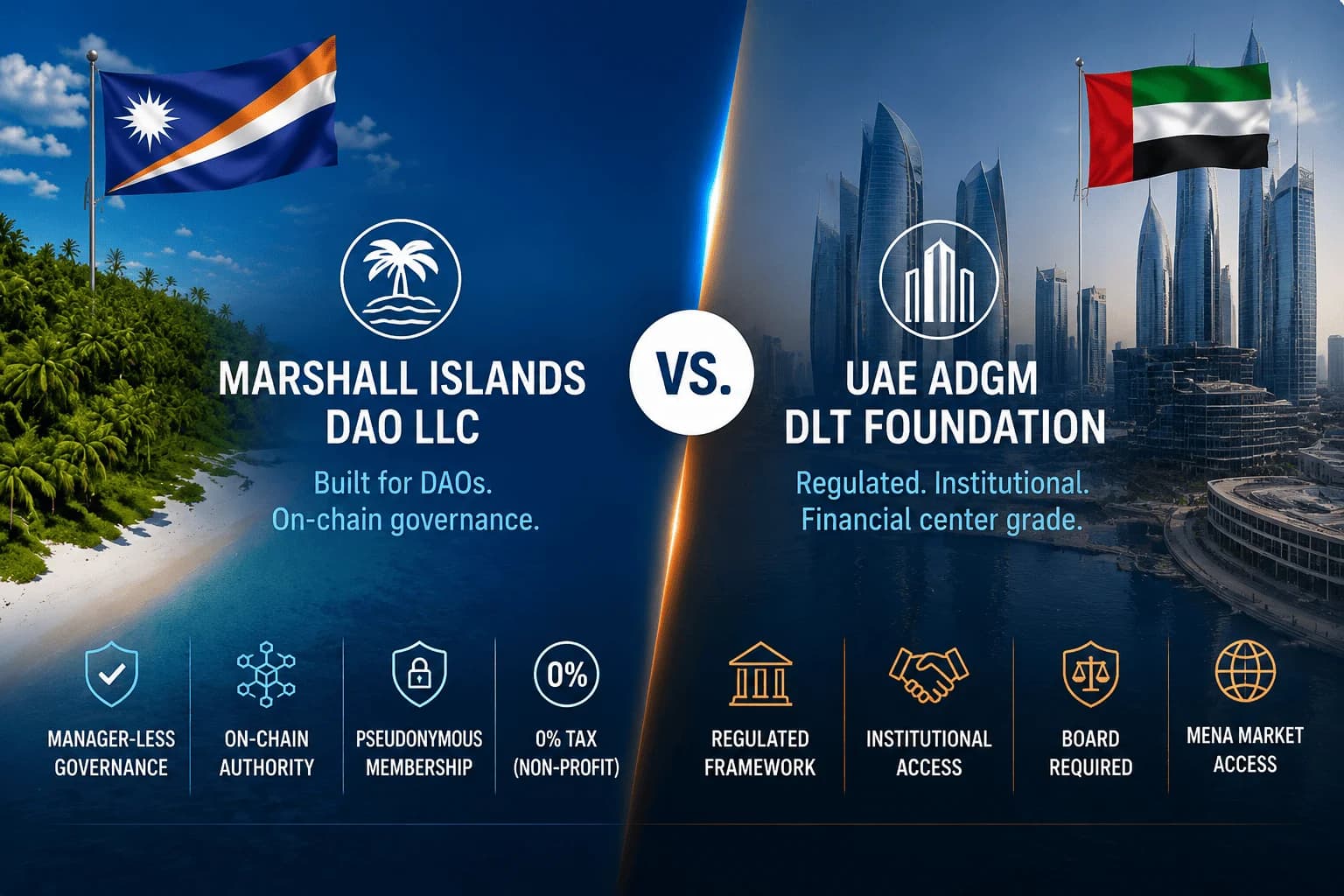
Marshall Islands DAO LLC vs. UAE ADGM: A Detailed Comparison
A comparison of the Marshall Islands DAO LLC and UAE ADGM DLT Foundation, explaining how the two Web3 legal structures differ in governance, compliance, tax, costs, and suitability for DAO-native projects, regulated digital asset businesses, and global crypto organizations.
The ADGM FSRA 2025 Annual Report recorded 3,495 operational entities in Abu Dhabi Global Market by the end of 2025, a nearly 40% year-on-year increase, with 12,000+ active licenses and Assets Under Management up 36%. ADGM is one of the fastest-growing international financial centres in the world, and its DLT Foundations Framework has made it a serious option for blockchain projects seeking offshore legal recognition.
That growth creates a real decision point. Web3 founders evaluating offshore jurisdictions now have to choose between a structure designed for institutional credibility and regulatory oversight, and one designed from the ground up for how DAOs and token-based organizations actually govern themselves. ADGM and the Marshall Islands represent two fundamentally different philosophies.
This article compares the Marshall Islands DAO LLC and the UAE ADGM DLT Foundation across governance, compliance, tax, use cases, and cost, so you can make the right structural decision for your project.
What Is a Marshall Islands DAO LLC?
The Marshall Islands DAO LLC was the first DAO-specific legal entity adopted by a sovereign nation. The Republic of the Marshall Islands enacted the DAO Act of 2022, creating a new class of LLC built from the ground up around token-based membership, on-chain governance, and algorithmic management. No human directors, officers, or managers are required.
The framework has been updated twice since launch. The 2023 Amendment added Series DAO LLC capability, allowing parent DAOs to create subsidiary series with segregated assets and liabilities. The 2024 Regulations clarified KYC thresholds and on-chain monitoring standards.
MIDAO operates the exclusive government-authorized registration program for RMI DAO LLCs. 300+ DAOs and web3 projects have signed up, including Pyth Network, MoonDAO, ApeCoin Governance DAO, GMX, and Gnosis Guild.
DAO-Specific Legal Framework
The RMI DAO LLC was built to solve a specific problem: legal systems require an identifiable person to hold obligations, sign contracts, and absorb liability, but DAOs do not have one. The DAO Act 2022 makes the LLC itself that person, with governance authority flowing from token votes and smart contracts rather than named directors.
The operating agreement can reference smart contracts directly. When governance decisions are executed on-chain, they carry the legal weight of a valid organizational action. No off-chain board vote is required to validate what the community has already decided.
Governance and Operational Flexibility
The RMI structure supports every major DAO governance model:
- Token voting: Community decisions weighted by governance token balance
- Multisig execution: Threshold-based approval for treasury and protocol decisions
- Algorithmic management: Smart contracts as the operative governance layer with no human override required
- Hybrid models: Combining on-chain votes with defined emergency controls
Only beneficial owners holding 25% or more of governance rights provide KYC information under the 2024 RMI Regulations, keeping identification requirements proportionate to governance influence. The threshold is a guide; the official guidance sets the detail.
Why Web3 Projects Choose the Marshall Islands
The RMI DAO LLC is a sovereign offshore structure not subject to US federal law. Non-profit DAO LLCs pay zero corporate income tax, capital gains tax, or withholding tax, with no mandatory annual filings. For-profit DAO LLCs pay a 3% Gross Revenue Tax on revenue generated outside the RMI, excluding capital gains and dividends.
Key advantages of the RMI DAO LLC at a glance:
- Zero tax for non-profit structures; no corporate income, capital gains, or withholding tax
- No directors or managers required: algorithmic governance is the legal authority
- Threshold-based KYC: identification applies to beneficial owners at or above the 25% governance-rights threshold (official guidance)
- Securities law carve-out: non-profit governance tokens are explicitly not securities under RMI statute
- Under 30 days to form, $9,500 all-inclusive, as low as $3,000 for smaller projects
- No US nexus: the entity is not subject to SEC, CFTC, IRS, or FinCEN authority
That statutory carve-out, encoded in the 2023 Amendment, is the strongest purpose-built securities protection available in any DAO-specific jurisdiction.
For more on the legal consequences of operating without this kind of structure, see our article on why unincorporated DAOs are legally exposed to personal liability.

What Is UAE ADGM?
Abu Dhabi Global Market is an international financial centre operating under English Common Law within a UAE federal free zone, regulated by the ADGM Financial Services Regulatory Authority (FSRA). It offers a broad regulatory environment covering financial services, digital assets, corporate structures, and fintech, and is recognized as the MENA region's largest international financial centre by market capitalization.
ADGM operates independently from UAE federal law in most commercial and financial matters, applying English Common Law and maintaining its own court system, the ADGM Courts. This gives counterparties familiar with UK-derived legal systems a comfortable framework. The Avalanche Foundation incorporated an ADGM DLT Foundation in December 2025, bringing notable institutional recognition to the structure.
ADGM as a Financial and Business Jurisdiction
ADGM's strength is institutional depth. Over 300 financial firms, including major banks, asset managers, hedge funds, and private equity groups, have established operations there. The FSRA's regulatory framework covers banking, securities, insurance, and virtual assets, with a 2025 update strengthening capital requirements and explicit prohibitions on privacy tokens and algorithmic stablecoins.
Key advantages of the ADGM DLT Foundation:
- English Common Law applied in ADGM Courts, familiar to international lawyers and institutional counterparties
- Zero tax within the ADGM free zone
- Institutional banking access: ADGM hosts 300+ financial firms with strong crypto banking relationships
- Token voting and smart contract governance explicitly supported in the DLT Foundations Framework
- MENA market access: recognized as the region's largest international financial centre
- UAE residency available alongside entity formation for founders
For Web3 projects, ADGM offers access to a well-regulated financial ecosystem with strong international banking relationships, a jurisdiction recognized by major institutional counterparties, and a growing digital asset regulatory framework that gives licensed projects formal market standing.
Digital Asset Regulation Under ADGM
ADGM's FSRA regulates virtual asset activities through its Virtual Asset Framework, updated in June 2025. Firms conducting virtual asset regulated activities in or from ADGM must hold a Financial Services Permission (FSP) from the FSRA. The 2025 amendments updated the process for accepting virtual assets, introduced capital requirements for VA firms, and added product intervention powers for regulators.
The DLT Foundations Framework, launched as a specific product for blockchain foundations and DAOs, sits within this broader regulatory environment. ADGM describes it as the world's first framework for Blockchain Foundations and DAOs, promoting transparency and providing governance while minimizing centralization.
Token voting and smart contract governance are explicitly supported. However, a governance board remains a mandatory element of the structure.
Corporate Structures Available in ADGM for Web3 Projects
Web3 projects in ADGM have two primary structural options. The DLT Foundation is the closest equivalent to a DAO governance wrapper: it supports token voting, smart contract governance, and is explicitly designed for decentralized organizations. Standard ADGM companies (private companies limited by shares or guarantee) are also available for operating entities, similar to how a Delaware C-Corp functions in US-based hybrid structures.
The DLT Foundation requires a governance board, making it structurally different from the manager-less RMI DAO LLC. Directors carry fiduciary duties to the foundation's purpose, and their authority ultimately sits above the community's governance decisions in legal terms.
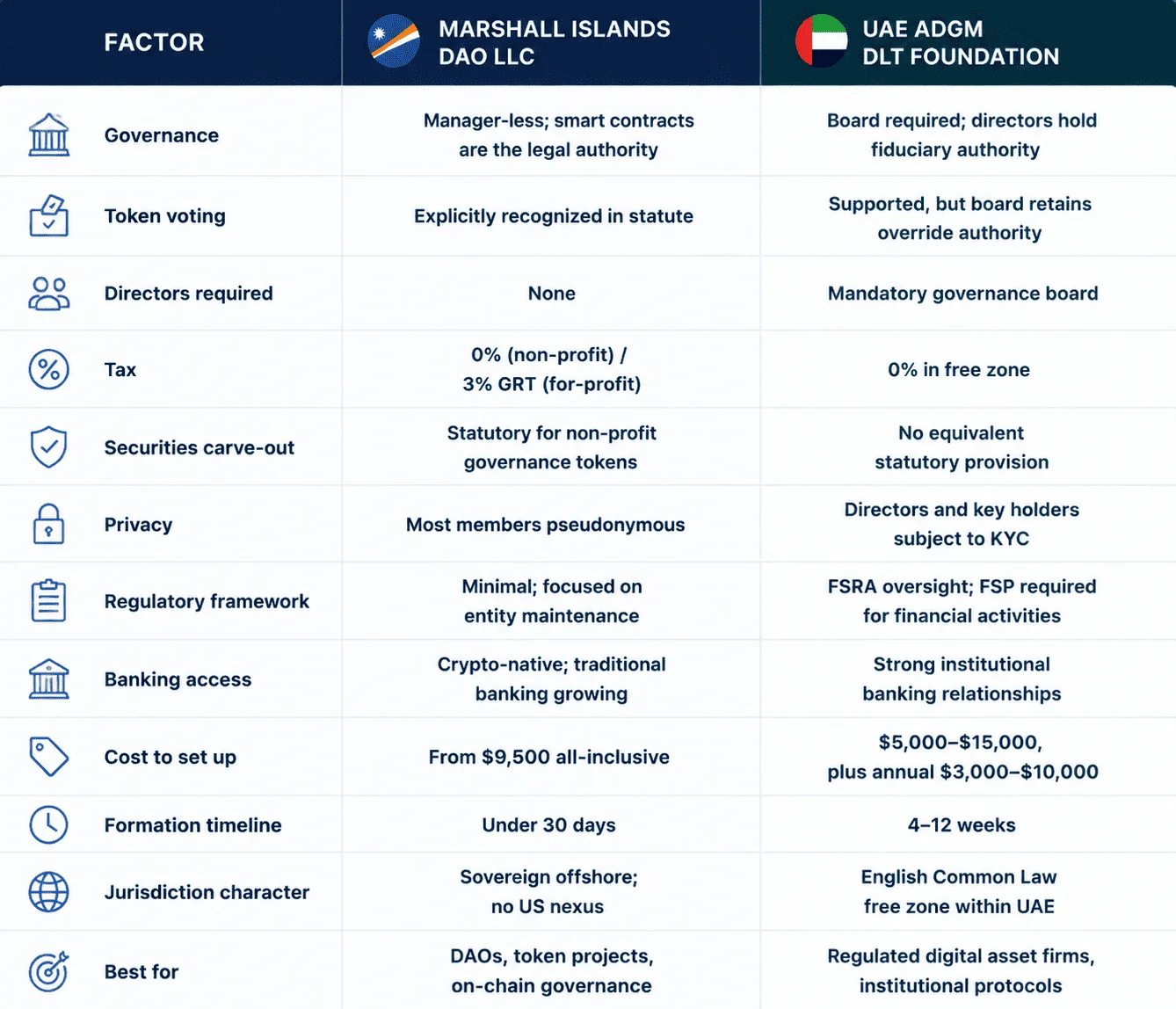
How Do the Marshall Islands DAO LLC and UAE ADGM Compare?
The two structures serve different priorities. The RMI DAO LLC is the stronger fit for on-chain-first governance. ADGM is the stronger fit for regulated financial activity and institutional relationships.
Legal Purpose and Design
The Marshall Islands DAO LLC was purpose-built for decentralized organizations. Every structural feature - manager-less operation, token membership, algorithmic governance, on-chain records - reflects how DAOs actually work. The law was written to close the gap between decentralized operations and the legal requirements of functioning in the real world.
For token projects specifically, the statutory securities carve-out makes the RMI structure uniquely valuable: see our guide on token issuance and securities law compliance for how this plays out in practice.
The ADGM DLT Foundation was designed as a regulated commercial structure for blockchain foundations and DAOs within an established international financial centre. It brings Web3 organizations into a well-governed institutional environment. That is a genuine advantage for projects that want that environment. It is a constraint for projects that want their community to retain actual legal authority.
DAO Governance Compatibility
The single most important structural difference is the governance board requirement. The RMI DAO LLC allows the community's on-chain decisions to carry full legal authority with no human intermediary. The ADGM DLT Foundation requires directors whose fiduciary duties can, in principle, override community governance decisions.
For projects where decentralization is functional rather than symbolic, this distinction is decisive. For projects where the board serves as a governance accountability layer that counterparties and regulators value, it is a feature.
Regulatory Approach and Compliance
The RMI framework focuses on entity maintenance: KYC for significant token holders, annual compliance, and AML/CTF obligations. There is no licensing requirement for governance activities, and no VASP licensing obligation for non-profit DAO LLC governance tokens.
RMI ongoing compliance requirements:
- Beneficial ownership reporting for any party holding 25%+ of governance tokens
- Annual compliance confirmation with the registered agent
- AML/CTF policy and on-chain monitoring documentation
- No audits, board meetings, or supervisory filings required
ADGM's compliance environment is materially more intensive. Virtual asset regulated activities require an FSP from the FSRA, with ongoing capital requirements, regulatory reporting, and supervisory oversight. For projects conducting licensed financial activities, that oversight is valuable. For governance-only DAOs, it is overhead.
Our DAO compliance requirements guide covers the full range of compliance obligations founders should understand before choosing a structure.
Tax and Business Environment
Both jurisdictions are tax-neutral at the entity level. RMI non-profit DAOs pay zero tax with no filings. ADGM entities pay zero tax within the free zone. The difference is in what sits alongside the tax rate.
The RMI structure imposes minimal compliance overhead: no audits, no board fees, no supervisory filings. ADGM's annual maintenance runs $3,000-$10,000 for the foundation plus regulatory fees for any licensed activities. For high-budget institutional protocols, that cost is manageable. For early-stage projects or lean teams, it adds up.

Which Projects Fit Each Structure?
The Marshall Islands DAO LLC and UAE ADGM DLT Foundation are not directly competing for the same projects. They serve different types of organizations at different stages with different priorities.
DAO-Native and Token-Governed Organizations
The RMI DAO LLC is best suited for projects where:
- Token holders participate directly in governance through on-chain voting
- Decisions are executed by smart contracts without a human management layer
- Community coordination is the primary operational model
- Pseudonymous participation is the norm and member privacy matters
- Cost efficiency and minimal compliance overhead are priorities
For a deeper look at what the legal wrapper layer means for these projects, our guide on what a crypto legal wrapper is and why your project needs one explains the foundations clearly.
Regulated Digital Asset and Financial Services Businesses
ADGM is best suited for projects that require:
- Licensing and formal regulatory standing for financial services activities
- Institutional banking relationships with major counterparties
- MENA-region market access and local business presence
- FSRA oversight as a credibility signal for institutional partners
- UAE residency alongside the entity structure
Exchanges, asset management firms, regulated DeFi protocols with institutional counterparties, and projects that benefit from FSRA oversight all fit naturally into the ADGM framework.
Global Web3 Infrastructure Projects
For large-scale infrastructure projects that need both community governance and institutional relationships, a hybrid structure is often the most practical answer: an RMI DAO LLC as the governance and treasury layer, with an ADGM or UAE operating entity managing commercial contracts, banking relationships, and regulated activities.
See our step-by-step guide to incorporating a token project in 2026 for how to sequence these decisions correctly before launch.
Marshall Islands DAO LLC vs. UAE ADGM: Final Verdict
The core insight from this comparison: ADGM brings decentralized organizations into a regulated institutional environment. The Marshall Islands DAO LLC brings the legal system to decentralized organizations.
Both achieve legal recognition. Both offer tax neutrality. Both support token voting and smart contract governance in some form. But they are built on different foundational assumptions about where authority sits and how much regulatory oversight should accompany it.
For projects where the community's on-chain decisions must be the final word, the RMI DAO LLC is the purpose-built answer. For projects where institutional relationships, FSRA oversight, and MENA market access are strategic requirements, ADGM is the right environment. Understanding which type of project you are building is the most important input into this decision.
For a broader comparison across all major jurisdictions, see our ranked guide to the best crypto-friendly jurisdictions in 2026.
Ready to incorporate your project in the first sovereign nation to adopt a DAO legal framework?
Start your Marshall Islands DAO LLC registration with MIDAO, the only government-authorized program for RMI DAO LLCs, and get your entity in place in under 30 days.
Frequently Asked Questions
Can a DAO LLC in the Marshall Islands operate internationally without establishing entities in other countries?
Yes. The RMI DAO LLC is a sovereign entity that can sign contracts, hold assets, and engage with counterparties internationally without requiring a local entity in each jurisdiction. It does not create a US tax nexus simply by existing, and its operations are not limited to any geographic region. Projects may choose to establish operating subsidiaries in specific markets for commercial reasons, but this is optional rather than legally required.
Can a traditional company in ADGM adopt DAO-style governance mechanisms?
An ADGM DLT Foundation explicitly supports token voting and smart contract governance mechanisms, making it the closest available option within ADGM for DAO-style decision-making. Standard ADGM companies can reference community governance in their constitutional documents, but the board retains legal authority over the entity's decisions. True manager-less, on-chain governance, where the community's token votes carry direct legal authority without a board intermediary, is not available within ADGM's current framework.
How does legal recognition of a DAO affect liability for founders and token holders?
Without legal recognition, a DAO may be classified as an unincorporated association or general partnership, potentially exposing governance participants to personal liability for the DAO's obligations. Both the RMI DAO LLC and the ADGM DLT Foundation resolve this by creating a legal entity that absorbs the DAO's obligations, shielding members from personal liability. The RMI framework additionally protects members from liability for the use of open-source software and allows most token holders to remain pseudonymous, providing stronger privacy protections than the ADGM structure.