
What Is a Crypto Legal Wrapper? (And Why Your Project Needs One)
A crypto legal wrapper is a legal entity that gives blockchain projects legal recognition, liability protection, and access to traditional financial systems. The article explains why such structures have become essential for DAOs, token projects, and AI-driven organizations amid rising regulatory pressure and legal precedent.
The Crypto Valley Top 50 report, CV VC, Q1 2026, values Switzerland's top blockchain entities at approximately $593 billion combined. Nearly every one of those projects built that value on top of a legal wrapper before it reached institutional scale.
Key takeaways
- A legal wrapper gives a crypto project formal recognition in the off-chain world, bridging on-chain activity with contracts, banking, and liability systems.
- The CFTC sued Ooki DAO as an unincorporated association of its voting token holders in 2022 and won a default judgment against the DAO in June 2023.
- A California federal judge found in November 2024 that the plaintiff had plausibly alleged Lido DAO is a general partnership, letting claims proceed against investor defendants alleged to have participated in governance.
- Without a legal entity, a project cannot own intellectual property, register trademarks, or hold a crypto wallet as a recognized legal asset.
- MoonDAO incorporated as a nonprofit DAO LLC in the Marshall Islands to open bank accounts while keeping its governance decentralized on-chain.
Most crypto founders encounter this lesson too late. A protocol grows, a treasury swells, governance proposals start flying, and at some point someone asks: who is legally responsible for any of this? Without a legal wrapper in place, the answer can come from a court rather than a founder. And courts have not been kind to unincorporated projects.
This article explains what a crypto legal wrapper actually is, why the need for one extends well beyond DAOs, what it enables in practice, and how to think about choosing one for your project.
What Is a Crypto Legal Wrapper?
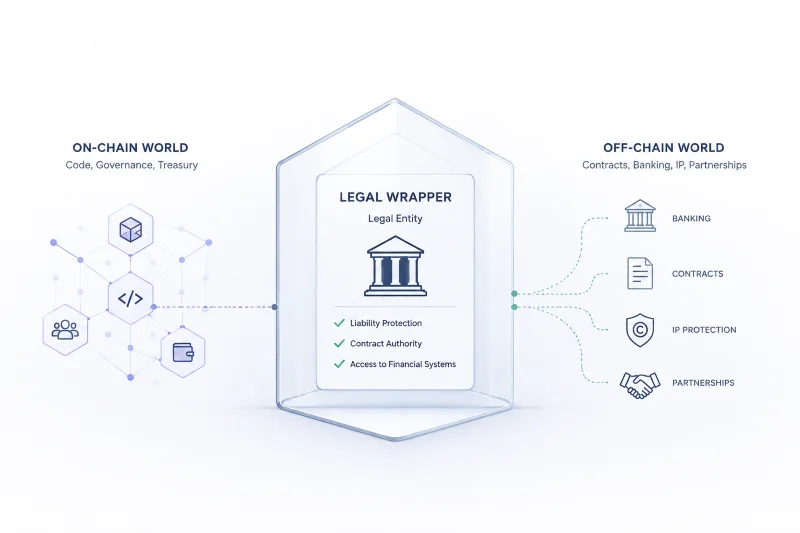
A crypto legal wrapper is a legal entity that gives a crypto project formal recognition in the off-chain world. It is not a single structure; it is a category of legal tools including LLCs, foundations, associations, and purpose-built DAO entities that serve as the bridge between a project's on-chain activity and the legal systems that govern contracts, banking, employment, and liability.
The term "wrapper" is apt. The legal entity wraps around the project's token systems, governance mechanisms, and treasury, giving them a face that regulators, banks, exchanges, and courts can recognize. The on-chain reality does not change. What changes is that it now has a legal counterpart that can act in the world.
A legal wrapper is not the same as the project itself. The DAO's governance still happens on-chain. The smart contracts still execute autonomously. The wrapper is the interface layer, the legal identity the project uses when it needs to show up in the real world.

Why Did Crypto Projects Need Legal Wrappers in the First Place?
The need for legal wrappers emerged because crypto projects started functioning like organizations before the law had a category for them. DAOs, DeFi protocols, NFT studios, and AI agent systems all do things that legal systems associate with companies: they manage assets, enter into commercial relationships, pay contributors, and take on obligations.
For years, the legal vacuum was tolerable. Projects were small, counterparties were lenient, and regulators were watching from a distance. That window has closed.
Two court rulings changed the stakes permanently:
- In 2022, the CFTC sued Ooki DAO itself, arguing that the token holders who voted on its proposals were members of an unincorporated association, and served it through its online forum and chat box. The court agreed and entered a default judgment against the DAO, with a $643,542 penalty. It did not rule on whether individual voters are personally liable, but that is the question the association theory raises.
- In November 2024, a California federal judge found the plaintiff had plausibly alleged that Lido DAO is a general partnership under California law and let claims proceed against investor defendants alleged to have participated in governance, including major venture capital firms; if the claims are proven, general partners face joint-and-several liability.
These are not fringe cases. They are the direction the law is moving. Every project operating without a legal wrapper leaves its governance participants open to claims of unlimited personal liability.
What Does a Legal Wrapper Actually Enable?
A legal wrapper gives a crypto project four practical capabilities it cannot have without one.
Legal Personhood and Contract Authority
Without a legal entity, a project has no legal standing. It cannot sign contracts in its own name. Every agreement with a vendor, auditor, exchange, or service provider has to be signed by an individual, and that individual assumes the personal legal risk of the relationship.
With a legal wrapper, the entity signs. If the agreement is disputed, the counterparty sues the entity. The founders and contributors are shielded by limited liability, which means their personal assets are not on the table for the organization's obligations.
Banking and Financial Infrastructure Access
No legal entity means no bank account in the project's name. Most financial institutions, payment processors, and centralized exchanges require a recognized legal counterparty before they will transact with an organization.
MoonDAO raised $8.3 million on-chain and sent an astronaut to space on Blue Origin. Their treasury is entirely on-chain. But they incorporated as a non-profit DAO LLC in the Marshall Islands and now open bank accounts using that entity. The wrapper gives them the legal standing to operate in the real world while keeping governance decentralized on-chain.
Liability Protection for Contributors
When a group of people works toward a common goal without a legal entity, the law can treat them as a general partnership. In a general partnership, every member can be held jointly and severally liable for the organization's actions, meaning a plaintiff who wins a judgment can go after any individual member for the full amount. A legal wrapper creates a corporate veil that separates the organization's liabilities from its contributors' personal assets.
Asset Ownership and IP Protection
A project without a legal entity cannot own intellectual property, hold a crypto wallet as a recognized legal asset, register trademarks, or enforce rights. Under US copyright law, copyright requires human authorship. Patents require a named human inventor. An LLC can own all of these things, providing a legal home for everything the project creates or controls.
What Are the Main Types of Crypto Legal Wrappers?
Legal wrappers are not one-size-fits-all. The right structure depends on whether the project distributes profits, how governance works, and what the team's cost and compliance tolerance is. The major types in active use today are:
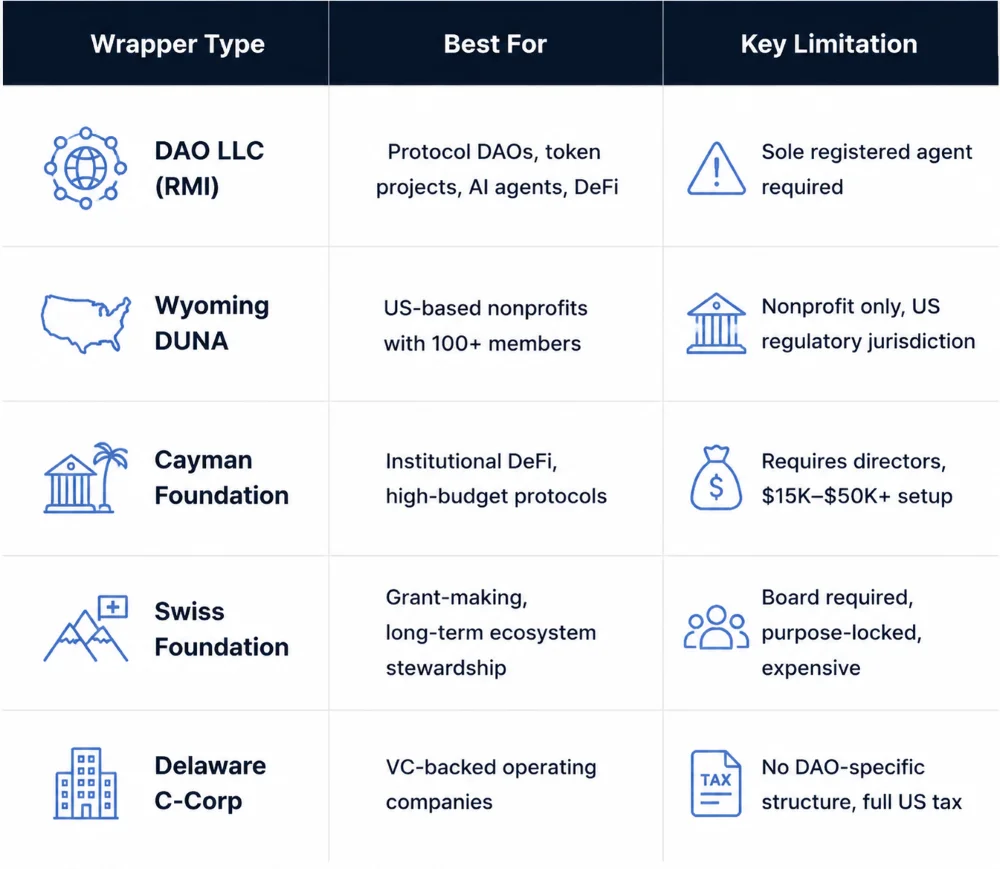
The RMI DAO LLC, registered through MIDAO's government-authorized program, is the only wrapper built from the ground up for how DAOs actually work: token-based membership, algorithmic management, smart contract governance, and no required directors. The other structures were adapted, to varying degrees, from traditional company law.
Which Project Types Actually Need a Legal Wrapper?
Not just DAOs. Most of MIDAO's registered entities are not traditional DAOs. The DAO LLC is a legal designation available to any tokenized organization. The following project types have concrete, practical reasons to incorporate:
- DeFi protocols: Treasury management, exchange listings, and institutional partnerships all require a legal counterparty. Without one, the protocol and its governance participants could face claims of unlimited personal liability.
- NFT and digital IP projects: Content ownership, licensing, royalty enforcement, and artist contracts all require a legal entity. Without one, IP floats in a legal vacuum with no enforceable claim.
- AI agent systems: Agents cannot open bank accounts, sign contracts, or own IP. A legal wrapper gives the agent a legal home and defines who is accountable for its actions.
- DePIN and infrastructure networks: Real-world assets, equipment agreements, and service contracts require an entity that can hold and enforce those arrangements.
- Early-stage token launches: Even before a protocol has traction, the founders and early contributors are exposed from the moment governance activity begins. Wrapping early is almost always cheaper than wrapping after the fact.
- Meme coin and community projects: Any project with a treasury, a governance mechanism, and contributors taking decisions is exposed without a wrapper, regardless of how informal the structure feels.
How Does a Legal Wrapper Connect On-Chain and Off-Chain Systems?
A legal wrapper works by mapping on-chain governance logic into legally enforceable documents. The key instrument is the operating agreement, which is the founding document of an LLC. For most crypto projects, this has historically meant writing governance rules twice: once in smart contracts and once in legal documents, with no clean connection between them.
The RMI DAO LLC solves this with a native bridge. The operating agreement can reference smart contracts directly. When the contracts are updated or upgraded, the governance mechanism updates accordingly. The legal structure follows the on-chain reality rather than constraining it.
Other structures require governance to be described in full in written founding documents. That creates a mismatch between the living, upgradable on-chain governance and a static legal text. Every time governance changes, the documents need to be amended. The RMI approach eliminates that bottleneck entirely.
The operating agreement under the RMI framework can recognize multiple governance models:
- Token voting, where community decisions are weighted by token balance
- Multisig, where a threshold of designated signers must approve decisions
- Hybrid models combining on-chain votes with multisig execution
- Algorithmic management, where a smart contract or AI agent acts as the operational authority
Code, in this structure, is not just code. It is the governance document. Legal enforceability follows from the operating agreement's reference to the smart contract, giving the chain's reality the weight of law.
What Does the Future of Crypto Legal Wrappers Look Like?
Legal wrappers are becoming infrastructure, not optional compliance. Three trends are accelerating this:
- AI agents are driving demand for digital entity frameworks. Agents manage portfolios, negotiate contracts, execute trades, and generate content. Without legal wrappers, agent-to-agent transactions have no enforceable contracts, no legal entities in the picture, and no mechanism to resolve disputes. Mastercard and PayPal have already launched agent identity and payment frameworks because the agent economy needs verifiable legal identity to function at scale.
- Regulatory expectations are increasing across every major jurisdiction. EU MiCA, US SEC enforcement, and international AML frameworks are all moving toward requiring identifiable legal entities behind crypto projects. Operating without a wrapper is no longer just a legal risk; it is increasingly a barrier to market access.
- "Digital entity" as a legal category is gaining momentum. The Marshall Islands DAO LLC represents a purpose-built digital entity class. Wyoming, Tennessee, and other jurisdictions have followed with their own variants. The direction is toward standardized legal frameworks for algorithmic organizations, and the RMI structure currently has the most complete implementation.
What Is the Right Legal Wrapper for Your Project?
The most important insight from this article is structural: a legal wrapper is not a compliance checkbox. It is foundational infrastructure that determines what your project can do, who is protected, and how governance scales.
Choosing the wrong structure means retrofitting a legal layer onto an existing organization, which is significantly more complex and costly than doing it at formation. Choosing the right one gives your project a legal identity that matches how it actually works.
For most globally distributed, on-chain-governed crypto projects, the RMI DAO LLC provides the cleanest alignment: purpose-built for token-based governance, no required directors, explicit smart contract authority, tax-neutral for non-profits, and fully compliant with KYC and beneficial ownership requirements. See the full breakdown of structure options and pricing on the MIDAO website.
Ready to give your project a legal identity?
Start your DAO LLC registration with MIDAO, the only government-authorized program for RMI DAO LLC registration, and get set up in under 30 days.
Frequently Asked Questions
Do all crypto projects actually need a legal wrapper, or only DAOs?
No, legal wrappers are not only for DAOs. Any crypto project that manages a treasury, enters into agreements, pays contributors, or holds assets needs a legal wrapper to protect its participants from personal liability and to give the organization legal standing to operate. DAOs are one category, but token projects, NFT studios, DeFi protocols, AI agent systems, and DePIN networks all have concrete, practical reasons to incorporate.
Can a project change or upgrade its legal wrapper later?
Yes, but it is significantly more complex than incorporating at formation. Migrating from one wrapper to another involves transferring assets, reassigning intellectual property, novating or renegotiating contracts, and potentially addressing tax consequences depending on the jurisdictions involved. Projects that outgrow their initial structure or choose the wrong one early face material, legal, and operational costs to fix it. Choosing the right wrapper at launch is almost always cheaper than restructuring later.
Are legal wrappers the same across all jurisdictions?
No. Legal wrappers vary significantly by jurisdiction in governance flexibility, tax treatment, cost, and the degree to which they recognize on-chain governance as legally valid. The Marshall Islands DAO LLC explicitly supports algorithmic management and smart contract governance by statute. Cayman and Swiss foundations require directors with fiduciary duties who can override token-holder governance. Wyoming's DUNA is nonprofit only and subject to US federal regulation. The jurisdiction is not just an address. It determines how the entity works, what it costs to maintain, and how much legal weight on-chain decisions carry.