
DAO Compliance Requirements: What Every Founder Must Know
A guide to DAO compliance requirements, covering the key legal, governance, token, treasury, and KYC considerations founders need to address to build a compliant decentralized organization.
In its sixth targeted update on virtual assets and VASPs, the Financial Action Task Force, June 2025, found that while global AML/CFT implementation has progressed, jurisdictions continue to face significant difficulties identifying the legal persons and control mechanisms behind decentralized virtual asset activity.
Key takeaways
- FATF's June 2025 targeted update found that jurisdictions still struggle to identify the legal persons and control mechanisms behind decentralized virtual asset activity.
- Courts have treated DAOs without a formal entity as general partnerships, exposing every governance participant to personal liability for the organization's obligations.
- The CFTC's action against Ooki DAO and a California court's treatment of Lido DAO as a general partnership both turned on governance participation, not incorporation status.
That finding is a direct signal to DAO founders. Compliance pressure on decentralized organizations is no longer theoretical. Regulators, financial institutions, and institutional counterparties are increasingly looking for identifiable legal structures, documented governance authority, and clear accountability behind every project that manages assets, issues tokens, or operates a protocol.
None of this requires your project to identify as a DAO. A DAO LLC is a legal designation, not an identity requirement: protocol teams, token projects, NFT communities, DePIN operators, and AI agent ventures face the same expectations and use the same structures.
Decentralization changes how compliance must be designed, not whether it applies. This article covers the core DAO compliance requirements every founder needs to address, from legal entity formation and governance documentation to token classification, treasury controls, and KYC obligations.
Why Does DAO Compliance Matter for Web3 Projects?
Operating without a compliance framework exposes a DAO and its participants to risks that grow with the project's size. The most immediate is legal liability: without a formal entity and documented governance, courts default to classifying DAOs as general partnerships, making every governance participant personally liable for the organization's obligations.
The practical consequences extend further. Banks and payment processors require a recognized legal counterparty before opening accounts. Institutional investors and exchange partners expect documented governance and entity-level accountability. Regulatory exposure under securities law, AML rules, and tax frameworks does not disappear because governance is on-chain.
Our article on what happens when a DAO gets sued covers the real consequences in detail.
Decentralization Does Not Eliminate Legal Responsibility
Regulators increasingly examine the substance of how a DAO operates, not just its on-chain structure. The CFTC's action against Ooki DAO and the California court's treatment of Lido DAO as a general partnership both demonstrate that participation in governance, not formal incorporation, is what triggers liability under current law.
Courts look at control mechanisms, decision-making authority, and economic activity. A community that votes on protocol upgrades, manages a treasury, and pays contributors is acting like an organization, regardless of how it is labeled. Legal compliance provides the structure that separates organizational liability from individual exposure.
For a full breakdown of the enforcement cases driving this shift, see why unincorporated DAOs are legally exposed to personal liability.
Compliance as a Foundation for DAO Growth
Compliance is not a barrier to decentralization. It is the infrastructure that makes decentralization sustainable at scale. Projects that address compliance early can access institutional partnerships, raise capital, engage banks, and expand their ecosystems without restructuring under pressure.
The alternative is building on a foundation that creates friction at every point where the protocol intersects with the real world. Every CEX listing, institutional partnership, and grant program will eventually ask for documentation that an unstructured DAO cannot provide.
Why Legal Entity Formation Is the First DAO Compliance Requirement
A legal entity is the foundational compliance requirement for DAOs because it resolves the most fundamental problem: the absence of a legal person. Without an entity, there is no counterparty to sign contracts, no defined holder of assets, no mechanism for liability to stop at the organizational level, and no recognized party for regulators to interact with.
The right entity type matters as much as forming one. A traditional LLC or corporation forces DAO governance into structures that were not built for token-based membership or algorithmic decision-making. DAO-specific legal structures, like the Marshall Islands DAO LLC, resolve this by building the entity around how DAOs actually work.
If you are new to the concept, our guide on what a crypto legal wrapper is and why your project needs one explains the foundations clearly.
DAO Legal Wrappers and Compliance
A DAO LLC connects on-chain governance with traditional legal recognition without requiring the project to adopt a conventional corporate hierarchy. Under the RMI DAO Act of 2022 and its subsequent amendments, a DAO LLC can operate with token-based membership, smart contracts as the legal governance authority, no named directors or managers, and blockchain records as the authoritative corporate record.
This structure satisfies the core compliance need, a recognized legal entity with documented governance, while preserving the decentralized character of the project. The MIDAO government-authorized incorporation program is the exclusive channel for registering RMI DAO LLCs, with 300+ DAOs and web3 projects signed up, including Pyth Network, MoonDAO, and ApeCoin Governance DAO.
Choosing a Jurisdiction That Supports DAO Operations
Jurisdiction determines whether the entity's governance structure is legally valid, not just tolerated. Founders should evaluate five factors when selecting a jurisdiction:
- DAO recognition: Does the jurisdiction have purpose-built DAO legislation or a generic structure adapted for Web3?
- Governance flexibility: Is algorithmic management and token-based membership explicitly authorized by statute?
- Tax framework: What is the effective entity-level tax, and are there pass-through obligations for members?
- International usability: Does the entity type have recognition among banks, exchanges, and institutional counterparties globally?
- Compliance overhead: What are the mandatory annual obligations, directors, audits, and fees?
The Marshall Islands is the only jurisdiction where algorithmic governance is explicitly authorized by statute, general members provide no personal information, and governance tokens with no economic rights are explicitly not treated as securities.
What Are the DAO Governance Compliance Requirements?
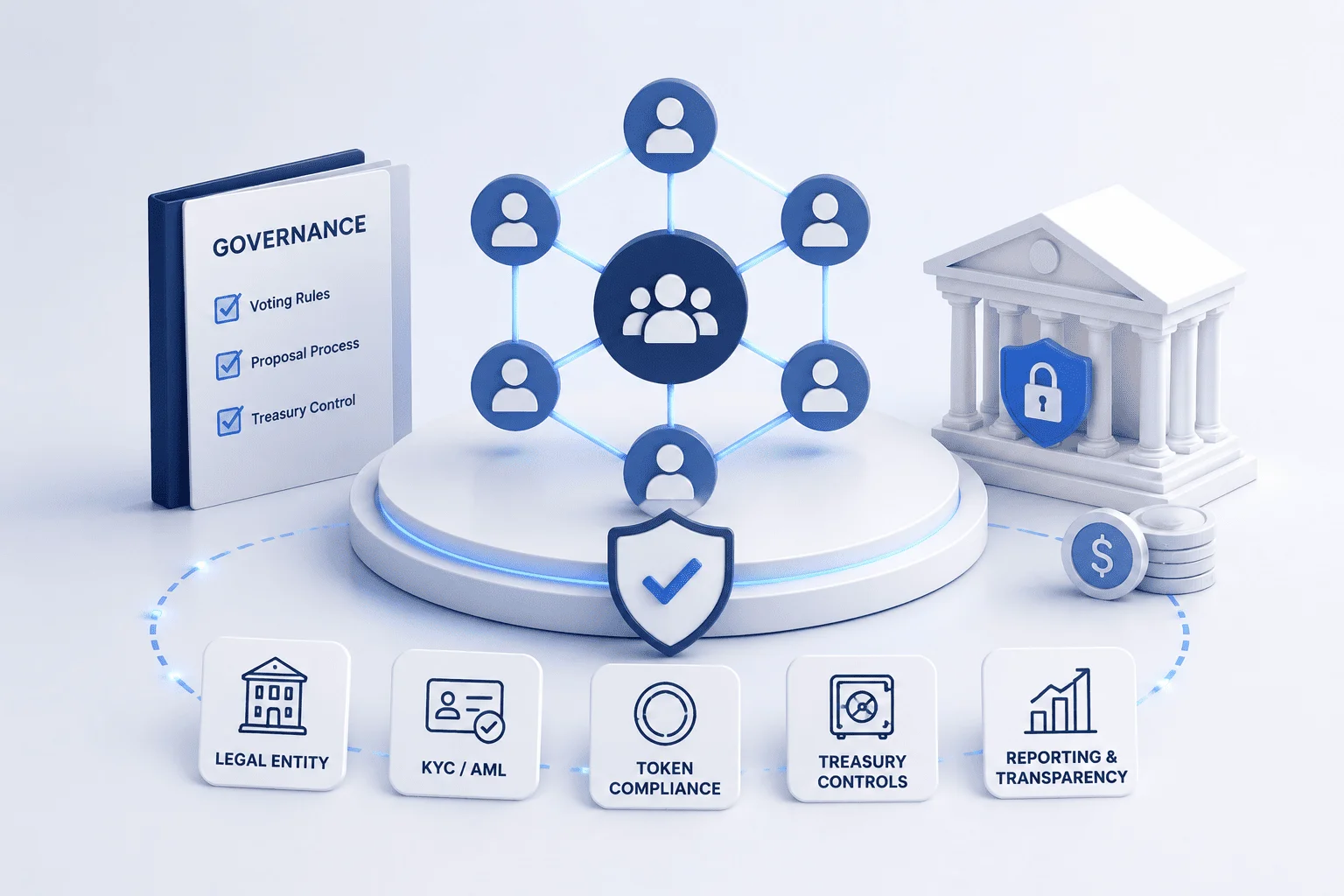
Governance design is central to DAO compliance because it defines who has authority, what they can do, and how that authority is documented. Undefined governance creates liability gaps and dispute risks that grow with the DAO's size. Documented governance creates the accountability trail that regulators, partners, and institutional counterparties expect.
Defining Roles and Decision-Making Authority
A compliant governance framework defines at minimum:
- Voting rights: Who can vote, how votes are weighted, and what quorum thresholds apply
- Treasury management authority: What approvals are required for expenditures, and at what thresholds
- Emergency controls: Who can pause operations, override a proposal, or respond to a security incident
- Contributor responsibilities: What roles exist, what authority each carries, and how contributors are compensated
These definitions should exist in the operating agreement, referenced by or aligned with the project's smart contracts.
Aligning On-Chain Governance With Legal Agreements
The most common compliance gap in DAO governance is a mismatch between what the smart contracts do and what the legal documents say. If the operating agreement describes governance one way and the on-chain contracts execute it differently, the DAO is operating with legal documentation that does not reflect reality.
Under the RMI DAO LLC framework, operating agreements can reference smart contracts directly, so that changes to on-chain governance are automatically reflected in the legal structure. This alignment is the key advantage of purpose-built DAO legislation over adapted traditional structures.
Creating Accountability Without Centralizing the DAO
Documented governance does not require centralized management. Fully decentralized DAOs can maintain compliance through transparent on-chain voting records, immutable audit trails on-chain, delegated authority frameworks, and defined dispute resolution procedures in the operating agreement. These mechanisms create accountability without concentrating control.
What Are the Token Compliance Requirements for DAOs?
Token design is one of the highest-stakes compliance decisions a DAO founder makes, because the token's structure determines its regulatory classification in every jurisdiction where participants are located.
Understanding Token Classification Risks
A token's regulatory treatment depends on four factors: its functionality (governance only vs. revenue-linked), its distribution method (public sale, airdrop, or community reward), whether holders have a reasonable expectation of profit from others' efforts, and the jurisdiction of the issuer and holders.
The non-profit RMI DAO LLC provides the strongest statutory protection available: governance tokens with no economic rights are explicitly not treated as securities under RMI law. This is statutory, not an opinion. US law applies separately for US persons, but the offshore structure reduces the jurisdictional nexus that US regulators need to apply US securities law.
Token Launch and Distribution Considerations
Compliance considerations at token launch include:
- Whether the distribution constitutes a securities offering in relevant jurisdictions
- How the token sale is structured relative to applicable safe harbors
- How airdrops and community rewards are treated for tax purposes across member jurisdictions
- Who the legal issuer of record is, and whether that issuer has a recognized legal entity behind it
Exchanges require a legal entity as the issuer of record before listing. Without one, a token launch creates exposure without the organizational structure to manage it.
Avoiding Regulatory Issues Around Governance Tokens
Governance rights and financial expectations interact in ways that matter for regulatory classification. A token that grants governance voting rights but also carries a reasonable expectation of profit, because token value is linked to protocol revenue or treasury growth, looks more like a security than a pure governance instrument.
The safest structure for most protocol DAOs is a non-profit entity issuing governance tokens with no economic rights, no right to distributions, and no claim on assets. For investment DAOs where profit distribution is the point, a for-profit structure with appropriate legal and securities law advice is the right path.
How Should DAOs Manage Financial and Treasury Compliance?
DAO treasuries require documented controls because the absence of defined authority creates both governance disputes and regulatory exposure. A treasury with no spending rules and no approval process is a compliance gap that regulators, auditors, and institutional partners will flag.
Treasury Management Rules
Effective treasury compliance requires: defined approval thresholds for expenditures (e.g., multisig required above a certain amount), documented spending categories aligned with the DAO's stated purpose, on-chain records of all transactions, and clear authority for who can initiate transfers.
For non-profit DAO LLCs, treasury growth is tax-free and no distributions to members are permitted. This constraint is also a compliance feature: it keeps the treasury's legal character clean and the governance token's non-security classification intact.
Accounting and Financial Transparency
On-chain records are an asset, not a liability, for DAO compliance. Most DAO treasuries maintain a fully public, immutable transaction history by default. For formal compliance purposes, this should be supplemented by contributor payment records, service provider agreements, and periodic treasury reports for governance participants.
Banking and Traditional Financial Access
A legal entity resolves the banking access problem directly. An RMI DAO LLC has an entity identifier that financial institutions can process, members who can be identified for KYC purposes, and a registered agent that handles formal correspondence. Banks, payment processors, and institutional custodians can transact with a recognized entity. They cannot transact with a pseudonymous on-chain treasury that has no legal counterpart.
For a closer look at how RMI-incorporated DAOs approach banking in practice, see our article on banking and regulation for DAOs and Web3 projects in the Marshall Islands.
When Do DAOs Need AML and KYC Compliance Procedures?
Most DAO governance activities do not trigger KYC requirements under the RMI framework. Token-based membership allows general participants to join, vote, and govern without providing identity information. Only beneficial owners controlling 25% or more of governance tokens are required to provide KYC information under the 2024 RMI DAO Regulations.
When DAOs Need Identity Verification
KYC and AML obligations are more likely to apply when the DAO engages in:
- Token sales to the public, particularly in jurisdictions with securities or VASP licensing requirements
- Financial services activities including lending, exchange, or custody
- Regulated activities in jurisdictions with comprehensive crypto frameworks
- Institutional onboarding where counterparty KYC is contractually required
DAOs should obtain legal advice on their specific activities before assuming that decentralized governance eliminates all KYC obligations.
Building Compliance Into DAO Infrastructure
Compliance is easier to build in at formation than to retrofit after operations begin. Access controls, verification systems, and treasury approval mechanisms integrated into the operating agreement and governance smart contracts from day one create a compliant-by-design structure rather than a compliant-after-the-fact one.
See our overview of the best crypto-friendly jurisdictions in 2026 for a comparison of how different jurisdictions approach these requirements.
What Data Protection and IP Compliance Requirements Apply to DAOs?
Protecting User and Contributor Data
DAOs operating globally face data protection obligations in any jurisdiction where they have meaningful user or contributor activity. This includes obligations under GDPR for EU-facing projects, and comparable frameworks in other jurisdictions.
Key considerations are: what personal information is collected through governance platforms, how contributor databases are maintained, and what third-party platform requirements apply to the project's tools and infrastructure.
Managing Intellectual Property Ownership
IP ownership should be defined at formation, not disputed after the protocol generates value. A DAO LLC can hold trademarks, copyrights, and other IP directly. The operating agreement should include IP assignment provisions covering code produced by contributors, branding and design assets, research and documentation, AI-generated assets, and community-created content. Without clear ownership, enforcement becomes impractical, and disputes are inevitable.
The Bottom Line on DAO Compliance
The strongest insight from this guide: compliance is not something DAOs grow into. It is something they build from the start or pay to retrofit later, at significantly higher cost.
Successful DAOs in 2026 combine decentralized technology with appropriate legal and operational frameworks from formation. They choose a legal entity that matches their governance model, document that governance in legally enforceable agreements, design their tokens with classification risk in mind, and maintain treasury controls that satisfy both governance participants and external counterparties.
Founders who address compliance before regulatory or operational issues arise have options. Founders who address it after have constraints.
Ready to build compliance into your DAO from day one? Start your RMI DAO LLC registration with MIDAO, the only government-authorized program for Marshall Islands DAO LLCs, and get a structure purpose-built for compliant decentralized governance.
Frequently Asked Questions
Can a DAO be compliant without forming a legal entity?
A DAO can implement some compliance practices, like on-chain governance documentation and treasury transparency, without a legal entity. However, without a formal entity, the DAO cannot satisfy the most fundamental compliance requirements: no recognized legal counterparty for contracts and banking, no mechanism to contain liability at the organizational level, and no defined structure for regulators to engage with. Most meaningful compliance obligations, from beneficial ownership reporting to exchange due diligence, require a legal entity to be satisfied properly.
How do DAO compliance requirements differ from those of traditional companies?
Traditional companies have named shareholders, board-controlled governance, and compliance frameworks built around human decision-makers and hierarchical authority. DAOs may have token-based membership, algorithmic governance, and pseudonymous participants. The core compliance goals - documented governance, defined authority, liability protection, and regulatory accountability - are the same. But the mechanisms must match the operating model. Purpose-built DAO structures like the RMI DAO LLC provide compliance frameworks designed for token-based governance rather than forcing DAOs into traditional corporate compliance systems that do not fit.
What documents should every DAO maintain for legal and operational purposes?
At minimum, a compliant DAO should maintain: a Certificate of Formation or equivalent registration document; an operating agreement that defines governance, membership, and treasury authority; documentation of beneficial ownership for any party holding 25% or more of governance rights; on-chain transaction records for the treasury; contributor and service provider agreements; and annual filings required by the registered jurisdiction. For non-profit RMI DAO LLCs, no audited financial statements are required, and annual compliance is significantly lighter than Cayman or Swiss alternatives.