
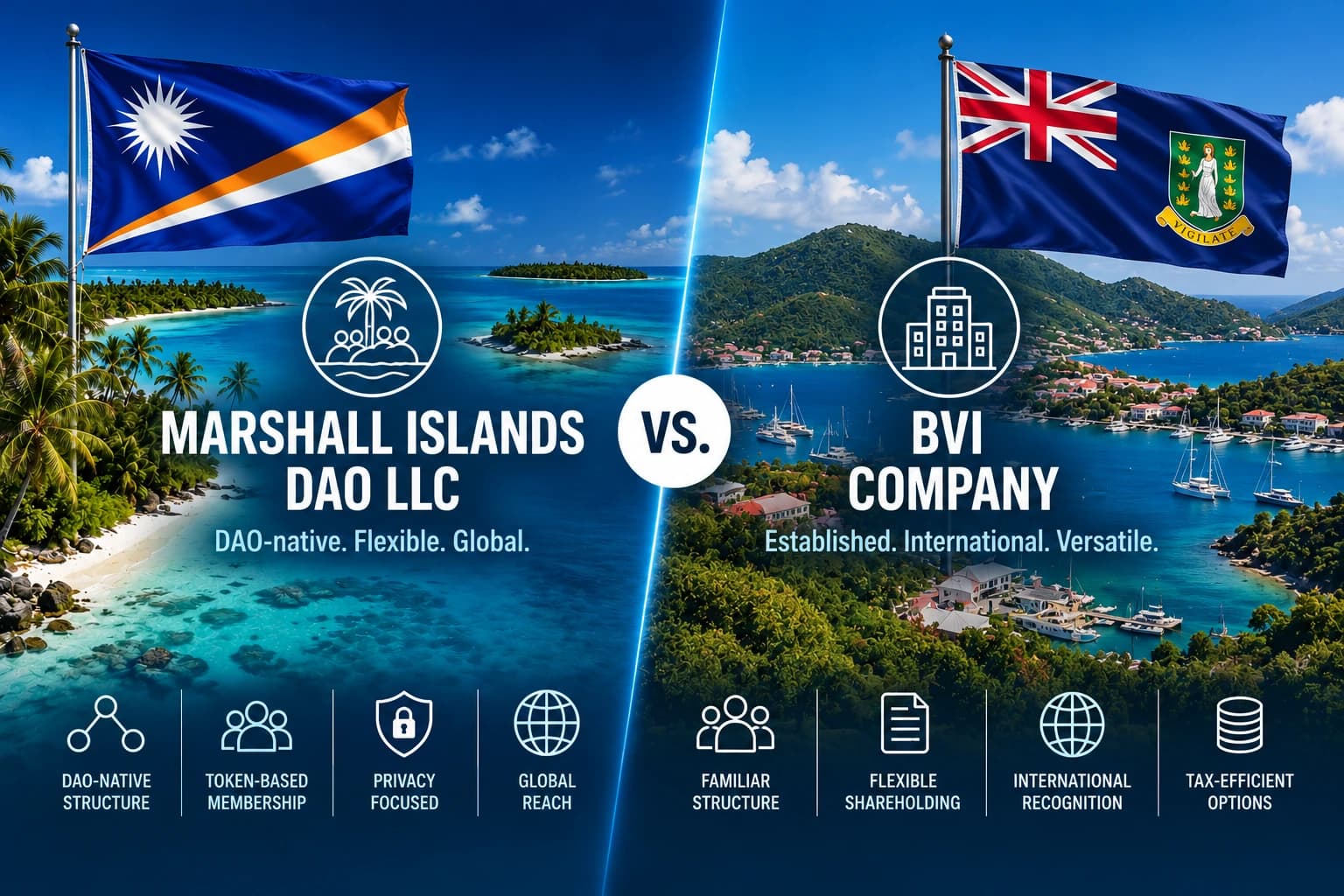
Marshall Islands DAO LLC vs. BVI company, in short: A Marshall Islands DAO LLC is designed for token-based membership and on-chain governance. A BVI company is a conventional company run by directors for its shareholders, which suits a token issuer or a commercial operating entity. Choose by how your project makes decisions. The structures can be combined, with the DAO LLC holding equity in the BVI company.
Carey Olsen's December 2025 update on BVI digital assets reports that the British Virgin Islands remains a jurisdiction of choice for token issuers, because its VASP Act does not currently regulate the primary issuance of tokens.
That makes the BVI a natural first stop for many Web3 founders. But issuing a token is only one part of running a project. A BVI company is a conventional corporate structure of shareholders and directors, built for businesses rather than communities that govern on-chain.
The Marshall Islands took a different approach. Its DAO LLC is designed for decentralized governance from the ground up.
This article compares the two across governance, ownership, tax, privacy, and cost, so you can match the entity to how your project actually works.
How Do the Marshall Islands DAO LLC and the BVI Company Work?
A Marshall Islands DAO LLC is designed for decentralized governance, while a BVI company follows a conventional corporate structure with shareholders who own it and directors who manage it.
Marshall Islands DAO LLC
The DAO LLC was created by the Marshall Islands DAO Act of 2022, later refined by a 2023 Amendment and 2024 Regulations. It gives a Web3 organization legal personality and limited liability.
Its main features include:
- Token-based membership: members are tracked by token holdings, not named registries
- On-chain governance: smart contracts can serve as statements of authority, subject to the Certificate of Formation or LLC agreement (DAO Act section 115(1)), with algorithmic management supported
- Two models: non-profit and for-profit, chosen at formation
- Typical uses: DAOs, DeFi protocols, tokenized organizations, and AI-driven projects
MIDAO is the exclusive registered agent for this entity type. If the concept is new to you, our guide to what a crypto legal wrapper is explains the basics.
BVI Company
A BVI company is formed under the BVI Business Companies Act. Shareholders own it, and directors manage it.
In Web3, BVI companies are commonly used for:
- Token issuance
- Holding intellectual property
- Commercial operations
Decentralized governance needs extra arrangements. Token holders are not shareholders by default, and legal authority sits with the directors. Community votes would need to be tied to the company through contracts.
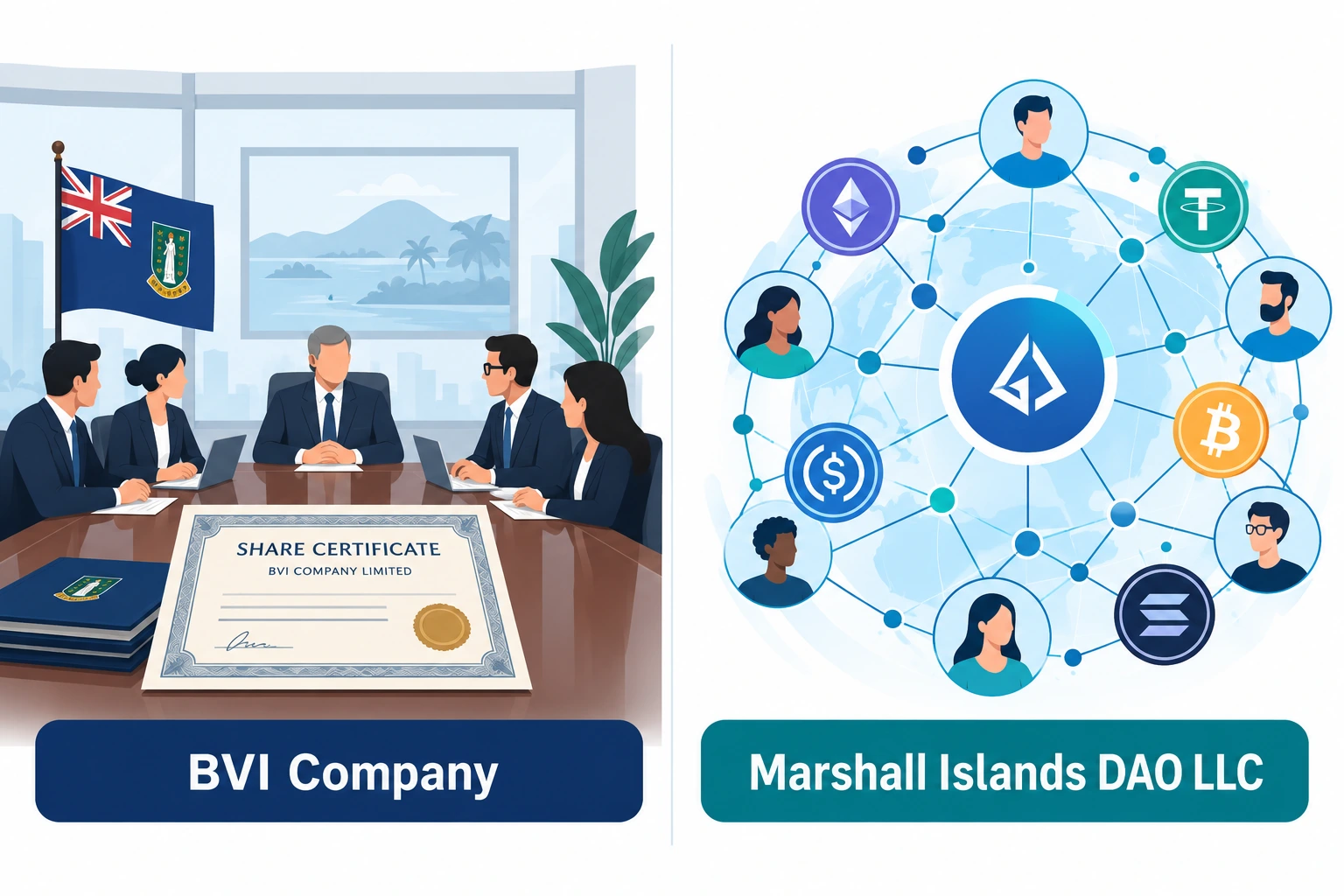
What Are the Key Differences Between Marshall Islands DAO LLCs and BVI Companies?
The key difference is who holds authority: token holders and smart contracts in a DAO LLC, versus shareholders and directors in a BVI company.
Factor Marshall Islands DAO LLC BVI Company
Governance
Token voting and smart contracts; on-chain governance recognized
Board-led decisions by directors, with shareholder votes on key matters
Ownership
Token-based membership
Shares, including different classes and voting rights
Token compatibility
Built for token-based models
Tokens are not shares; needs contractual structuring
Management
No human manager required; algorithmic management supported
At least one director required; corporate and non-resident directors permitted
Taxation
0% for non-profit; 3% Gross Revenue Tax on for-profit top-line revenue
Generally no company-level income tax; annual fees and economic substance rules may apply
Privacy
Reporting centers on 25%+ governance-rights holders (general benchmark)
Beneficial ownership information filed with the BVI Registry
Registration
Through MIDAO; normally 21 to 28 days
Through a licensed BVI registered agent, with a BVI registered office
Ongoing compliance
Registered agent renewal, simplified annual report, ownership updates
Registered agent, annual fees, records, and an annual financial return unless exempt
Governance and Management
In a DAO LLC, decisions run through on-chain voting and smart contract execution. No traditional manager is required, so the community can govern without a board.
In a BVI company, directors are responsible for managing the business. Decisions follow board resolutions and shareholder votes, not token votes.
Ownership and Token Compatibility
A DAO LLC treats token holdings as membership. Governance tokens map to voting rights, which suits decentralized communities and protocol ecosystems.
A BVI company is owned through shares. Linking tokens to shares or shareholder rights takes contractual arrangements, and it can raise securities questions.
Our guide to token issuance and securities law explains how design choices affect that analysis.
Taxation and Financial Obligations
A non-profit DAO LLC has no entity-level tax in the Marshall Islands, as described in MIDAO's guide. A for-profit DAO LLC pays a 3% Gross Revenue Tax on top-line revenue, excluding capital gains, dividends, and invested capital.
A BVI company is generally not taxed on income at the company level, apart from annual fees. Economic substance rules may apply to certain activities.
Where a company is managed and operates can create tax obligations elsewhere. Founders and members also pay tax in their own jurisdictions, whichever entity you choose.
Our overview of DAO tax implications explains how those questions arise.
Privacy, Compliance, and Reporting
In a DAO LLC, KYC and beneficial ownership reporting generally centers on holders of 25% or more of governance rights, as a general benchmark that depends on structure; only if no one reaches it, all managers; only if there are no managers, one member (see MIDAO's KYC/KYB and beneficial ownership guidance).
Since January 2025, BVI companies file beneficial ownership information with the BVI Registry. Most also file an annual financial return with their registered agent unless exempt.
Token activity is treated differently in each. The BVI's Virtual Assets Service Providers Act regulates services such as exchange, custody, and transfer, while issuing your own token is generally outside it.
In the Marshall Islands, a DAO LLC that issues governance tokens and runs a treasury is not automatically a VASP.
Our DAO compliance requirements guide covers the wider picture.
Token Issuance and Securities Considerations
Under the 2023 Amendment, digital assets issued, sold or transferred by a non-profit DAO LLC to its members or in advancing its non-profit purpose are not deemed securities under Marshall Islands law, and neither is any governance token that confers no economic rights. That treatment does not extend to other countries' securities laws.
A BVI company can issue tokens, and the VASP Act generally does not regulate primary issuance. But if a token is considered an investment under the Securities and Investment Business Act, BVI law firms note that further requirements may apply.
In both cases, the entity alone does not make a token compliant. Token features and the laws where the token is sold still decide the analysis.
Incorporation Costs and Maintenance
The two structures differ in how formation is priced and administered:
- Marshall Islands DAO LLC: $9,500 standard, as low as $3,000 for projects with under $250k in treasury and funding, including RMI government fees, template legal documents, and unlimited operating agreement workshops, plus a tiered annual fee of $2,000 to $5,000; applications normally take 21 to 28 days
- BVI company: about $1,500 to $3,500 for a bare company, per typical provider quotes on MIDAO's pricing page, before any governance structuring or licensing work, plus a licensed registered agent and annual government fees, which vary by company
- Cost drivers for both: legal advice, nominee directors where used, tax and securities analysis, and bank onboarding
Formation fees alone do not show the total cost. BVI timelines vary by agent and KYC, so confirm them with your provider.
Which Structure Fits Different Web3 Business Models?
The right structure depends on whether your project behaves like a community or a company. Many projects use both.
When a Marshall Islands DAO LLC May Be Suitable
A DAO LLC fits best when:
- A community governs a protocol and a decentralized treasury
- Token holders manage the organization
- The project wants legal recognition of on-chain governance
When a BVI Company May Be Suitable
A BVI company fits best when:
- The project needs a token issuer or a commercial operating company
- A holding company will own intellectual property or investments
- Investors and counterparties expect conventional shareholder and director arrangements
Using Both Structures Together
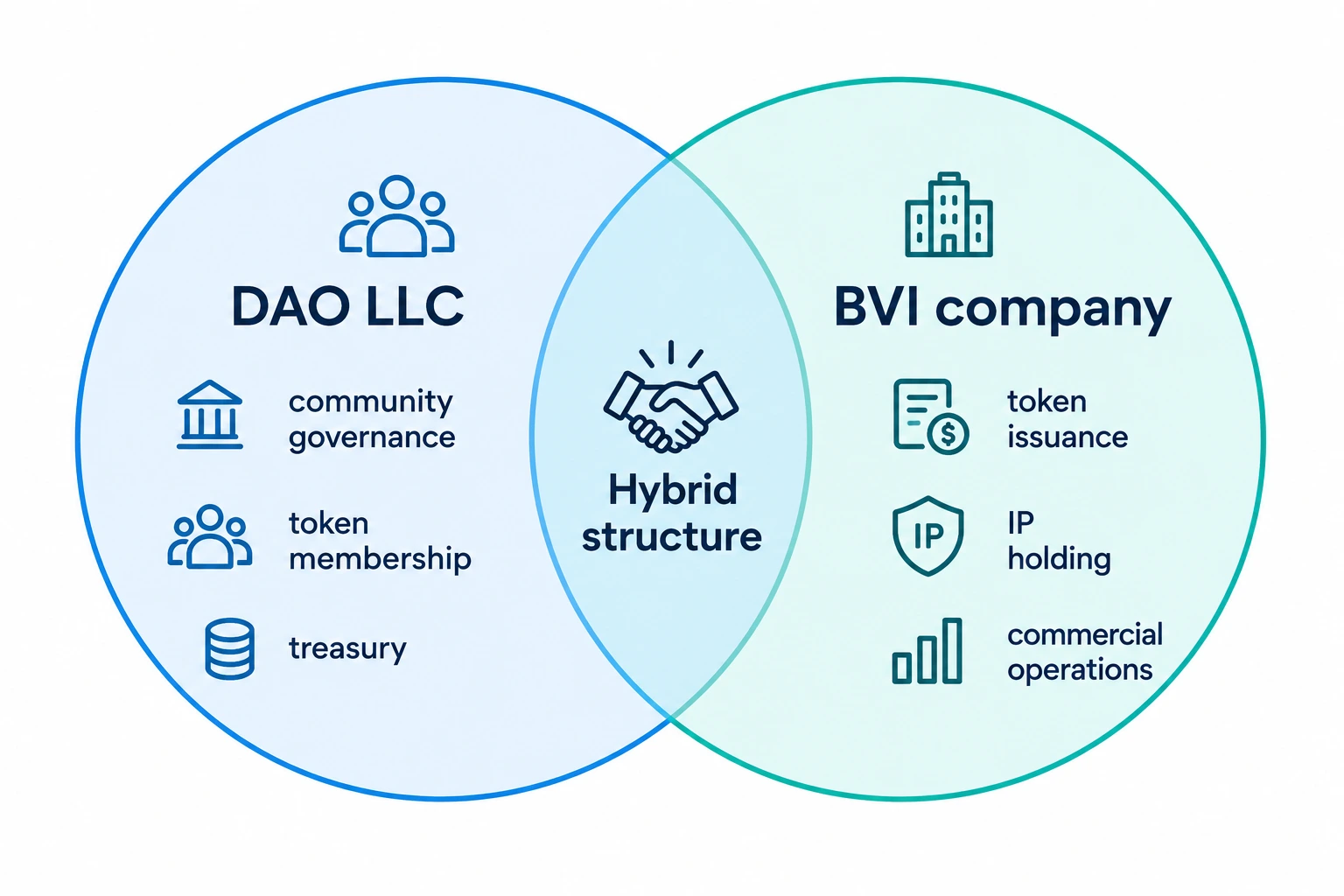
Projects can combine the two. A non-profit DAO LLC can act as the governance and treasury layer, while a BVI company serves as a token issuer or commercial operating entity.
The DAO LLC can hold equity in the BVI company, and the two can be linked by service agreements and IP licenses. The community governs at the protocol level, and the company executes at the operational level.
This keeps decentralized governance intact while giving counterparties the conventional entity they expect.
Governance Model First, Jurisdiction Second
Decentralized governance and traditional corporate management are different operating models, and the right entity is the one that matches yours.
A DAO LLC suits projects governed by token holders and smart contracts. A BVI company suits projects run by directors for shareholders.
Weigh your governance model, commercial activities, and regulatory requirements before choosing. When decentralized governance is the model, MIDAO helps projects explore Marshall Islands DAO LLC formation.
Our ranked guide to the best crypto-friendly jurisdictions in 2026 offers a broader comparison.
Ready to build on a structure made for decentralized governance?
Explore Marshall Islands DAO LLC incorporation with MIDAO. Applications normally take 21 to 28 days.
Frequently Asked Questions
Can an existing BVI company be converted into a Marshall Islands DAO LLC?
Generally, the path is to form a new Marshall Islands DAO LLC and transfer assets, IP, and contracts from the BVI company. Whether any direct continuation route exists should be confirmed with counsel in both jurisdictions. Review the tax and legal effects of the transfer first.
Can a Marshall Islands DAO LLC legally own shares in a BVI company?
Generally yes. A DAO LLC is a legal entity that can hold assets, and BVI companies may have corporate shareholders. A DAO LLC holding equity in an operating company is a common pattern, but counsel should confirm the details.
Can both entity types open business bank accounts outside their jurisdictions?
Both can apply, but approval depends on each bank's due diligence. Banks typically ask for entity documents, ownership information, and an explanation of the activity. Neither structure guarantees access.
Can non-resident founders establish either structure without visiting the jurisdiction?
Yes. A BVI company is formed remotely through a licensed registered agent, with no residency requirement for directors or shareholders. A Marshall Islands DAO LLC has no local presence requirement and is formed through MIDAO.
What happens to existing contracts and intellectual property if a Web3 project changes its legal structure?
Neither moves automatically. IP needs a written assignment to the new entity, and contracts may need the counterparty's consent or a novation. Making the change before major launches or agreements keeps the transfer simpler.
Can a DAO use a BVI company?
A project with a DAO community can use a BVI company, but the company itself is conventional. Token holders are not shareholders by default, and legal authority sits with the directors, so community votes have to be tied to the company through contracts. A Marshall Islands DAO LLC is designed for token-based membership, so the two can be combined.