
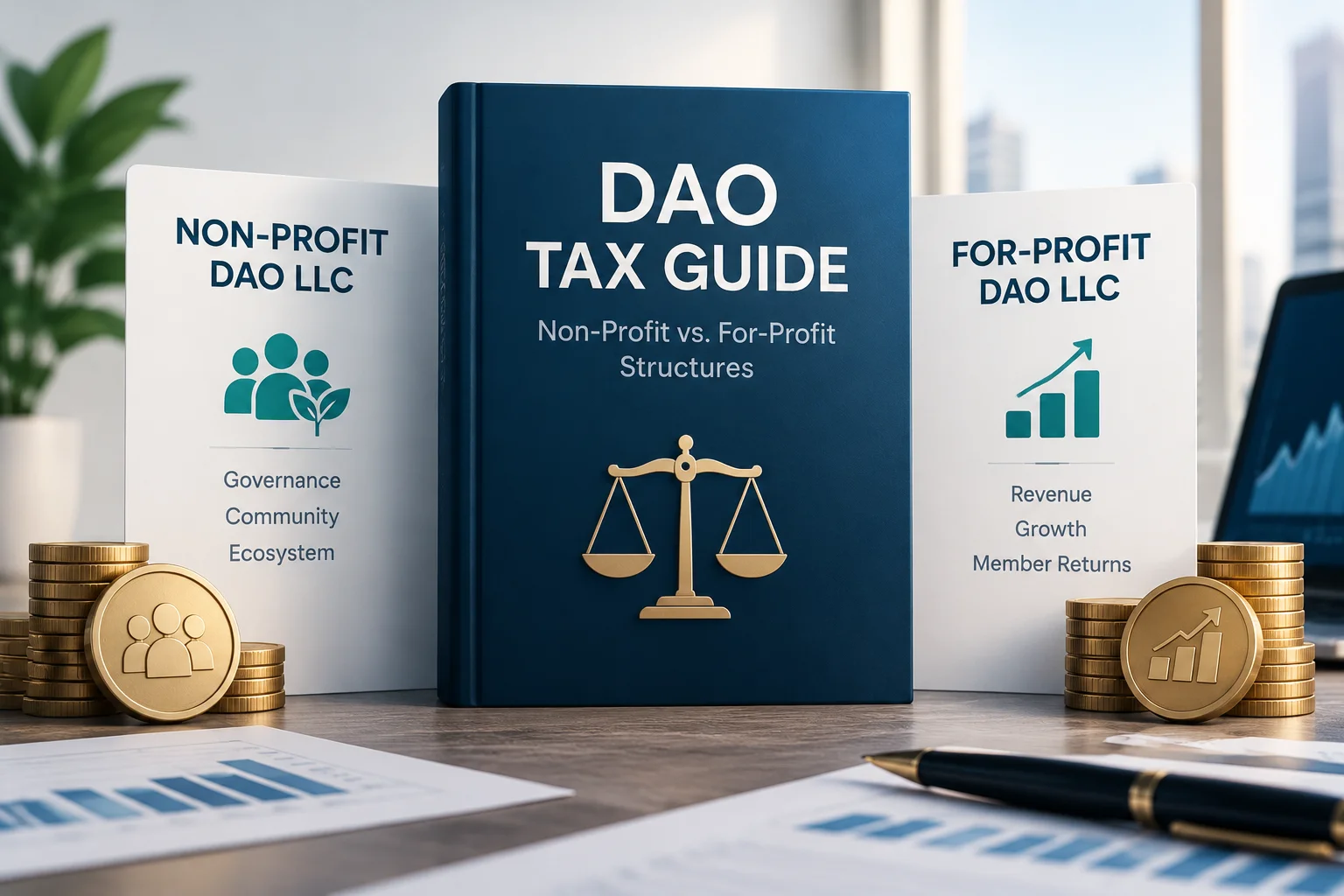
DAO Tax Guide: Non-Profit vs. For-Profit Structures
A comparison of non-profit and for-profit DAO structures, explaining how entity choice impacts taxation, token rights, treasury management, and the long-term setup of decentralized organizations.
Revenue Procedure 2024-28, issued by the IRS, requires US crypto holders to track cost basis wallet-by-wallet rather than across a universal pool, effective for the 2025 tax year. That shift is one signal in a broader trend: digital asset taxation is becoming formal, specific, and harder to ignore.
For DAOs, that trend creates an urgent problem. Most DAOs generate revenue, accumulate treasury assets, and pay contributors without a legal structure that clarifies how any of it is taxed. Without a legal entity, the IRS and tax authorities in other jurisdictions do not treat the DAO as a separate taxpayer. They look through it to whoever is identifiable behind it, and those individuals may find themselves with tax obligations they did not anticipate and no clear way to report them accurately.
This guide explains how DAOs are taxed without a legal entity, how non-profit and for-profit DAO LLC structures change that picture, and why the choice between the two must be made before incorporation.
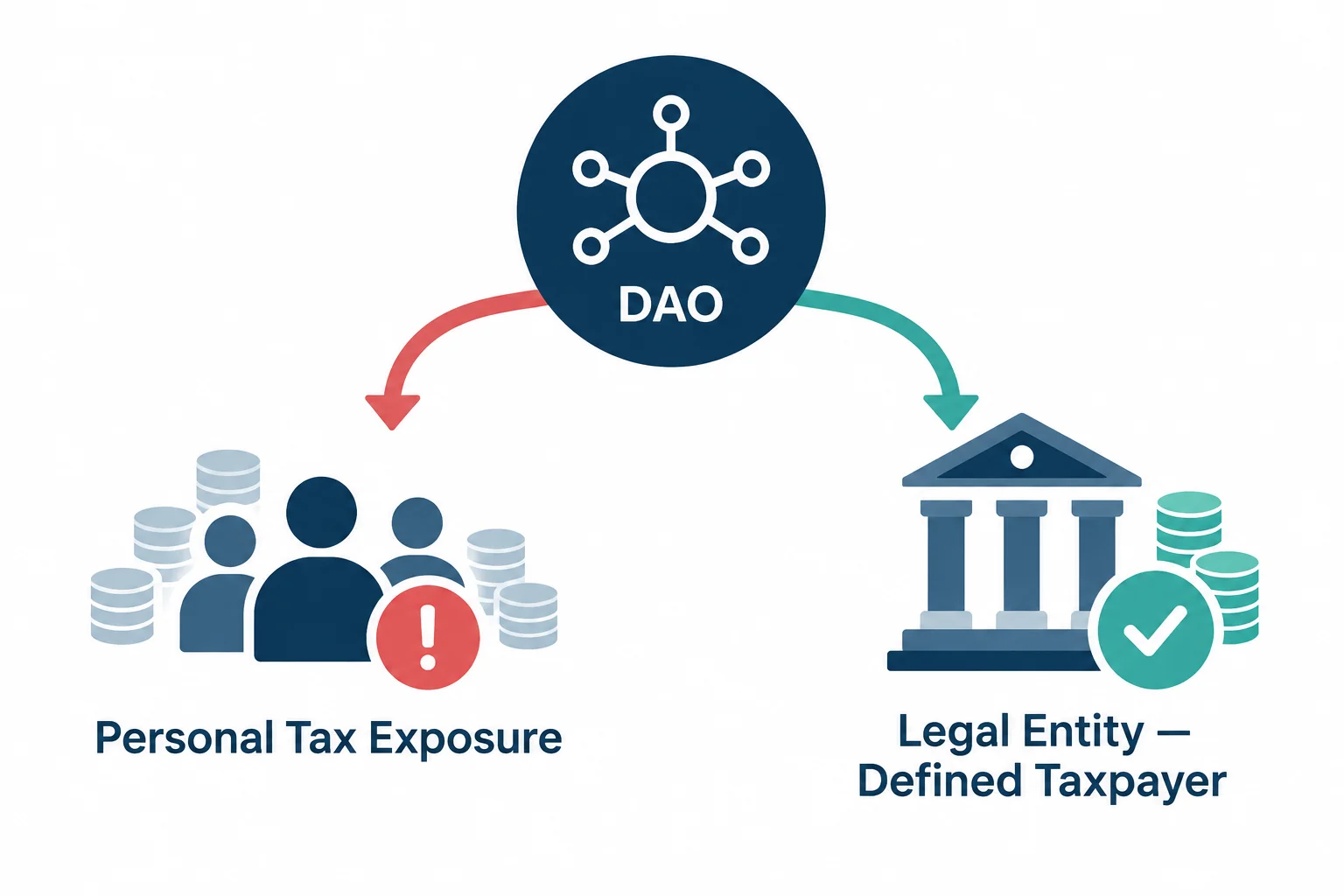
Do DAOs Pay Taxes?
Whether a DAO pays taxes depends entirely on its legal structure, not on how it is governed or what blockchain it runs on. An unincorporated DAO is not a taxpayer in most jurisdictions. What it is, by default, is a pass-through arrangement where the tax burden falls on identifiable participants.
An incorporated DAO LLC, by contrast, is a recognized legal entity. The entity is the taxpayer. Its structure, jurisdiction, and revenue model determine what it owes.
Our DAO compliance requirements guide covers the full range of obligations that come with incorporation, including reporting and beneficial ownership rules.
The DAO's tax treatment depends on five factors:
- Entity type: unincorporated association, LLC, foundation, corporation
- Jurisdiction: where the entity is formed and where it generates revenue
- Revenue model: protocol fees, grants, trading activity, service income
- Token design: whether tokens carry economic rights or governance rights only
- Distribution structure: whether the organization distributes proceeds to members or retains them
What Happens to DAO Taxes Without a Legal Entity?
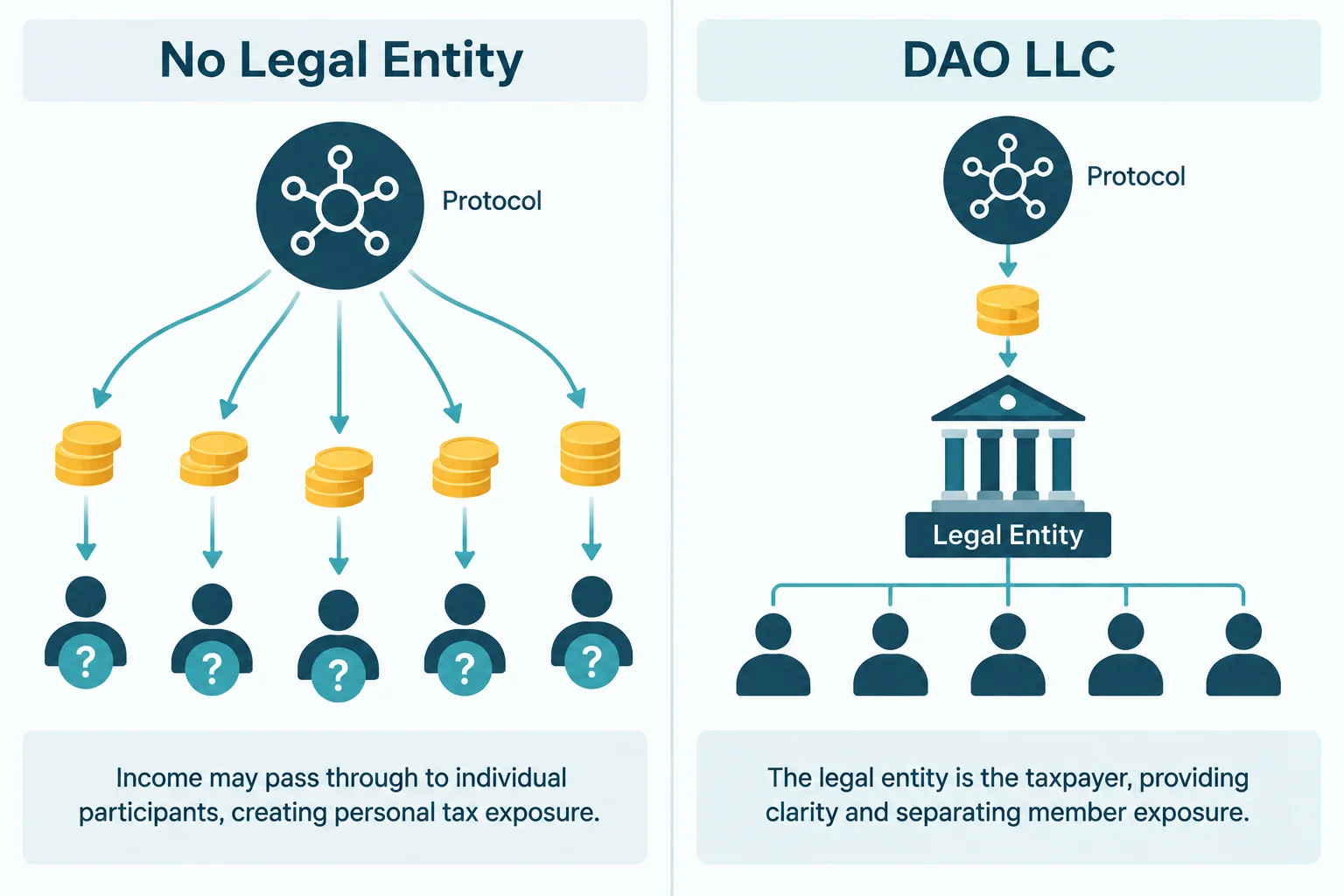
Operating without a legal entity does not eliminate a DAO's tax exposure. It redistributes that exposure to individual participants in ways most of them do not expect.
Pass-Through Tax Issues
When a DAO has no legal entity, US tax authorities may treat it as an unincorporated partnership. That classification requires the partnership to file a Form 1065 return and issue Schedule K-1s to members showing their proportionate share of income. In practice, most DAOs with thousands of pseudonymous token holders cannot do this. Most holders do not know the protocol's revenue figures. Most cannot calculate their share.
Consider the example from MIDAO's own tax discussion: a DAO with 10,000 governance token holders generating $50 million in annual protocol fees. Without an entity, that income potentially flows through to all 10,000 holders as taxable income in their respective jurisdictions. Each holder is, in theory, liable for their share, whether or not they received a distribution. That is not a theoretical edge case. It is the default classification that applies when there is no legal structure in place.
A non-resident DAO could also be classified as a foreign publicly traded partnership if its tokens trade on secondary markets, as noted in CoinTelegraph's analysis of DAO tax considerations, which would subject US token holders to further tax complexity, including potential passive foreign investment company treatment.
Lack of Tax and Operational Clarity
Beyond income attribution, unincorporated DAOs face a wider set of tax and operational clarity problems:
- Treasury ownership: Who legally owns the treasury? Who reports it?
- Contributor payments: Are payments to contributors wages, self-employment income, or something else?
- Grant activity: How are grants treated for tax purposes for both the DAO and recipients?
- Business expenses: There is no entity to deduct legitimate operational costs against revenue
- Revenue recognition: No clear accounting framework exists without a legal entity behind it
A legal entity resolves all of these questions by creating a defined taxpayer with a clear relationship to its income, expenses, and participants.
How Is a Non-Profit DAO LLC Taxed?
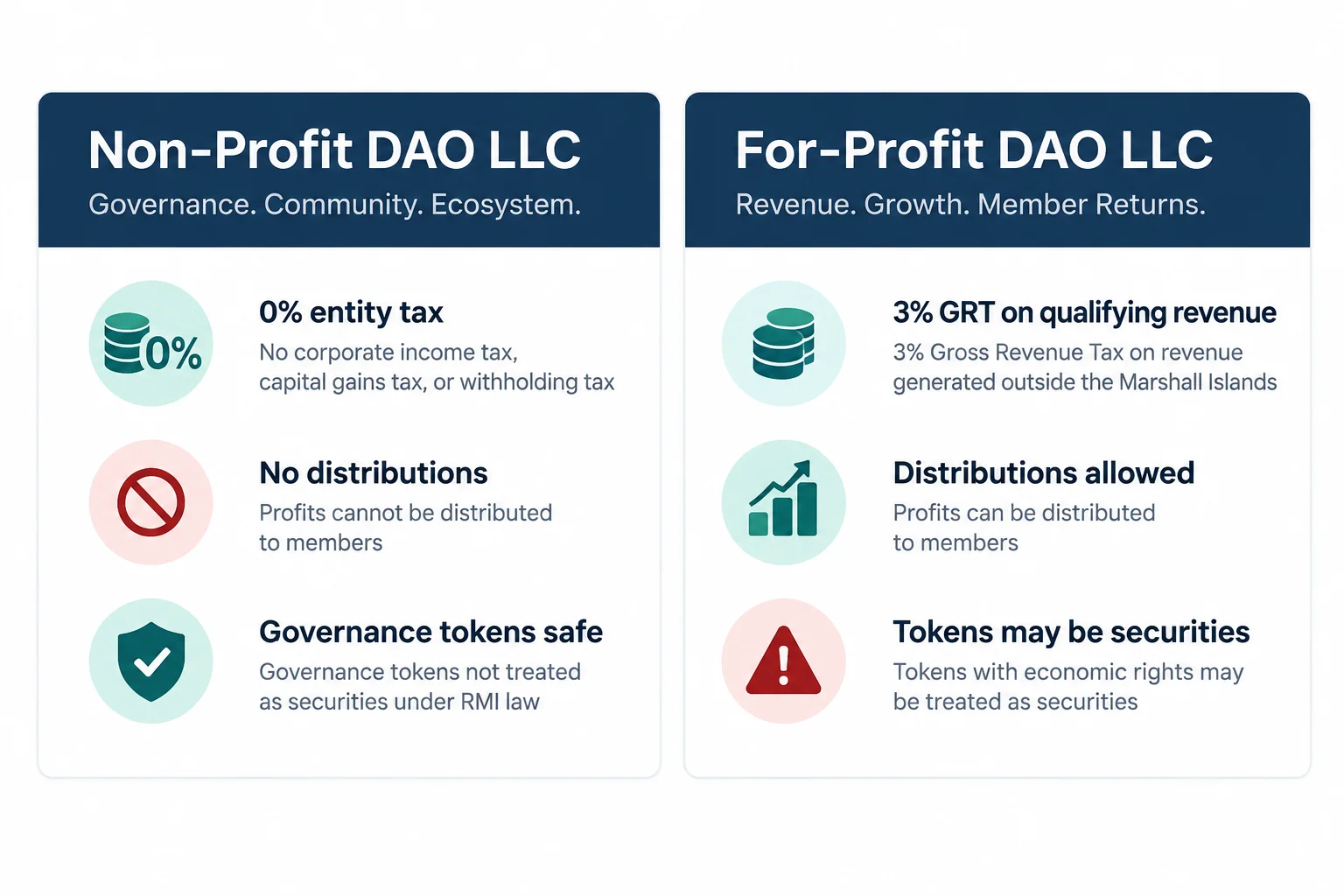
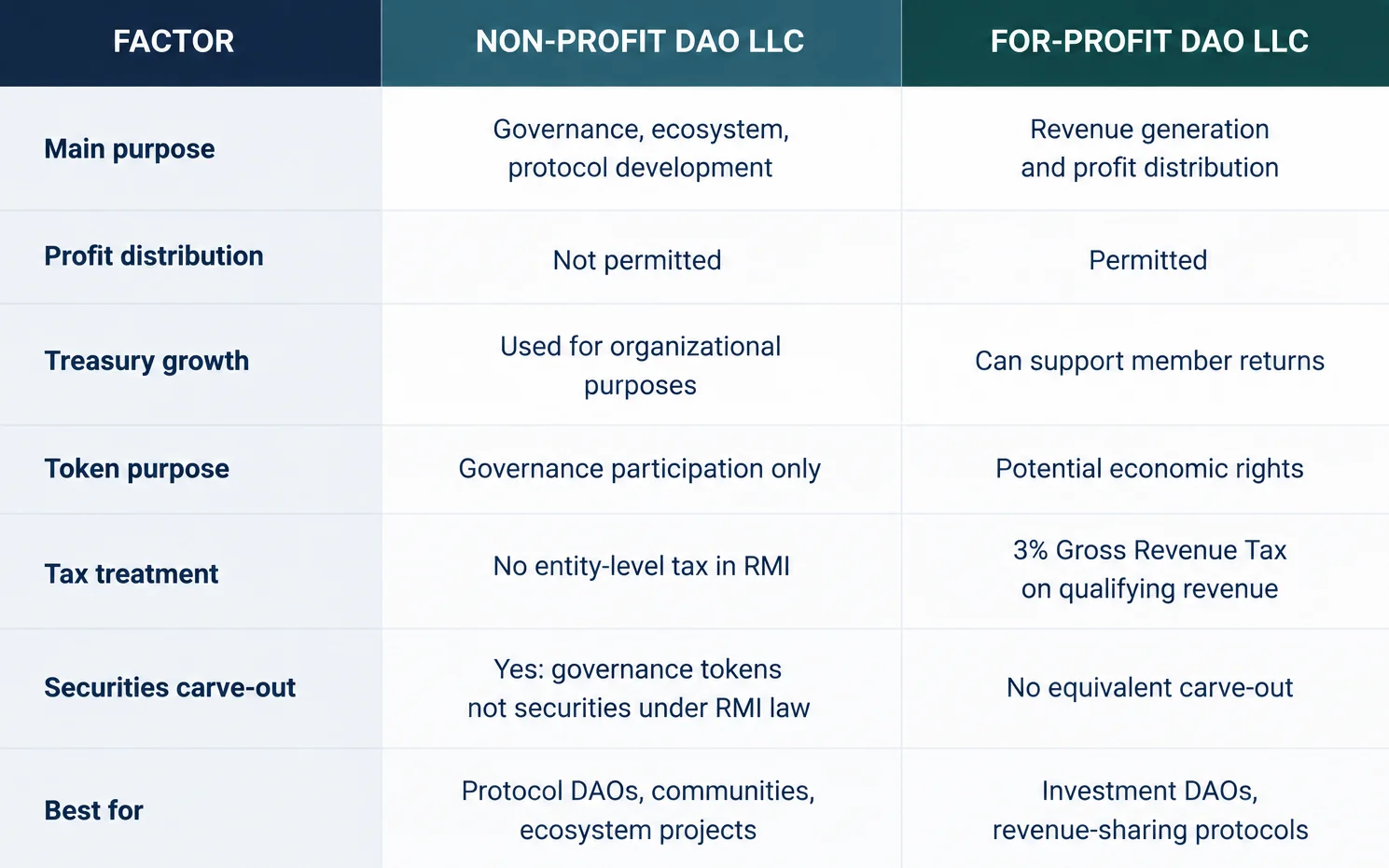
A non-profit DAO LLC incorporated in the Marshall Islands pays no entity-level taxes. Zero corporate income tax, zero capital gains tax, zero withholding tax on treasury growth. This is statutory, built into the RMI DAO Act, not a legal interpretation.
Non-profit DAO LLCs are designed for protocol governance organizations, community-driven ecosystems, and DAOs that accumulate treasury assets without distributing profits to members. The structure has three defining characteristics:
- Profit distributions to members are not permitted
- Treasury funds must support the organization's purpose rather than benefit members personally
- Governance tokens represent participation rights, not economic ownership
What Non-Profit DAO LLCs Can Do With Their Treasury
"Non-profit" is frequently misunderstood. It does not mean the DAO cannot generate revenue, hold assets, or accumulate value. It means the organization cannot distribute net profits to members as dividends or distributions.
A non-profit RMI DAO LLC can:
- Pay contributors, contractors, and service providers
- Fund development grants and ecosystem initiatives
- Acquire and hold tokens, including appreciating assets
- Invest in and hold equity in other organizations
- Maintain and deploy a treasury across multiple asset classes
- Acquire intellectual property and protocol-related assets
The distinction is between using treasury funds for organizational purposes and distributing profits to members. The first is permitted and unrestricted. The second converts the entity into a for-profit structure, which is a separate and permanent designation.
For a deeper look at how this structure fits into a broader Web3 legal approach, see our guide on what a crypto legal wrapper is and why your project needs one.
Securities Law Advantage of the Non-Profit Structure
The non-profit structure also carries a meaningful securities law benefit. Governance tokens issued by a non-profit RMI DAO LLC, where those tokens carry no economic rights, are explicitly not treated as securities under RMI law.
This is written into the 2023 DAO Act Amendment as statute. For protocols whose governance tokens should not be classified as investment instruments, this carve-out is the strongest available protection in any DAO-specific jurisdiction.
See our article on token issuance and crypto securities law compliance for a full breakdown of how token design interacts with this protection.
How Is a For-Profit DAO LLC Taxed?
A for-profit DAO LLC incorporated in the Marshall Islands is subject to a 3% Gross Revenue Tax on revenue generated outside the Marshall Islands. That rate excludes capital gains, dividends, and invested capital. For most protocols where revenue comes from trading fees, protocol fees, or service income rather than investment returns, the 3% GRT is the applicable rate.
The for-profit structure is appropriate for:
- Investment DAOs where members expect economic returns
- Revenue-sharing protocols that distribute proceeds to governance participants
- Organizations where token holders hold economic rights alongside governance rights
Member Tax Obligations Under For-Profit Structures
The 3% GRT is an entity-level tax. It does not eliminate personal tax obligations for members in their home countries. Members who receive distributions from a for-profit DAO LLC may have income tax obligations in their own jurisdictions. US persons in particular should be aware that their US tax obligations do not disappear because the entity is offshore.
The for-profit structure also does not carry the same securities law carve-outs as the non-profit. Tokens with economic rights, meaning tokens that grant claims on assets or rights to distributions, look more like securities regardless of where they are issued, and require appropriate securities law analysis for each target market.
Non-Profit vs. For-Profit DAO LLC: What Is the Right Choice?
The choice between non-profit and for-profit is permanent. Once the DAO LLC is formed as one or the other, it cannot be converted. This is the single most consequential structural decision in DAO incorporation, and it must be made before filing.
The most common pattern among larger projects is a hybrid: a non-profit DAO LLC for governance, paired with a separate for-profit operating company for business operations. The DAO LLC holds the treasury and IP. It issues governance tokens that are explicitly not securities. The operating company, typically a Delaware C-Corp, raises capital, employs the team, and handles commercial contracts. Each entity does what it was built for.
Our step-by-step guide to incorporating a token project in 2026 walks through how this sequencing works in practice.
Choosing the Right DAO Tax Structure Before Launch
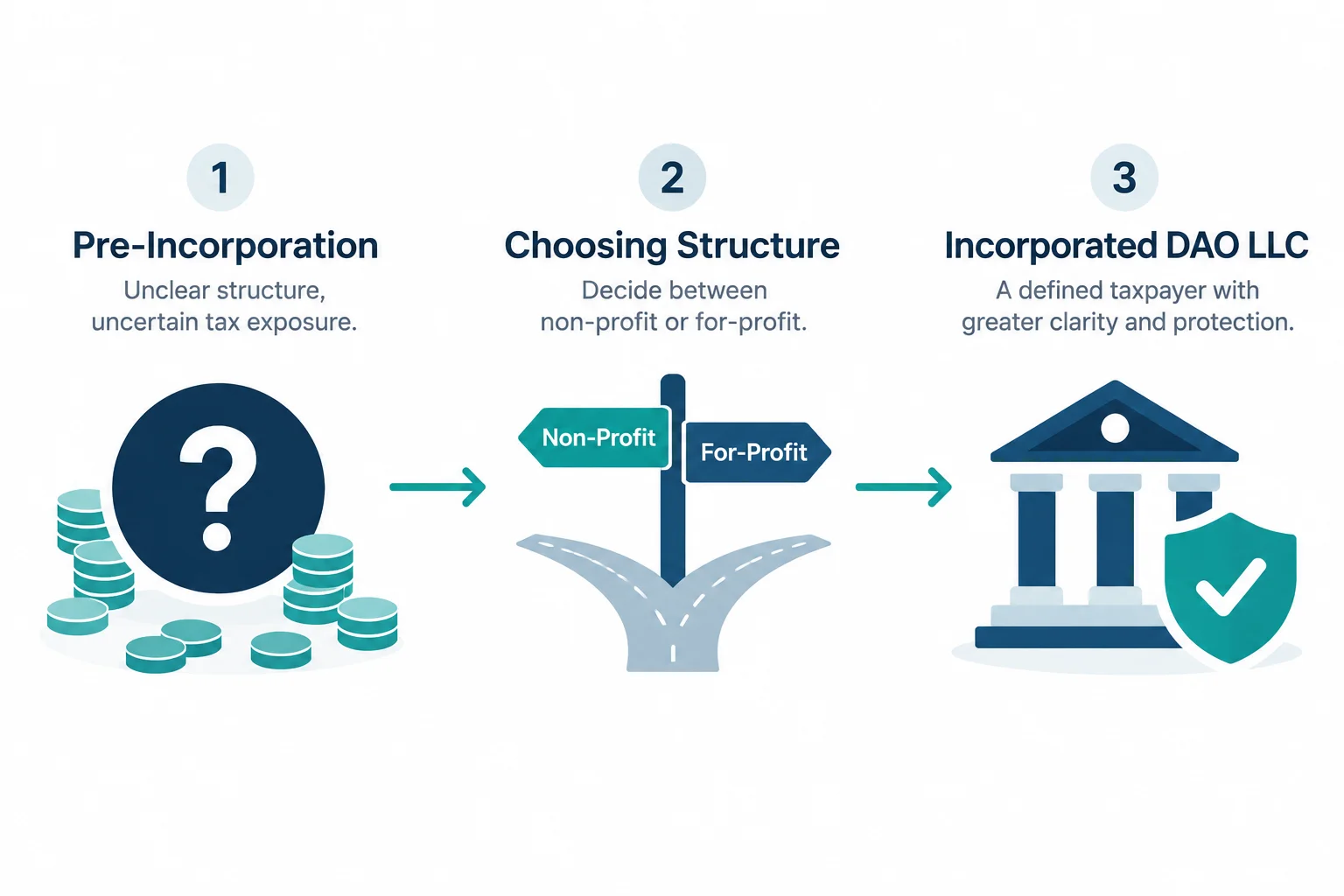
DAO taxation is determined by legal structure, not by blockchain design or community intent. An unincorporated DAO that generates revenue creates unclear tax obligations for its participants, with no clean mechanism for reporting or resolution. An incorporated DAO LLC creates a defined taxpayer with a clear relationship to its income, assets, and participants.
Non-profit and for-profit DAO LLCs serve fundamentally different purposes. The non-profit is the right choice for protocol DAOs and community governance organizations that accumulate treasury value without distributing it. The for-profit is the right choice when members expect economic returns and token holders hold genuine economic rights.
The key decision is timing. Choosing the wrong structure requires full restructuring, which means forming a new entity, transferring assets, and renegotiating the token's legal character. That process is expensive and complex. Getting it right at formation is not.
A properly structured DAO entity allows Web3 organizations to operate with clear tax treatment, liability protection, and legal recognition, from the earliest stage of the project through institutional scale.
Ready to choose the right DAO structure for your project? Start your RMI DAO LLC registration with MIDAO, the only government-authorized program for Marshall Islands DAO LLC formation, and get expert guidance on non-profit vs. for-profit structure before you file.
Frequently Asked Questions
Can a non-profit DAO LLC generate revenue?
Yes. A non-profit RMI DAO LLC can generate revenue from protocol fees, grants, licensing, and other sources, and those revenues are not taxed at the entity level in the Marshall Islands. The restriction is on distribution: the DAO cannot pay out net profits to members as dividends or distributions. Revenue must be used for the organization's stated purposes, including paying contributors, funding development, and maintaining infrastructure.
Can a DAO change from non-profit to for-profit after incorporation?
No. The choice between a non-profit and for-profit DAO LLC is permanent and cannot be reversed after formation. A DAO that needs to change its structure would need to form a new entity and transfer assets, which is a material legal and operational undertaking. This is one of the most important reasons to get the structure right before incorporating, rather than treating it as a detail to sort out later.
Are DAO token holders personally responsible for DAO taxes?
Under a properly incorporated non-profit RMI DAO LLC, members are not personally liable for DAO taxes simply from holding governance tokens. The entity handles its own tax obligations at the entity level, and the non-profit structure eliminates entity-level taxes in the Marshall Islands entirely. Without a legal entity, however, unincorporated DAOs may be treated as partnerships by the IRS, which would make members personally responsible for reporting and paying tax on their proportionate share of DAO income regardless of whether they received any distribution.