
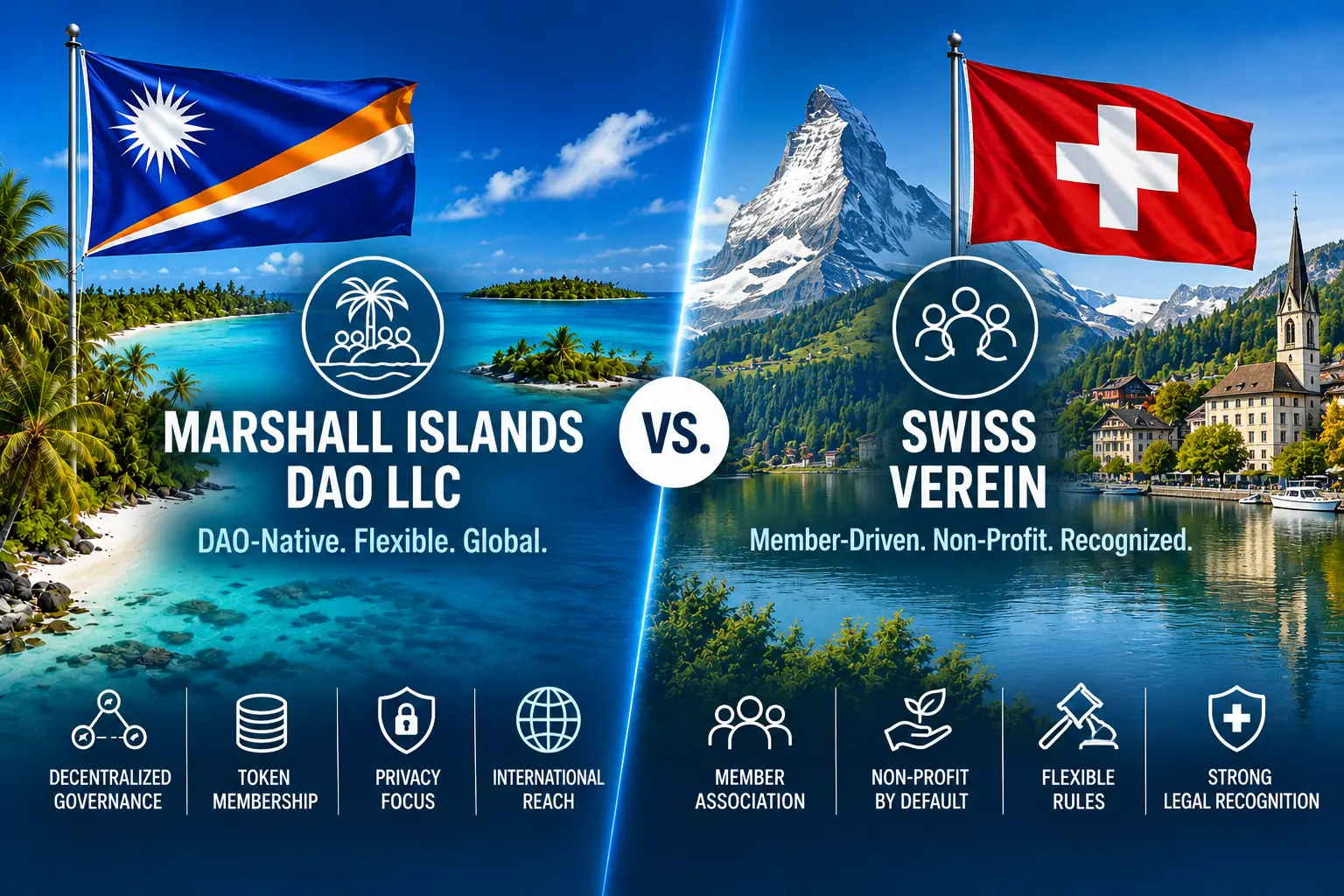
TThe Swiss government's SME portal states that an association needs at least two founders, no seed capital, a general assembly and a board, and that it must pursue a goal for the greater good rather than profit. That makes the Swiss Verein a familiar home for open-source communities and industry bodies.
It also explains why Web3 founders are weighing it against the Marshall Islands DAO LLC. Both can organize a community, hold assets and sign contracts. They do it in very different ways.
Web3 projects need a legal structure for three jobs: supporting community governance, managing a treasury, and entering contracts with developers, auditors, and service providers. This guide covers Marshall Islands DAO LLC vs. Swiss Verein so you can match the structure to the job.
Marshall Islands DAO LLC vs. Swiss Verein: Understanding Both Structures
A Marshall Islands DAO LLC is a token-governed company, while a Swiss Verein is a membership association with a noncommercial purpose. Each treats the community differently from the start.
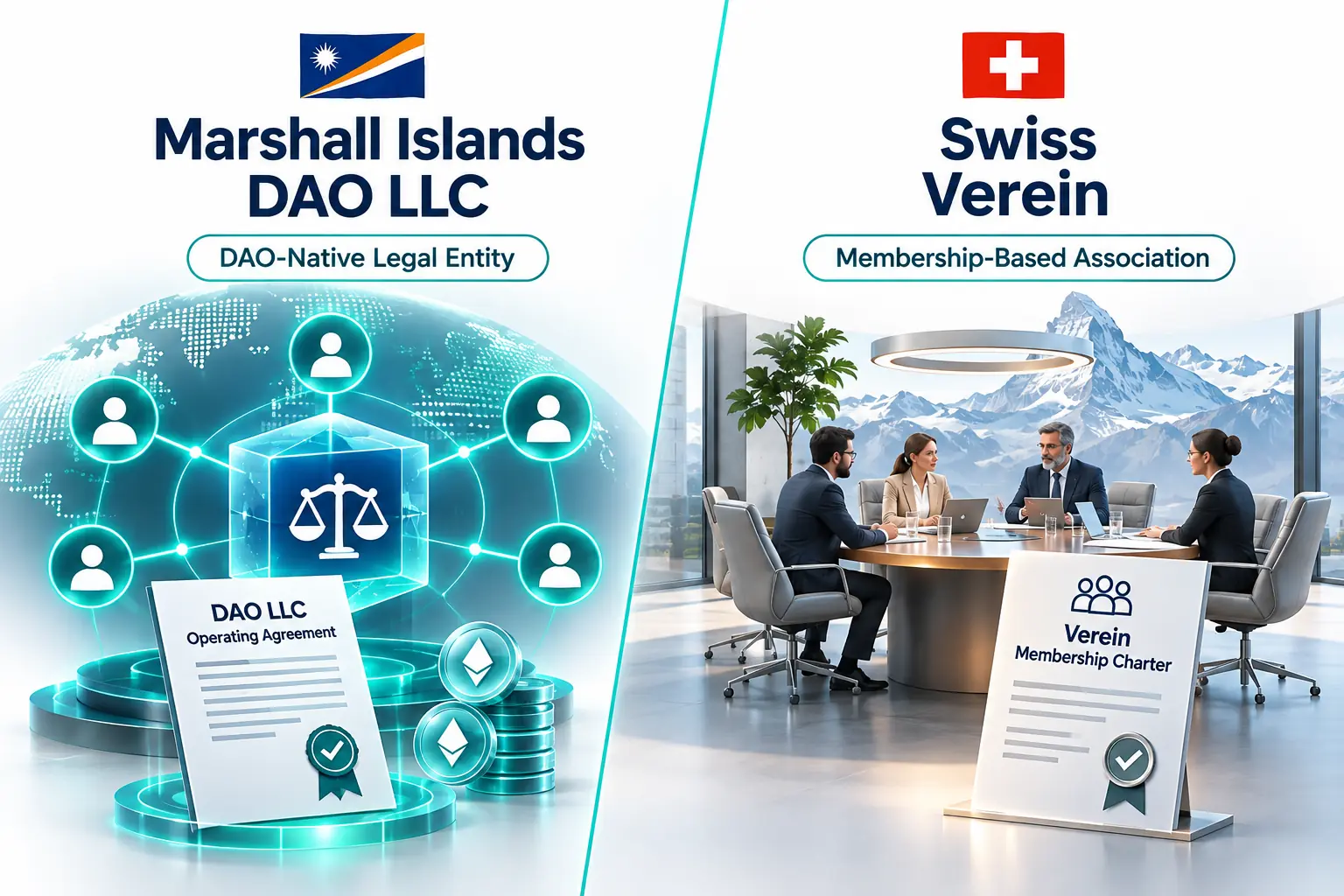
What Is a Marshall Islands DAO LLC?
The Marshall Islands DAO Act of 2022, as amended in 2023 and supplemented by the 2024 Regulations, gives a DAO legal recognition as a limited liability company. The entity can own assets, sign contracts, and limit member liability.
Its main features include:
- Token-based membership, where holding tokens can define who a member is
- Smart contract governance written into the operating agreement
- Algorithmic management, so no traditional board of directors is required
- A nonprofit option, with no entity-level tax and no distributions
- A for-profit option, with a 3% Gross Revenue Tax on qualifying revenue
- Formation through MIDAO from $9,500, typically in under 30 days
It is used for DAOs, DeFi protocols, and tokenized organizations.
What Is a Swiss Verein?
A Verein is an association governed by Articles 60 to 79 of the Swiss Civil Code. It is a membership organization with its own legal personality, formed by at least two founders who adopt written statutes.
Its main features include:
- A general assembly of members, which is the supreme body
- An association board with at least one member
- A noncommercial or public-benefit purpose, so it cannot be run for profit
- Permission to carry out commercial activity that supports its noncommercial goals
- Statutes that can define how members are admitted, vote, and leave
Web3 projects often use the statutes to give tokenholders a defined role, for example through delegated or token-weighted voting inside the general assembly.
A Verein is not a Swiss foundation (Stiftung). A foundation has no members and is run by a council, while a Verein is built around an assembly of members. Our comparison of the Swiss foundation route covers that structure separately.
What Are the Key Differences Between a Marshall Islands DAO LLC and a Swiss Verein?
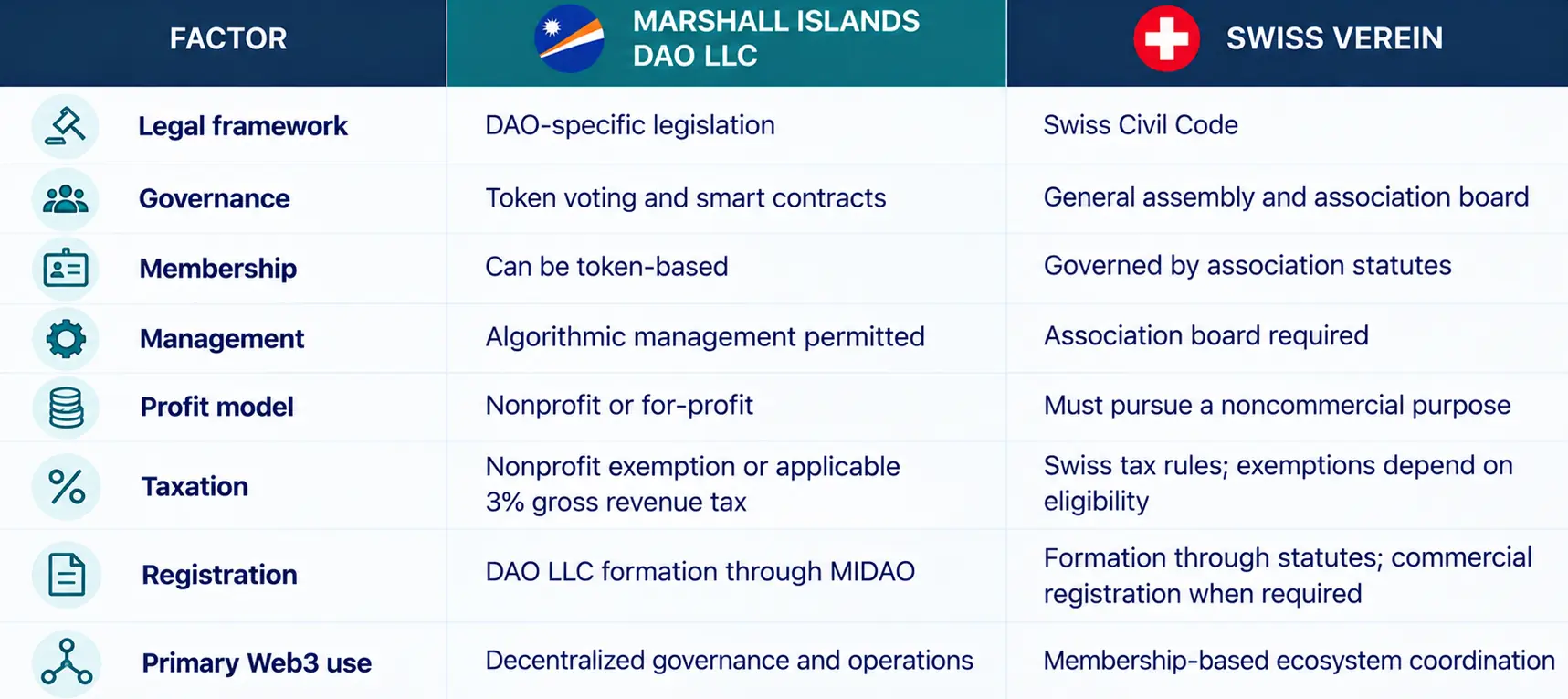
The core difference is that a DAO LLC lets code and tokenholders govern directly, while a Verein requires a board and an assembly under Swiss statutes. Most other differences follow from that.
Governance and Decision-Making
In a DAO LLC, the operating agreement can point directly at the governance smart contracts. An approved vote is a recognized company action with no extra off-chain approval step.
A Verein works the other way. Authority sits with the general assembly and the board, and Swiss law sets mandatory rules on how they operate.
Associations can still adopt DAO voting. The statutes can say that on-chain results guide or feed into the assembly. But the board and assembly keep their legal roles, so some decisions may need a formal step outside the chain.
This matters when a vote is contested. In a DAO LLC, the on-chain outcome is the decision, while in a Verein the statutes and the board's duties decide whether the vote is binding.
Membership and Tokenholder Rights
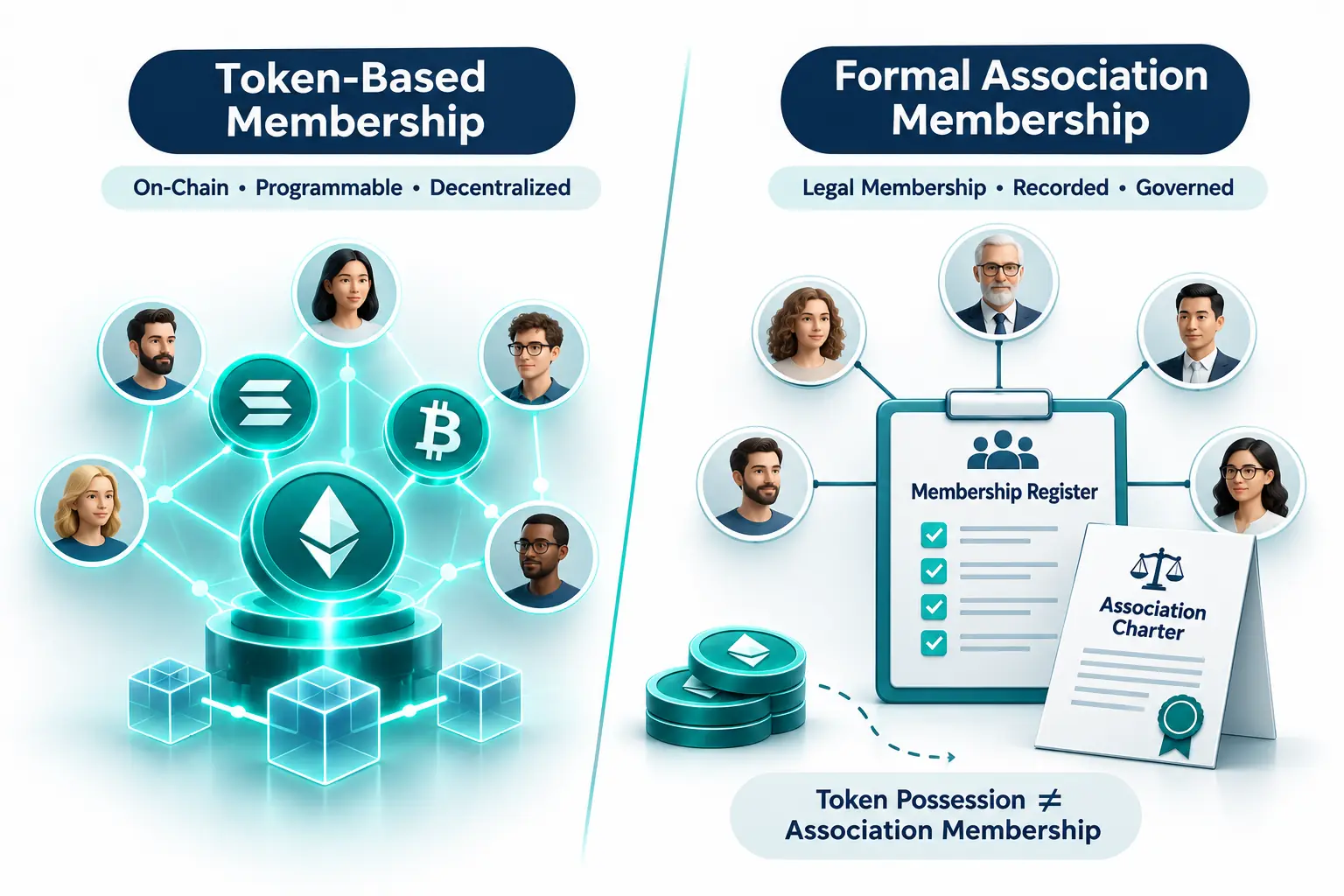
A DAO LLC can define membership by tokens. Holding the governance token carries the rights described in the operating agreement.
In a Verein, membership comes from the statutes, which set admission, voting rights, and termination. Holding a token does not by itself make someone a member.
Three issues come up often:
- Enforceability: A token creates enforceable membership rights only if the statutes say so and admission steps are followed.
- Anonymity: Anonymous wallet holders are hard to fit into an association that needs identifiable members.
- Transferability: Freely traded tokens sit awkwardly with voting eligibility that is tied to admitted members.
Founders often solve this with a hybrid, where the token has on-chain meaning, and the Verein admits a smaller set of identified members.
Commercial Activities and Asset Ownership
A DAO LLC can be nonprofit or for-profit. A for-profit entity can earn revenue and run products, subject to the 3% Gross Revenue Tax. A nonprofit entity makes no distributions.
A Verein must pursue a noncommercial purpose. It can carry out commercial activity that supports that purpose, but it is a poor fit for a profit-driven protocol.
Both can hold crypto, protocol treasuries, and intellectual property in the entity's name.
Teams that need heavy commercial activity often add a separate operating company, as covered in our guide to what a crypto legal wrapper is.
Taxation and Regulatory Compliance
Under the RMI model, a nonprofit DAO LLC pays no entity-level tax, while a for-profit DAO LLC pays a 3% Gross Revenue Tax on qualifying revenue. The choice is permanent, so it should be made at formation.
Our DAO tax guide explains the options.
A Verein is subject to Swiss tax rules. Income tax exemption is possible for associations that qualify as nonprofit or public-benefit organizations, but eligibility depends on meeting the conditions and should be confirmed with Swiss counsel.
On compliance, the two structures differ in what they disclose:
- DAO LLC: Only holders of 25% or more of governance rights are disclosed. General tokenholders stay pseudonymous.
- Verein: The association keeps member records and a board that is identifiable.
- Both: Securities, AML, and tax rules in each user's country can still apply. Our DAO compliance guide covers what to expect.
Privacy here means protecting tokenholders while meeting obligations, never avoiding them.
Formation, Administration and Ongoing Costs
DAO LLC formation runs through MIDAO, with one registered agent and one filing process. It typically takes under 30 days and starts from $9,500.
A Verein is formed by adopting written statutes at an organizational meeting, appointing a board and an auditor. According to the SME portal, it needs at least two founders and no minimum capital. Registration in the commercial register is required in specified circumstances, such as when the association carries on a commercial business.
Ongoing duties differ in kind:
- DAO LLC: Registered agent services, beneficial ownership updates, and operating agreement upkeep.
- Verein: Annual general assembly, bookkeeping, board administration and possible auditing, plus any local representation Swiss rules require.
Swiss costs vary widely by provider and by whether registration is required, so confirm current figures with Swiss counsel.
Which Structure Fits Different Web3 Projects?
Choose a DAO LLC when tokenholders should govern with legal effect, and a Verein when the goal is a member-led, nonprofit community with a formal board. The purpose of the project should drive the choice.

When a Marshall Islands DAO LLC May Be Suitable
A DAO LLC suits projects that need legal weight behind on-chain governance:
- DAOs seeking legally recognized on-chain governance
- Tokenholder-controlled protocols and decentralized treasuries
- Projects that want algorithmic management without mandatory human directors
- Organizations that need the choice between nonprofit and for-profit structures
When a Swiss Verein May Be Suitable
A Verein suits communities built around members rather than tokens:
- Open-source communities and nonprofit Web3 ecosystems
- Blockchain industry associations and protocol development communities
- Projects that want membership-based coordination with a formal board
- Organizations focused on ecosystem support rather than profit distribution
Many teams combine both: a DAO LLC for the on-chain protocol and treasury, and a Verein for ecosystem and community coordination.
Our guide to token issuance and securities law explains what to review before settling the structure.
Let Governance Needs Choose the Entity
Governance needs, tokenholder rights, commercial plans, and compliance duties should decide the entity, not the other way around. If the community should decide with legal effect, the DAO LLC matches. If the project is a member-led nonprofit network, a Verein can serve it well.
For live protocols with tokens, treasuries, and global contributors, the DAO LLC usually fits better. It offers token membership, no required managers, privacy with compliance, and a lower cost of entry. A Verein remains a strong tool for the community layer around the protocol.
Explore Marshall Islands DAO LLC incorporation through MIDAO
Frequently Asked Questions
Can a Swiss Verein legally recognize anonymous wallet holders as association members?
Membership in a Verein comes from the statutes, and members are generally admitted and recorded. Fully anonymous wallet holders are hard to fit into that model. Counsel should review any design that tries to include them.
Can either entity open a bank account and receive payments in cryptocurrency?
Both are legal entities and can generally seek bank accounts and hold crypto in their own names. Whether a bank or custodian accepts them depends on its own onboarding and AML rules. Expect due diligence on the entity and its controllers.
Can a Swiss Verein or Marshall Islands DAO LLC hire developers and contractors internationally?
Yes, both can sign contracts in their own names, which includes agreements with international developers and contractors. Employment, tax, and withholding rules in the contractor's country may still apply. Local advice helps for any long-term hire.
What happens if a Swiss Verein's board disagrees with a governance vote approved by tokenholders?
The board's legal duties come from the statutes and Swiss law, so a token vote is not automatically binding. The outcome depends on how the statutes link on-chain votes to the assembly and board. This is a main reason many tokenholder-led projects prefer a DAO LLC.
How are remaining cryptocurrency assets distributed if either organization dissolves?
Each structure follows its governing documents and applicable law. A DAO LLC follows its operating agreement, while a Verein follows its statutes, and nonprofit status can limit who may receive assets. Set dissolution terms at formation and confirm them with counsel.