

Section 715(1) of the Marshall Islands Decentralized Autonomous Organization Act, as published by the Nitijela (RMI Parliament), says that when the certificate of formation or LLC agreement conflicts with a smart contract, the certificate or agreement pre-empts the conflicting contract terms. The provision treats those documents and smart contracts as effective statements of authority.
That one rule shows how on-chain governance legal recognition really works. The code is not the whole law, and the paperwork is not the whole organization. The two have to be connected on purpose.
DAOs use proposals, token votes, and smart contracts to decide things together. An on-chain vote shows what a community wants, but it does not automatically create legally enforceable authority. Legal recognition matters once a DAO needs to own assets, sign contracts, manage funds or enforce its own procedures.
This guide explains how a blockchain governance legal entity turns a recorded vote into a recognized decision, and what it still cannot do.
What Does Legal Recognition of On-Chain Governance Mean?
Legal recognition means a DAO's governance procedures are treated as the organization's own, so decisions made through them can bind the entity. It turns a recorded vote into an organizational act.
How On-Chain Governance Works Without a Legal Entity
Most DAOs follow a similar loop. Someone submits a proposal, tokenholders vote, and a smart contract or a group of signers carries out the result.
Common governance models include:
- Token-weighted voting: voting power follows token balances.
- Delegation: holders assign their votes to representatives.
- Multisignature approvals: a set number of signers must approve an action.
A decision recorded on a blockchain is not the same as a decision legally attributable to an organization. Without an entity, there may be no clear answer to who owns the assets, who can sign a contract, or who is responsible if the decision causes harm.
In many places, a group acting together without an entity can be treated as a general partnership.
Our guide on why unincorporated DAOs are legally exposed explains what that means for members.
How Legal Recognition Changes DAO Governance
A legally recognized entity can hold rights and obligations separately from its members. That is the foundation for everything else.
It also lets governance procedures live in legally operative documents. When a decision is properly authorized under those documents, a tokenholder vote can become a binding internal decision of the organization.
Legal recognition of governance procedures is not the same as automatic enforceability of every blockchain transaction. A transaction can still be challenged under the documents, the law, or the facts, and some actions still need off-chain steps.
In practice, recognition changes four things:
- Authority: a vote follows rules the entity itself adopted, so it counts as the entity's decision.
- Accountability: the entity, not a handful of wallet holders, answers for the result.
- Ownership: assets and intellectual property sit with the entity, not with whoever controls a key.
- Evidence: the documents and on-chain records together show what was decided and why.
This is why counterparties, banks, and auditors ask for a legal entity before they engage with a DAO. They need to know whose decision they are relying on.
How Does On-Chain Governance Work Under a Marshall Islands DAO LLC?
Under a Marshall Islands DAO LLC, token voting and smart contracts are connected to the entity through its formation documents. The operating agreement is the bridge.
Legal Recognition Under the Marshall Islands DAO Act
The DAO Act of 2022, amended in 2023 and supplemented by the 2024 Regulations, recognizes a DAO as a limited liability company with its own legal personality. It supports blockchain-based organizational management and smart contract governance.
Key points include:
- Smart contract recognition: governance smart contracts can be named in the formation documents.
- Management options: a DAO LLC can be run by its members or managed algorithmically, with no traditional board required.
- Token-based membership: tokens can be tied to legally recognized membership interests, as defined in the operating agreement.
- Nonprofit or for-profit: nonprofit DAO LLCs pay no entity-level tax and make no distributions, while for-profit DAO LLCs pay a 3% Gross Revenue Tax on qualifying revenue.
Connecting Smart Contracts to the Operating Agreement
The operating agreement defines the rules that give on-chain actions legal meaning. It sets membership, voting rights, quorum, and decision procedures.
It can also identify the governance smart contracts and authorize on-chain voting and specific kinds of automated execution. That is what lets code carry legal weight instead of sitting beside the law.
A good operating agreement covers:
- Membership: who is a member and how tokens relate to membership interests.
- Voting: rights, quorum and approval thresholds.
- Contracts: which governance smart contracts apply and how upgrades are approved.
- Conflicts: what happens if the agreement and the code disagree.
That last point is critical. Under the 2023 amendments, the certificate of formation or LLC agreement takes precedence over conflicting smart contract provisions. A team that wants the code to control should write that into the documents rather than assume it.
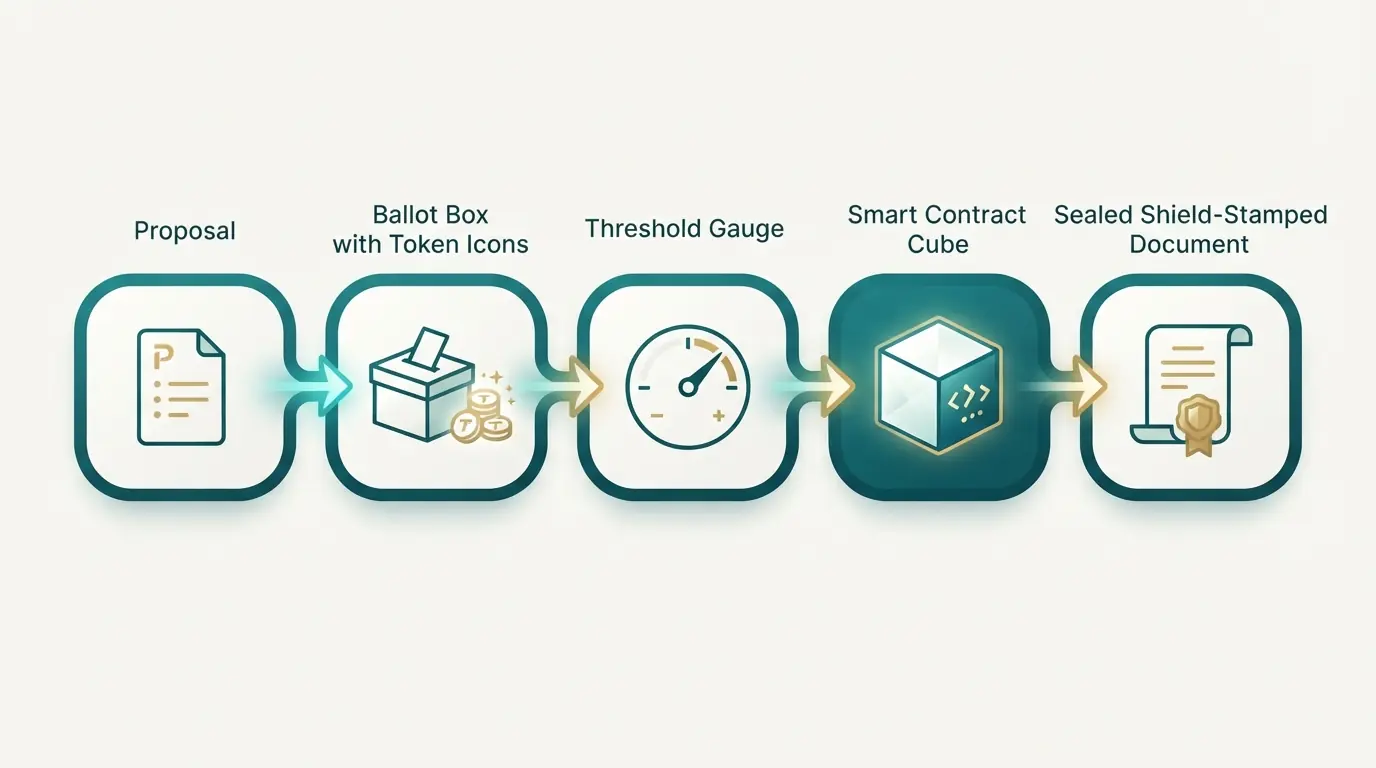
How a Legally Recognized On-Chain Decision Happens
Most DAO LLCs follow a similar path from idea to action:
Proposal → Tokenholder Vote → Approval Threshold → Smart Contract Execution → Legally Recognized DAO Action
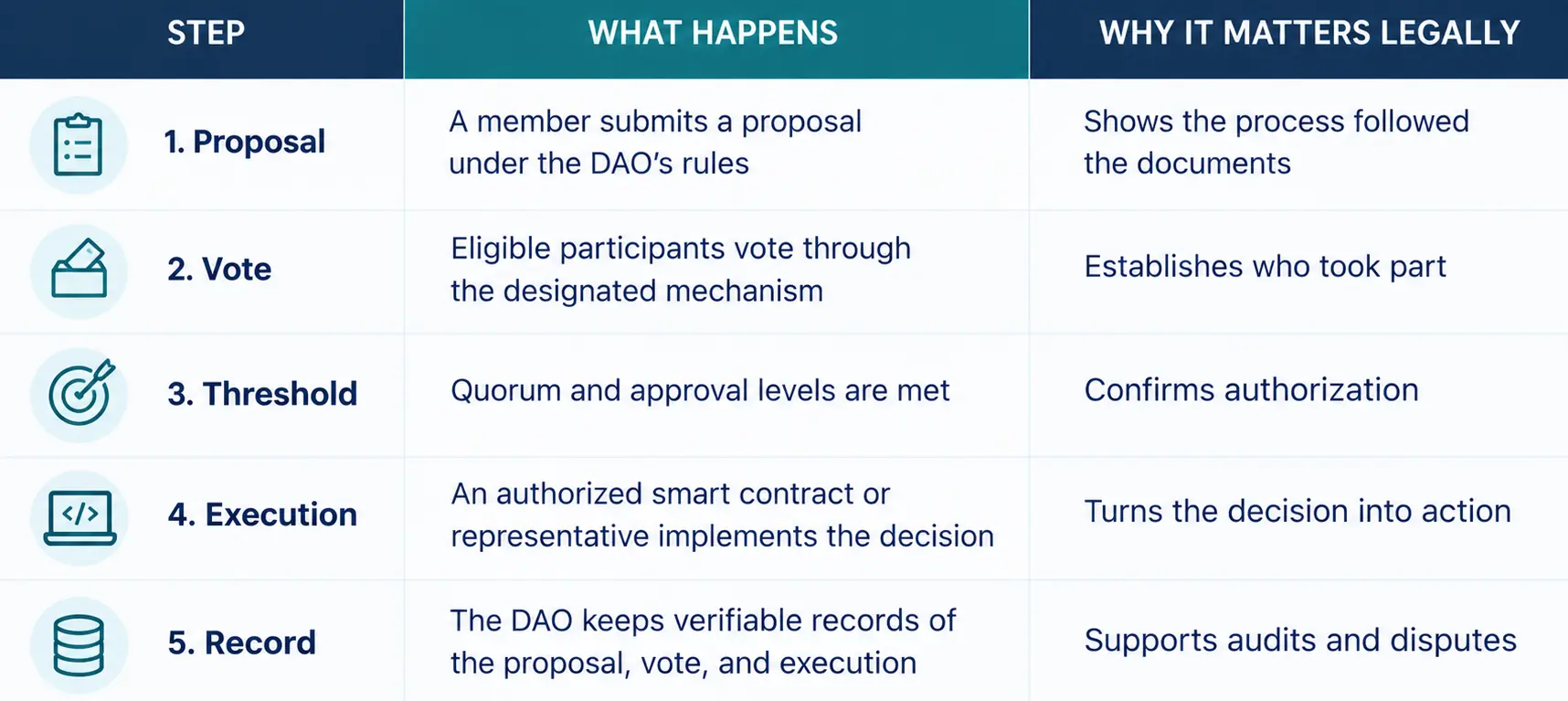
The legal effect depends on the DAO's governing documents and the nature of the decision. Some decisions fit fully on-chain. Others, like signing a bank form, still need a person to act.
Two details make this process stronger in practice. First, the documents should say who may submit proposals and what quorum applies to each type of decision, so a routine grant and a change to the operating agreement are not treated alike. Second, the record should be easy to produce. If a bank, auditor, or court asks how a payment was approved, the proposal, the vote tally, and the execution transaction should tell one consistent story.
What Can a DAO Legally Manage Through On-Chain Governance?
A DAO LLC can manage treasury decisions, governance changes, and external agreements through on-chain governance, as long as its documents authorize them. Some activities still need authorized people.
Treasury Management and Financial Decisions
Tokenholder votes can authorize treasury transfers, grants, and contributor payments. Smart contracts can execute those decisions automatically.
Multisignature wallets, spending limits, and emergency controls add safeguards. Controlling a wallet is not the same as legally owning what is in it.
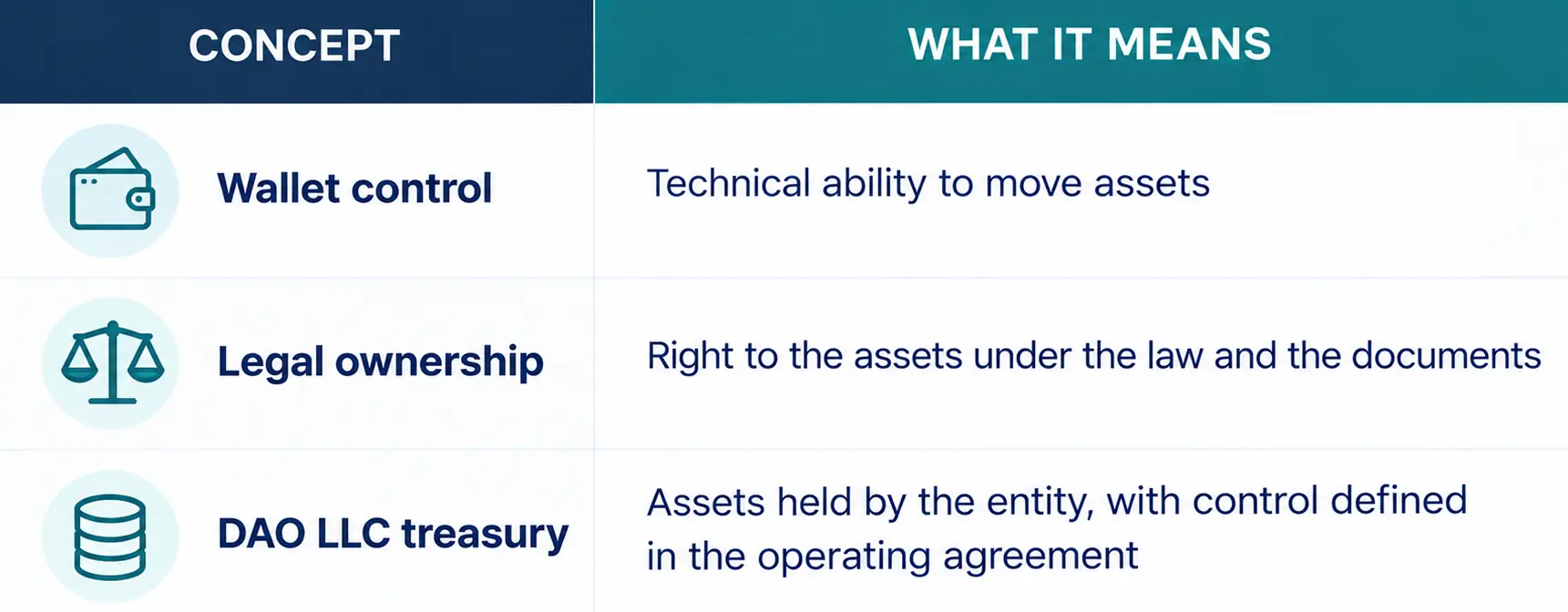
The entity makes the difference. It can hold assets in its own name, so ownership is clear even if signers change.
Treasury rules should also cover the awkward cases. Teams usually set spending limits for routine payments, higher approval thresholds for large transfers, and a defined emergency path if a signer loses a key or a contract needs to be paused. Writing these into the operating agreement means a crisis is handled by process rather than by argument.
Membership, Governance Changes and Protocol Upgrades
On-chain governance can also change how the DAO runs. Members can vote to add or change membership requirements, voting thresholds, delegation rules, and proposal procedures.
They can also approve protocol upgrades or changes to governance smart contracts. When a change affects legal rights, the operating agreement should be amended properly, not only the code.
This is where teams slip. If the contract changes but the agreement does not, the two can drift apart, and the agreement may prevail.
Our token project incorporation guide covers how to keep them aligned.

Contracts, Intellectual Property and External Operations
A DAO LLC can approve agreements with service providers and development teams. It can also hold trademarks, software rights, and other intellectual property.
Some off-chain activity still needs people. Authorized representatives may be needed to sign contracts, open bank accounts, or file documents.
Our overview of banking and regulation of DAOs in the Marshall Islands explains what institutions typically expect.
Where Code Meets Law: Putting the Pieces Together
The Marshall Islands DAO LLC works because it joins token-based participation, smart contracts, and enforceable internal rules in one structure. Tokens show who participates, contracts execute decisions, and the operating agreement gives both legal meaning.
Legally recognized governance does not remove regulatory requirements. Securities, tax, AML and sanctions rules can still apply, and proper documentation remains essential. Our DAO compliance guide covers what to prepare.
Done well, legal recognition makes decentralized governance more credible. It gives the community a decision process that counterparties, banks, and courts can understand.
Explore how MIDAO can help establish a Marshall Islands DAO LLC with governance arrangements that reflect your project's on-chain operations
Frequently Asked Questions
Can an existing DAO obtain legal recognition without replacing its governance token?
Often yes. A DAO can usually form a DAO LLC and map its existing token to membership rights through the operating agreement. The exact design should be reviewed so tokens and legal membership line up.
Does every tokenholder automatically become a legal member of a DAO LLC?
Not automatically. Membership depends on how the operating agreement defines it, so holding a token creates legal membership only if the documents say so. Many DAOs define membership by tokens, but this should be stated clearly.
Can a DAO legally operate without directors or human managers?
The Marshall Islands framework supports algorithmic management without a traditional board. Some off-chain tasks, such as signing forms or opening accounts, may still need authorized people. A registered agent is also required.
What happens if a governance smart contract is hacked after a proposal is approved?
The outcome depends on the operating agreement, the facts, and applicable law. Because the formation documents take precedence over conflicting smart contract terms, a well-drafted agreement can address emergency measures and dispute handling. Include recovery procedures at formation.
Can on-chain voting be legally valid if tokenholders remain pseudonymous?
Voting can be valid if the operating agreement recognizes the voting process, even when general members are pseudonymous. Holders of 25% or more of governance rights are disclosed under the RMI rules. Confirm current requirements with MIDAO before filing.