
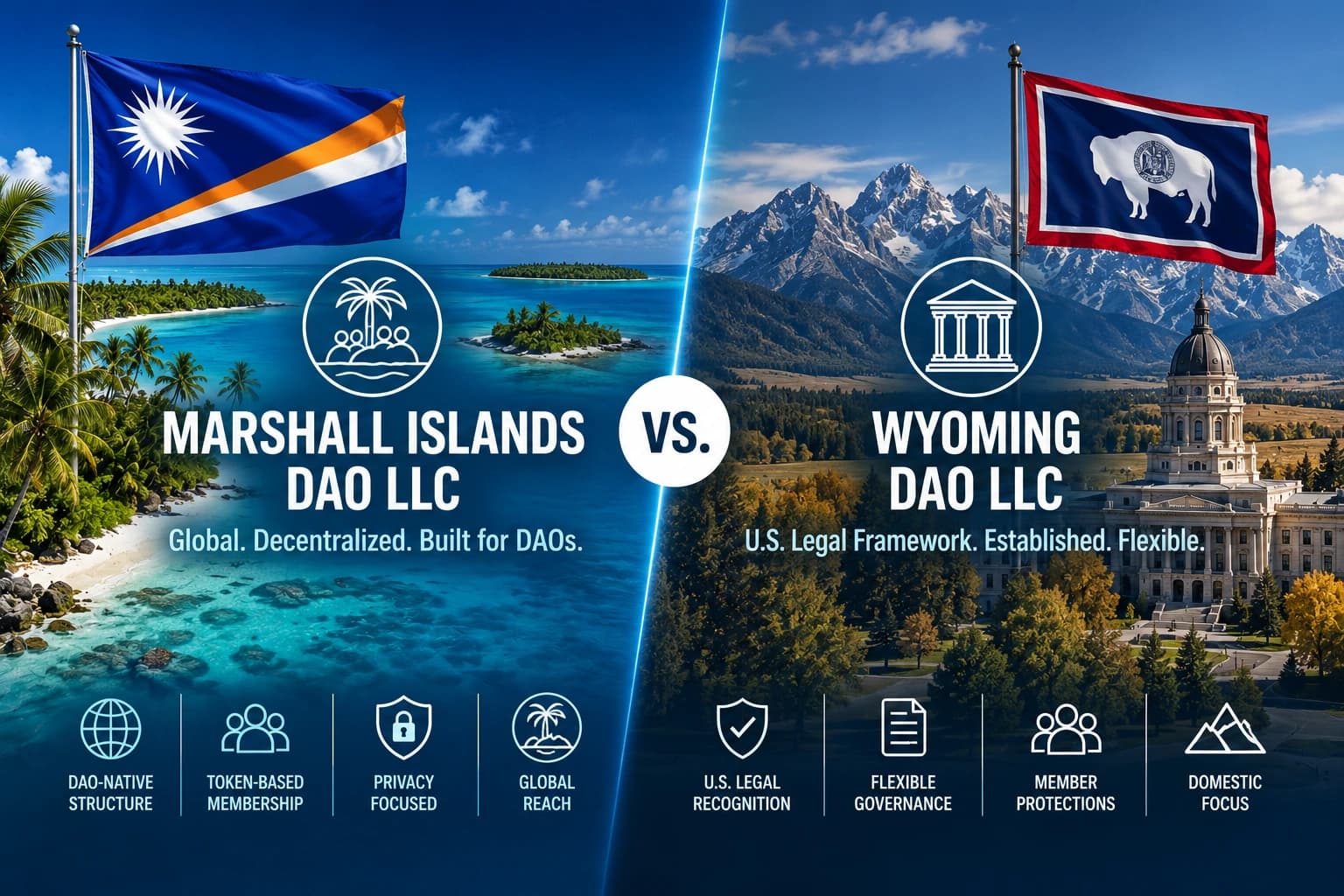
The Wyoming Secretary of State's DAO guidance, last revised March 9, 2022, confirms that a Wyoming DAO is formed by filing Articles of Organization for a $100 fee, and that those articles must publicly identify the smart contracts used to run the organization.
That detail captures the challenge. DAOs make decisions through code, but courts, banks, and counterparties deal with legal entities. Founders need a structure that connects the two.
Wyoming and the Marshall Islands have both written DAO-specific entity laws. They differ in jurisdiction, governance flexibility, taxation, and regulatory environment, and the right choice depends on how your project actually operates.
This article compares the Wyoming DAO and the Marshall Islands DAO LLC across each of those factors.
What Is a Marshall Islands DAO LLC?
A Marshall Islands DAO LLC is a limited liability company created under the DAO Act of 2022, built for token-based membership and blockchain-native governance.
The framework has since been refined by a 2023 Amendment and 2024 Regulations. It gives a Web3 organization legal personality and limited liability, so the entity can hold assets and sign contracts while members are generally shielded from its obligations.
Key features include:
- Token-based membership: no member KYC below the 25% beneficial ownership threshold
- Manager-less operation: algorithmic management is supported, with smart contracts as the governance authority
- Two models: non-profit and for-profit, chosen at formation and not reversible
- Delaware-based LLC law: counsel find the underlying concepts familiar
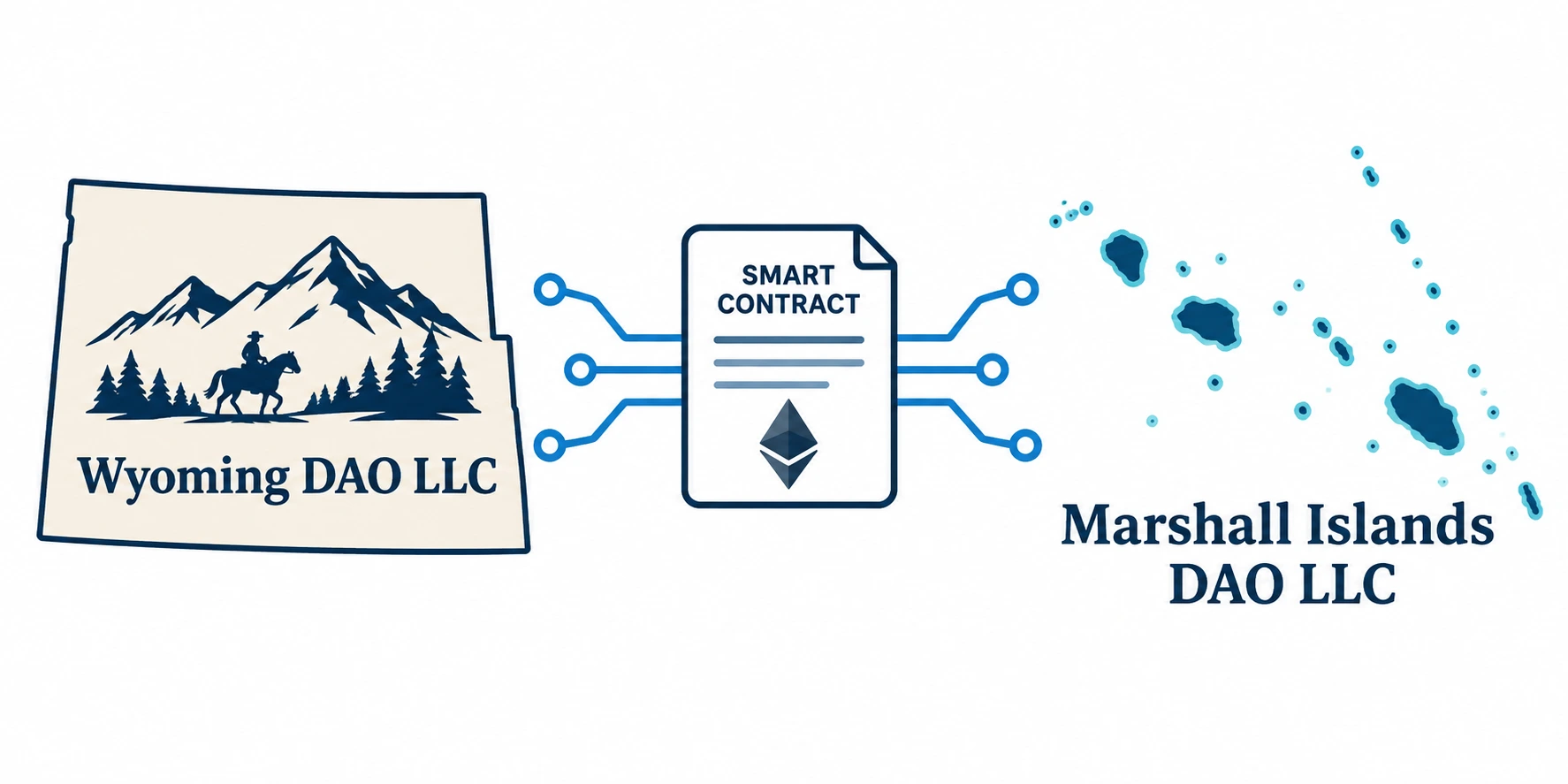
MIDAO is the exclusive registered agent for this entity type, with over 250 entities registered.
What Is a Wyoming DAO LLC?
A Wyoming DAO LLC is a standard Wyoming limited liability company that elects DAO status under the state's Decentralized Autonomous Organization Supplement, in force since July 1, 2021.
Wyoming adapted its existing LLC law rather than writing a new entity type. Smart contracts can help manage the organization, and the entity operates inside the US legal and regulatory environment.
How Wyoming Adapts Its LLC Law
Forming one involves several statutory requirements:
- The articles must state that the entity is a DAO and describe how it is managed, including how far management is algorithmic
- The articles must include a public identifier for any smart contract used to manage or operate the DAO
- The name must include "DAO," "LAO," or "DAO LLC," plus an LLC indicator
- A Wyoming registered agent is required, though founders can live anywhere
Articles, Operating Agreement, and Smart Contracts
The statute lets a smart contract serve as the DAO's operating agreement. The articles, the operating agreement, and the code therefore have to line up.
If the smart contract identifier is missing, the DAO has 30 days to supply it or it is dissolved. A 2023 amendment also requires amending the articles when the identifier changes.
US Legal Environment
A Wyoming DAO LLC is a US entity, so federal and state law apply, including securities, tax, and AML rules. The enrolled act sets out the original statutory text.
Wyoming also offers the DUNA, a separate nonprofit-only structure. Our Marshall Islands DAO LLC vs. Wyoming DUNA comparison covers it.
How Do the Marshall Islands DAO LLC and Wyoming DAO LLC Differ?
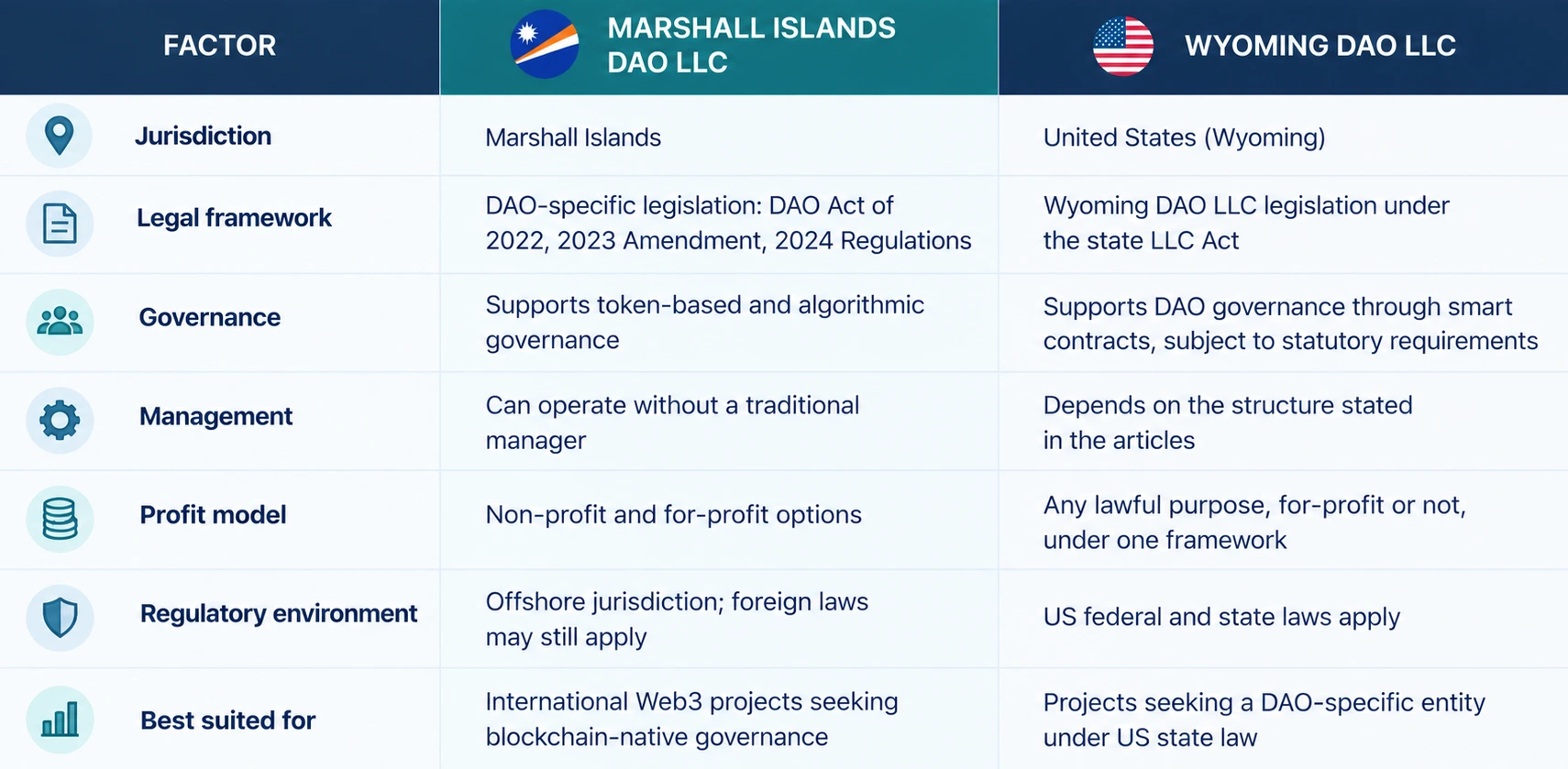
The core difference is jurisdiction and design: the Marshall Islands offers an offshore framework built around token membership and algorithmic governance, while Wyoming offers a DAO election inside US state LLC law.
How Do Governance and Smart Contract Requirements Compare?
Both connect legal authority to on-chain governance, but Wyoming does it through statutory filing requirements, while the Marshall Islands builds it into the operating agreement.
Marshall Islands DAO LLC
Membership is tracked by tokens, and the operating agreement can point to on-chain contracts as the source of authority. Algorithmic management is explicitly supported, and no human manager is required.
Corporate records can be maintained on a blockchain.
Wyoming DAO LLC
The articles must name the smart contracts and state how far management is algorithmic. Those contracts must be capable of being updated, and the articles must be amended when the identifier changes.
Wyoming also dissolves a DAO that approves no proposals and takes no actions for one year. A dormant project therefore carries a statutory risk that ordinary LLCs do not.
How Do Taxation and Profit Distribution Compare?
The Marshall Islands ties tax treatment to a choice between non-profit and for-profit models, while a Wyoming DAO LLC is taxed under the US system according to its federal classification.
For the Marshall Islands:
- Non-profit DAO LLC: no profit distributions, and 0% entity-level tax as described in MIDAO's guide
- For-profit DAO LLC: distributions permitted, with a 3% Gross Revenue Tax on qualifying revenue generated outside the Marshall Islands, excluding capital gains, dividends, and invested capital
A Wyoming DAO LLC may form for any lawful purpose, for-profit or not. Wyoming has no state income tax, but federal tax applies.
Its federal classification, revenue, ownership, and activities shape its obligations, so no two Wyoming DAO LLCs are guaranteed identical treatment. An entity with many members may also raise pass-through questions.
Neither entity's treatment decides every tax obligation. Founders, members, and international operations may still face obligations in their own jurisdictions.
Our overview of DAO tax implications explains how those questions arise.
How Does Jurisdiction Affect Securities Law and Regulatory Exposure?
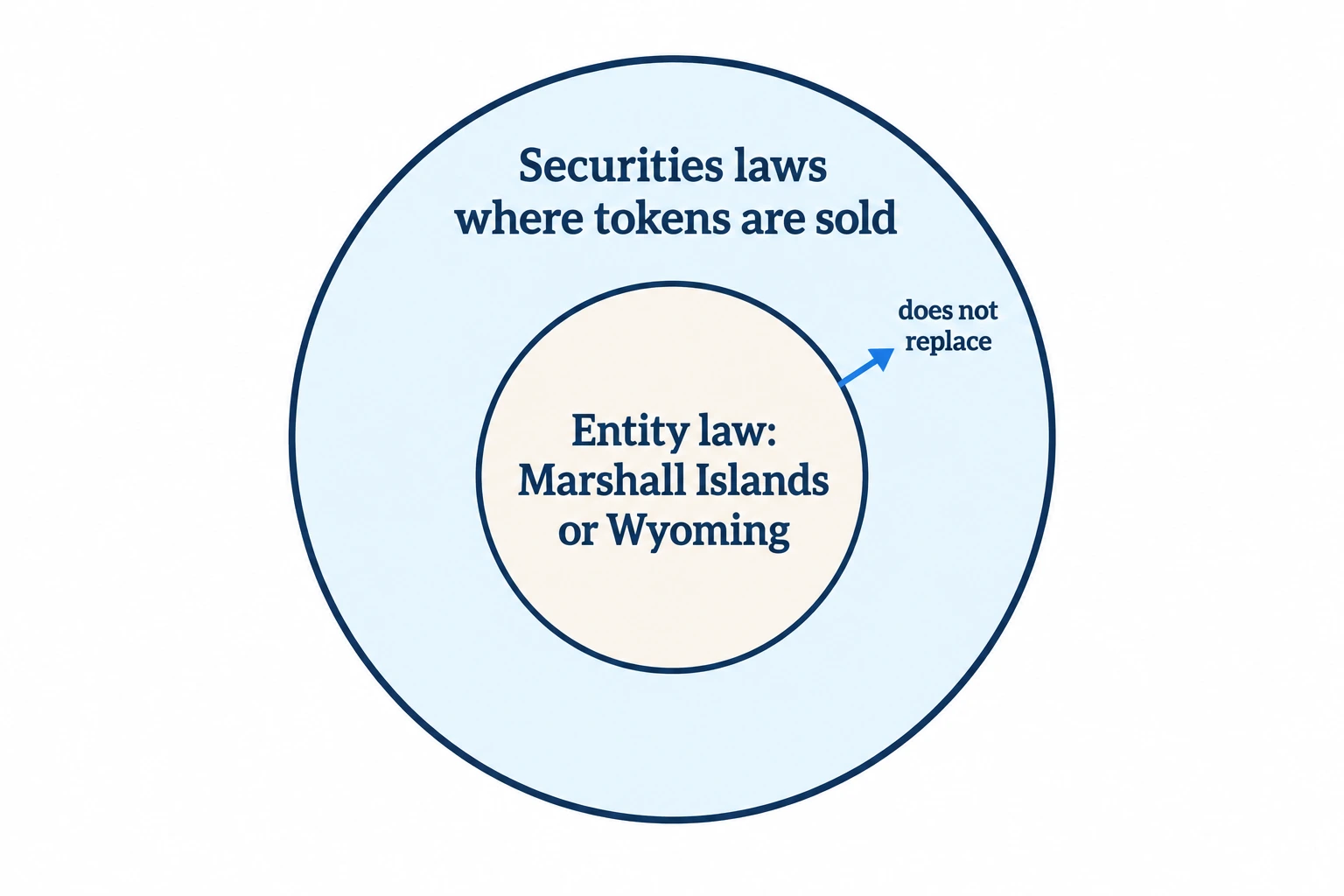
Jurisdiction shapes the starting point for token analysis, but neither structure makes a token automatically compliant.
Under the 2023 Amendment, governance tokens issued by a non-profit Marshall Islands DAO LLC that carry no economic rights are not treated as securities under RMI law. That does not exempt the token from the securities laws of other countries where it is sold.
For a Wyoming DAO LLC, US securities laws and other federal regulations remain relevant. As a US entity, it sits directly within US regulatory reach.
Our guide to token issuance and securities law explains how token design affects the analysis.
How Do Formation Costs and Maintenance Compare?
Wyoming's state fees are lower, but formation fees alone do not reflect total legal, tax, and compliance costs.
Wyoming figures below come from Secretary of State guidance and should be confirmed against the current fee schedule before filing. Marshall Islands figures come from MIDAO's incorporation materials.
| Item | Marshall Islands DAO LLC | Wyoming DAO LLC |
|---|---|---|
| Filing | Included in registration | $100 for Articles of Organization |
| Registered agent | Included in year one; renewal applies afterward | Required in Wyoming; fee varies by provider |
| Annual maintenance | Registered agent renewal and a simplified annual report | Annual report, minimum $60 |
| Typical set-up | From $9,500, under 30 days | $500 to $2,000, per MIDAO's incorporation guide |
A US entity brings US tax filings and regulatory work. An offshore entity still needs advice on tax and securities rules in the countries where members and buyers live.
Our DAO compliance requirements guide covers the wider picture.
What Should Founders Evaluate Before Choosing a Structure?
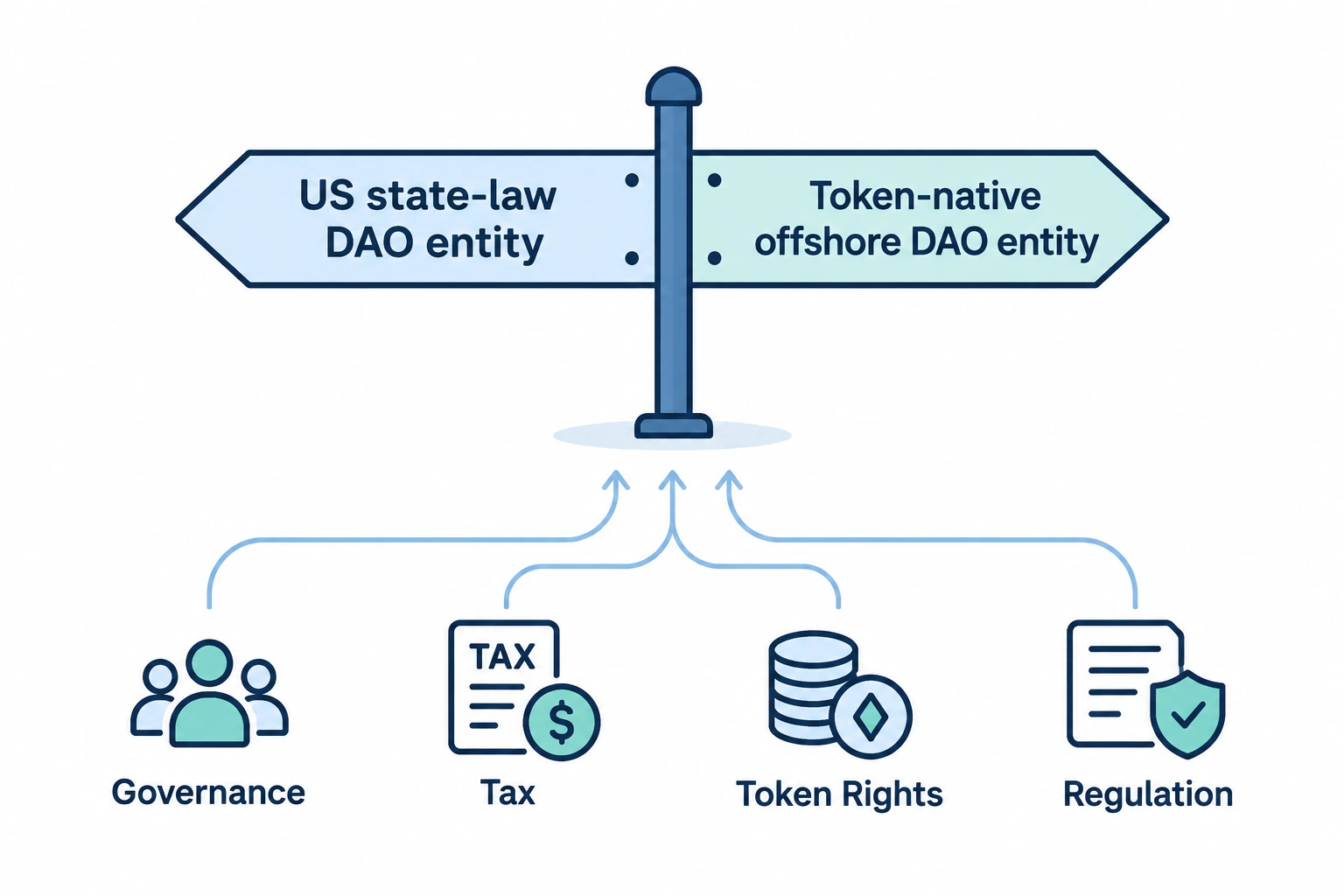
Founders should weigh four things before forming an entity:
- Governance: does the project need manager-less, algorithmic governance, or statutory smart contract requirements it can meet?
- Tax treatment: will the organization distribute profits, and where do members pay tax?
- Token rights: does the token carry economic rights, or governance rights only?
- Regulatory exposure: is a US legal home an advantage for your plans, or an added burden?
A US Home or a Sovereign One: Choosing Where Your DAO Lives
Wyoming offers a DAO-specific structure under US state law, while the Marshall Islands offers a framework designed for token-based membership and algorithmic governance, with non-profit and for-profit options.
Neither choice is automatically better. The right one follows your governance model, tax position, token design, and exposure to US regulators.
MIDAO helps projects explore Marshall Islands DAO LLC formation, from structure choices to registration and ongoing registered agent support.
Our ranked guide to the best crypto-friendly jurisdictions in 2026 offers a broader comparison before you decide.
Ready to explore a Marshall Islands DAO LLC for your project?
Start your registration with MIDAO and get your entity in place in under 30 days.
Frequently Asked Questions
Can a Wyoming DAO LLC later move its legal domicile to the Marshall Islands?
Generally, this means forming a new Marshall Islands DAO LLC and transferring assets, IP, and contracts from the Wyoming entity. Wyoming's own guidance says it does not register out-of-state DAOs, so the move cannot run in reverse. Have counsel review the tax and legal effects of the transfer first.
Can US residents participate in a Marshall Islands DAO LLC?
The framework has no residency requirement for members. US residents remain subject to US tax, securities, and sanctions rules, though, so participating through an offshore entity does not remove those obligations. Get US counsel before participating.
How are disputes involving DAO members resolved under each jurisdiction's laws?
In both, disputes are generally resolved under the governing documents and the applicable law. A Wyoming DAO LLC follows Wyoming LLC law, while Marshall Islands law is based on Delaware's LLC Act, so Delaware precedent can offer guidance. Either way, the agreements should set voting rules and a dispute resolution method such as arbitration or mediation.
Can a Wyoming DAO LLC own assets or intellectual property outside the United States?
As a legal entity, it can generally own property and IP, but recognition and enforcement abroad depend on local law. Trademarks, for example, are typically registered country by country. US tax and reporting obligations may also apply to foreign holdings.
What happens if a DAO's smart contracts become incompatible with its legal operating agreement?
The gap creates legal uncertainty, so the documents should be amended promptly. Wyoming requires the articles to be updated when the contract identifier changes, and legal commentary suggests the smart contract may control in a conflict. In the Marshall Islands, the operating agreement can reference on-chain contracts directly, which helps keep the two aligned.