
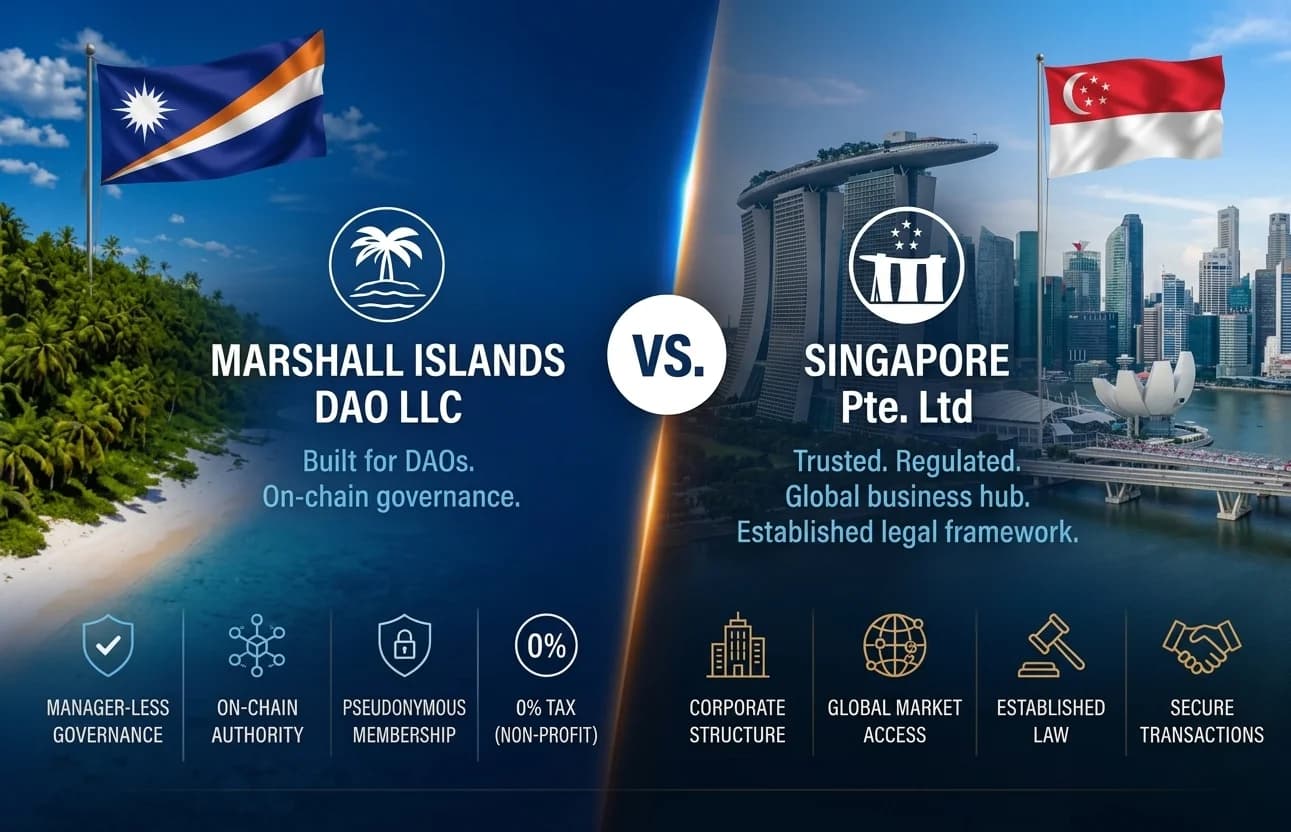
Marshall Islands DAO LLC vs. Singapore Pte. Ltd.: Key Differences
A side-by-side look at the Marshall Islands DAO LLC and Singapore Pte. Ltd., highlighting differences in governance, ownership, taxation, token compatibility, and the types of Web3 projects each structure is designed to support.
Singapore became Asia's most prominent crypto hub, with the Monetary Authority of Singapore licensing over 30 digital payment token service providers by end of 2024, a regulatory milestone that signaled serious institutional commitment to the sector.
That credibility makes Singapore a natural first instinct for Web3 founders in Asia. But a Singapore Pte. Ltd. is a general-purpose private limited company. It was built for businesses with shareholders, directors, and centralized management. It was not built for token-based membership, community governance, or decentralized decision-making.
This article compares the Marshall Islands DAO LLC and the Singapore Pte. Ltd. across governance, ownership, tax, and token compatibility, so founders can choose the structure that matches how their project actually works.
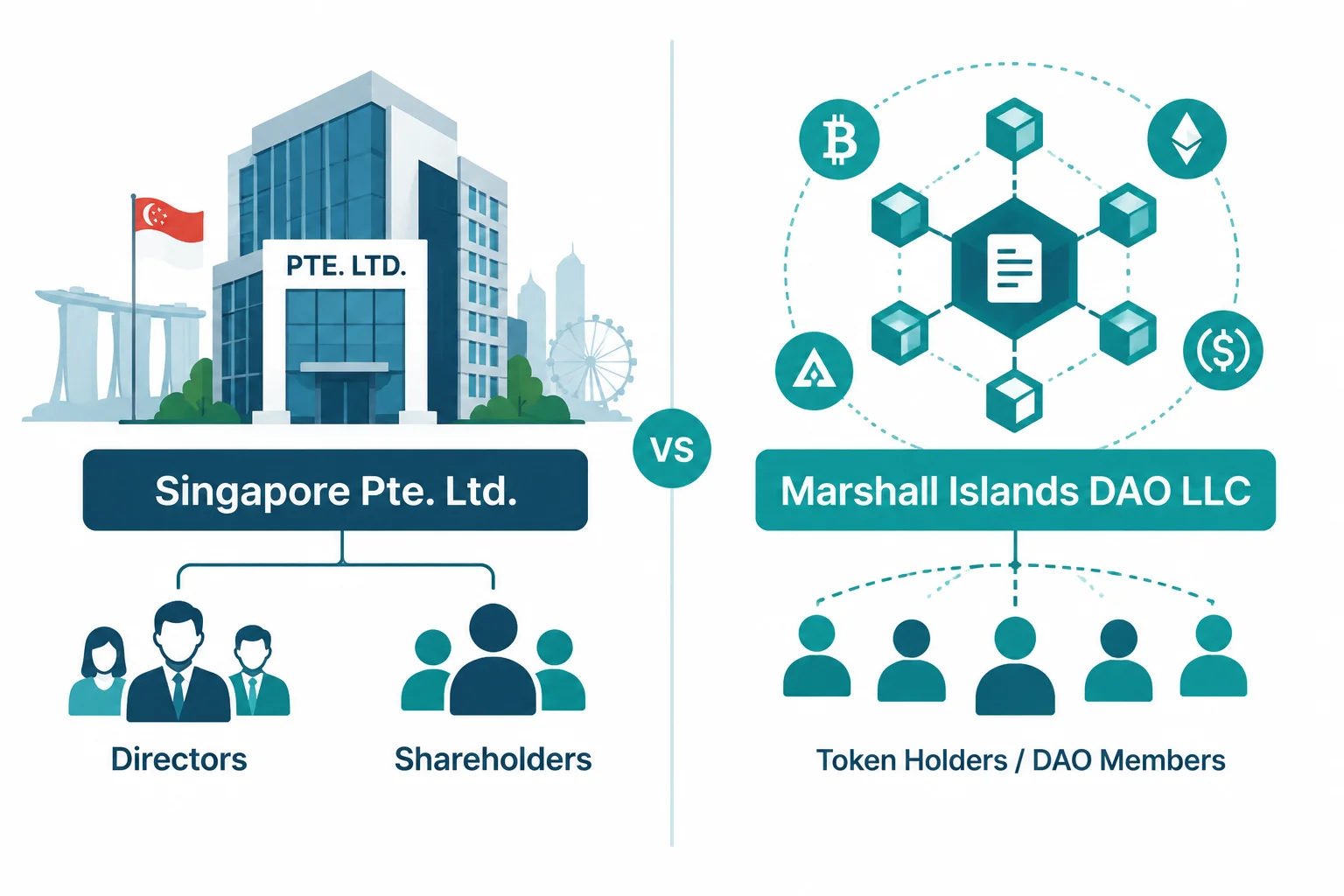
What Is a Marshall Islands DAO LLC?
The Marshall Islands DAO LLC is a legal entity built from the ground up for decentralized organizations.
The Republic of the Marshall Islands enacted the DAO Act of 2022, creating a new class of LLC designed around how token-based organizations actually operate: token membership, on-chain governance, algorithmic management, and no required human directors. It has since been refined by a 2023 Amendment and 2024 Regulations.
Key Features of the RMI DAO LLC
- Legal personhood and limited liability: The entity can own assets, sign contracts, and absorb legal claims without exposing its members personally
- Token-based membership: Members are tracked by token holdings, not named registries. Most participants provide no personal information
- Manager-less operation: Smart contracts and token voting can serve as the legal governance authority with no human directors required
- Non-profit and for-profit variants: Non-profit DAOs pay zero entity-level tax. For-profit DAOs pay a 3% Gross Revenue Tax on qualifying revenue outside the Marshall Islands
- Securities carve-out: Non-profit governance tokens with no economic rights are explicitly not securities under RMI statute
MIDAO operates the exclusive government-authorized registration program for RMI DAO LLCs, with over 250 entities registered, including Pyth Network, MoonDAO, and ApeCoin Governance DAO.
What Is a Singapore Pte. Ltd. Company?
A Singapore Private Limited Company, or Pte. Ltd., is one of the most commonly used corporate structures in Asia for technology and international businesses.
It is a private limited company under the Singapore Companies Act, with separate legal personality, shareholder ownership, and director-based management. Formation is fast and inexpensive, registration typically costs $1,500 to $3,000, and Singapore's legal system, English Common Law applied by highly competent courts, is one of the strongest in Asia.
Why Singapore Attracts Web3 Companies
- Financial infrastructure: Singapore hosts hundreds of global banks, asset managers, and financial institutions with sophisticated crypto capabilities
- Regulatory clarity: The Monetary Authority of Singapore has developed one of Asia's most comprehensive digital asset licensing frameworks
- International reputation: A Singapore entity is recognized by counterparties globally and signals institutional credibility
- Access to APAC markets: Singapore's position as a regional hub gives companies strong access to Southeast Asian, East Asian, and global investor networks
- Talent and ecosystem: Singapore has one of Asia's densest concentrations of fintech and blockchain talent
The limitation for decentralized projects is structural. Singapore Pte. Ltd. has no DAO-specific framework. Governance runs through directors and shareholders, not token holders or smart contracts. Token-based governance requires contractual workarounds that do not integrate cleanly with the entity's legal structure.
How Do the Two Structures Compare?
The table below maps the main differences across the factors that matter most for Web3 projects.
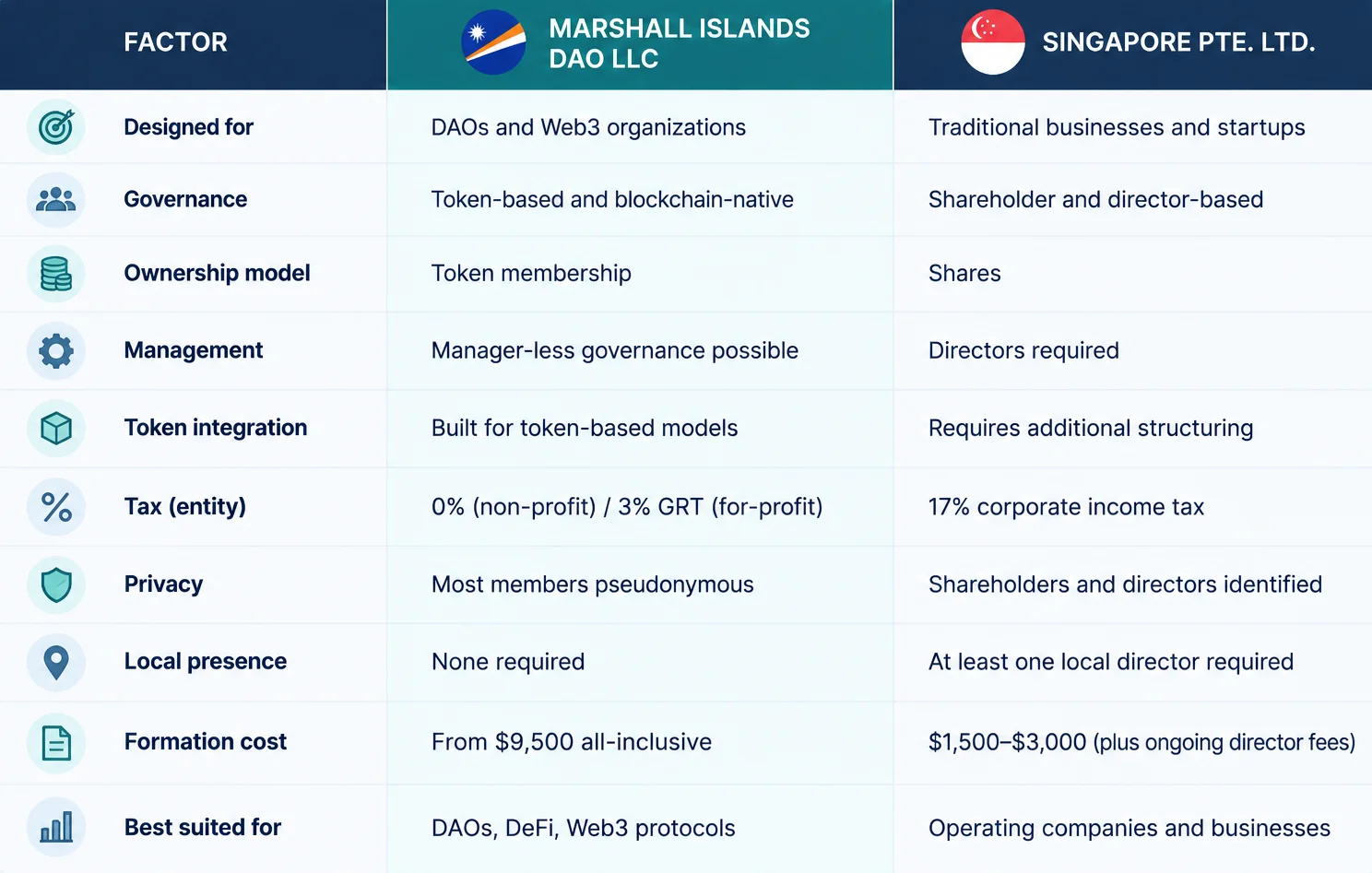
How Does Governance Differ Between the Two Structures?
Governance is the most consequential structural difference between the two entities.
Marshall Islands DAO LLC Governance
The RMI DAO LLC was built to make on-chain governance legally valid. The operating agreement can reference smart contracts directly, so token holder votes carry formal legal authority without a separate board vote to ratify them.
The structure supports every major governance model:
- Token voting: Community decisions weighted by governance token balance
- Multisig execution: Threshold-based approvals for treasury and protocol decisions
- Algorithmic management: Smart contracts serve as the operative governance layer with no human override required
- Hybrid models: Combinations of on-chain votes with defined human escalation paths
No directors, managers, or officers are required. The community governs, and the legal structure follows.
Singapore Pte. Ltd. Governance
A Singapore Pte. Ltd. is governed by its shareholders (who hold equity) and its directors (who manage operations). Decisions are made through board resolutions and shareholder votes, not token votes or smart contracts.
This structure works well for centralized companies. It does not map naturally to decentralized governance. Projects that want token holders to control protocol decisions would need to layer contractual arrangements on top of the corporate structure to approximate community governance, and those arrangements do not carry the same legal clarity as a purpose-built DAO entity.
At least one director must be a Singapore resident, adding a mandatory local presence requirement.
How Does Ownership Work in Each Structure?
Marshall Islands DAO LLC Ownership
The RMI DAO LLC uses token-based membership rather than equity shares. Governance token holders are recognized as members without needing to provide personal information, except for beneficial owners holding 25% or more of governance rights.
This model suits:
- Decentralized protocol communities where ownership is distributed across thousands of token holders
- Governance ecosystems where participation is earned through tokens rather than purchased through share subscriptions
- Projects where pseudonymous participation is important for community design
Singapore Pte. Ltd. Ownership
A Singapore Pte. Ltd. is owned by shareholders who hold equity. Shareholders must be identified, and share transfers follow formal corporate procedures.
This creates challenges for projects where token ownership and equity ownership are meant to represent the same economic or governance interest. Token holders are not shareholders by default. Making token holders shareholders would require each one to go through formal share issuance and transfer processes, and potentially trigger securities law obligations for the share issuance itself.
For a deeper look at how token ownership intersects with legal structure, see our guide on token issuance and how to stay compliant with crypto securities law.
How Do the Two Structures Handle Tax?
Marshall Islands DAO LLC Tax Treatment
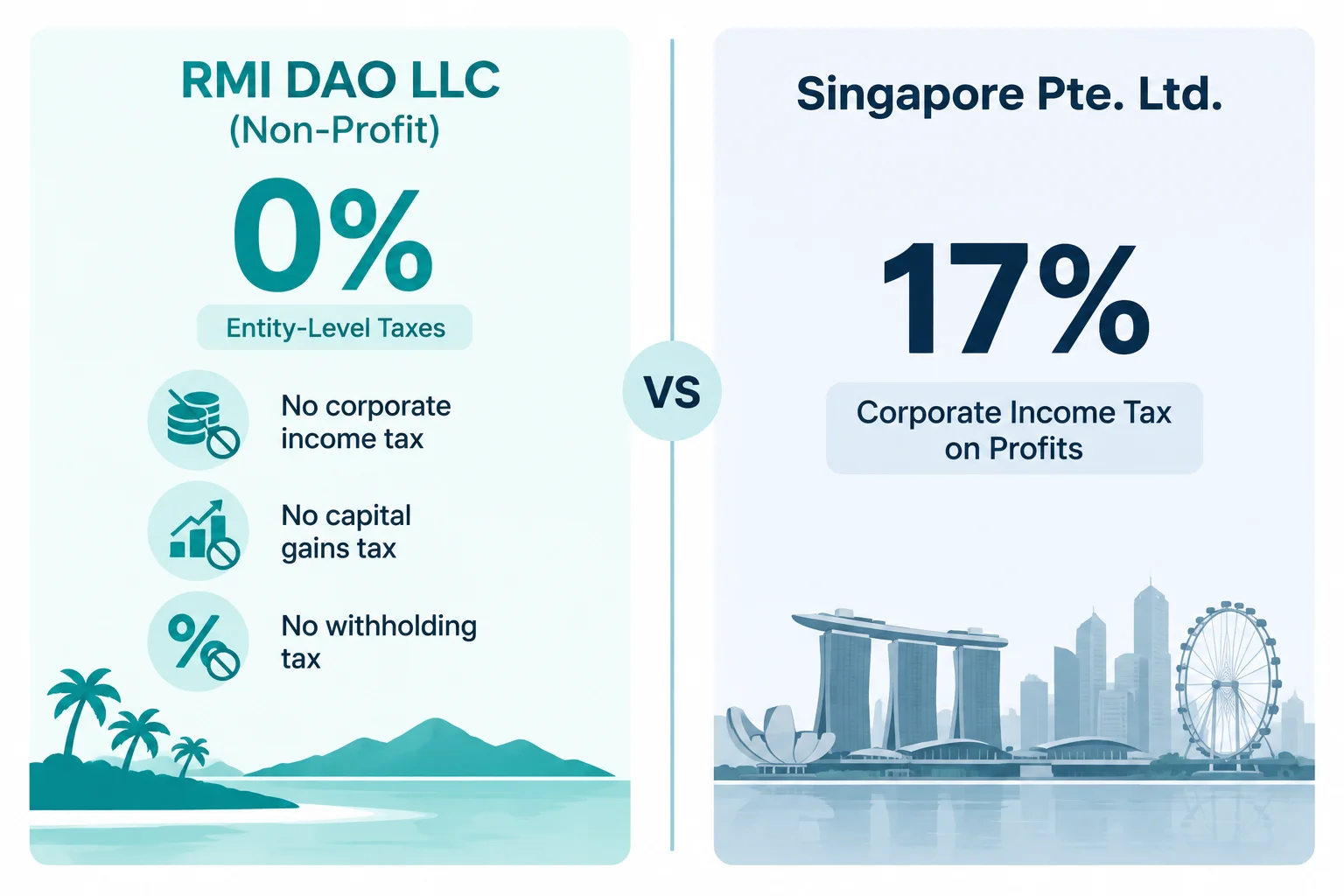
Non-profit RMI DAO LLCs pay zero corporate income tax, zero capital gains tax, and zero withholding tax. There are no mandatory annual tax filings at the entity level in the Marshall Islands.
For-profit DAO LLCs pay a 3% Gross Revenue Tax on revenue generated outside the Marshall Islands. Capital gains, dividends, and invested capital are excluded from this calculation.
The Marshall Islands is a sovereign jurisdiction not subject to US federal tax law. The entity does not create US tax nexus simply by existing, which matters significantly for globally distributed projects.
Singapore Pte. Ltd. Tax Treatment
Singapore imposes a corporate income tax of 17% on company profits. Singapore does offer partial tax exemptions for qualifying startups during their first three years of operation, and certain tax incentive schemes apply depending on the company's activities and structure.
Singapore's tax framework is transparent and well-administered. For a traditional operating company generating business profits, 17% is competitive by global standards. For a community-governed protocol accumulating treasury assets without distributing profits, it is a significant overhead compared to the non-profit DAO LLC structure.
Our DAO tax guide covering non-profit vs. for-profit structures provides a full breakdown of how these choices affect tax treatment.
How Do the Two Structures Handle Token Issuance and Securities Questions?
Marshall Islands DAO LLC Token Approach
The RMI DAO LLC is designed around token-based organizations. Non-profit governance tokens with no economic rights are explicitly not treated as securities under RMI statute, under the 2023 Amendment to the DAO Act. This statutory carve-out is the strongest available protection of this kind in any purpose-built DAO jurisdiction.
For-profit structures where tokens carry economic rights require separate securities law analysis for each target jurisdiction, as with any other structure.
Singapore Pte. Ltd. Token Approach
Singapore's MAS applies a substance-over-form analysis to digital tokens. Tokens may be classified as capital markets products (including securities) depending on their characteristics, regardless of what they are called.
A Singapore Pte. Ltd. by itself does not resolve token classification questions. Projects issuing tokens from a Singapore entity must conduct their own regulatory analysis under MAS frameworks, potentially requiring licensing, disclosure, or offering restrictions.
Singapore does have a relatively clear licensing framework for digital payment token services, but that clarity applies to service providers, not to governance token issuance by a community-governed protocol.
Which Structure Fits Which Project?
The choice between these two structures is not primarily about jurisdiction preference. It is about how the project actually governs itself.
The Marshall Islands DAO LLC fits better when:
- Governance runs through token voting and smart contracts
- Community members participate pseudonymously and expect privacy
- The project is a non-profit protocol or ecosystem DAO with no member distributions
- Tax neutrality and minimal annual compliance overhead are priorities
- The team is globally distributed with no APAC-specific market focus
The Singapore Pte. Ltd. fits better when:
- The project is a software company or service provider building in the Web3 space
- The team needs local Singapore presence, APAC banking relationships, or MAS licensing
- Traditional investors, venture capital, or equity-based fundraising is part of the plan
- The entity will employ staff under Singapore employment law
- The project operates like a business rather than a decentralized network
For projects that need both, the most common pattern is a hybrid: an RMI DAO LLC as the governance and treasury layer, with a Singapore Pte. Ltd. or Delaware C-Corp as the operating company.
Our step-by-step guide to incorporating a token project in 2026 walks through how to sequence these decisions before launch.
Structure Follows Governance: Choosing the Right Foundation
Singapore Pte. Ltd. is a strong choice for Web3 software companies, blockchain service providers, and technology startups that operate conventionally and need APAC credibility.
Marshall Islands DAO LLC is the purpose-built answer for projects where token membership, community governance, and decentralized decision-making are not just features but the operating model.
The fundamental question is simple: does the project function more like a company or a decentralized network? The right legal structure is the one that matches the answer. Forcing a decentralized network into a corporate entity creates legal friction that compounds as the project grows. Building on a purpose-fit foundation lets the project scale without restructuring under pressure.
For Web3 projects built around tokens, community governance, and decentralized operations, the RMI DAO LLC provides the legal foundation designed for exactly this use case.
See our complete guide to the best crypto-friendly jurisdictions in 2026 for a broader comparison across all major options.
Ready to incorporate your DAO or Web3 protocol in the Marshall Islands? Start your RMI DAO LLC registration with MIDAO, the only government-authorized program for Marshall Islands DAO LLCs, and get your entity in place in under 30 days.
Frequently Asked Questions
Can a Marshall Islands DAO LLC have traditional employees and contractors?
Yes. A non-profit RMI DAO LLC can pay contributors, contractors, and service providers from its treasury. The distinction between a non-profit and for-profit DAO LLC relates to profit distribution to members, not to the entity's ability to compensate the people doing work for it. Many projects combine an RMI DAO LLC as the governance and treasury entity with a separate operating company that formally employs the core team.
Can a project migrate from a Singapore Pte. Ltd. to a DAO LLC later?
Migration is possible but more complex than incorporating correctly at formation. The process involves forming a new RMI DAO LLC and transferring assets, intellectual property, and contractual relationships from the Singapore entity. Contracts may need to be renegotiated to name the new entity as counterparty. The earlier a project addresses structure, the simpler and less expensive the transition.
Does a DAO LLC eliminate the need for legal compliance?
No. Incorporating as an RMI DAO LLC satisfies entity-level compliance requirements in the Marshall Islands, including KYC for beneficial owners, annual filings, and AML/CTF obligations. It does not eliminate legal obligations that arise from the project's activities in other jurisdictions. Token issuance may trigger securities law obligations for participants in target markets. Revenue generation may create tax obligations for members in their home countries. A DAO LLC is a legal foundation, not a compliance shortcut.