
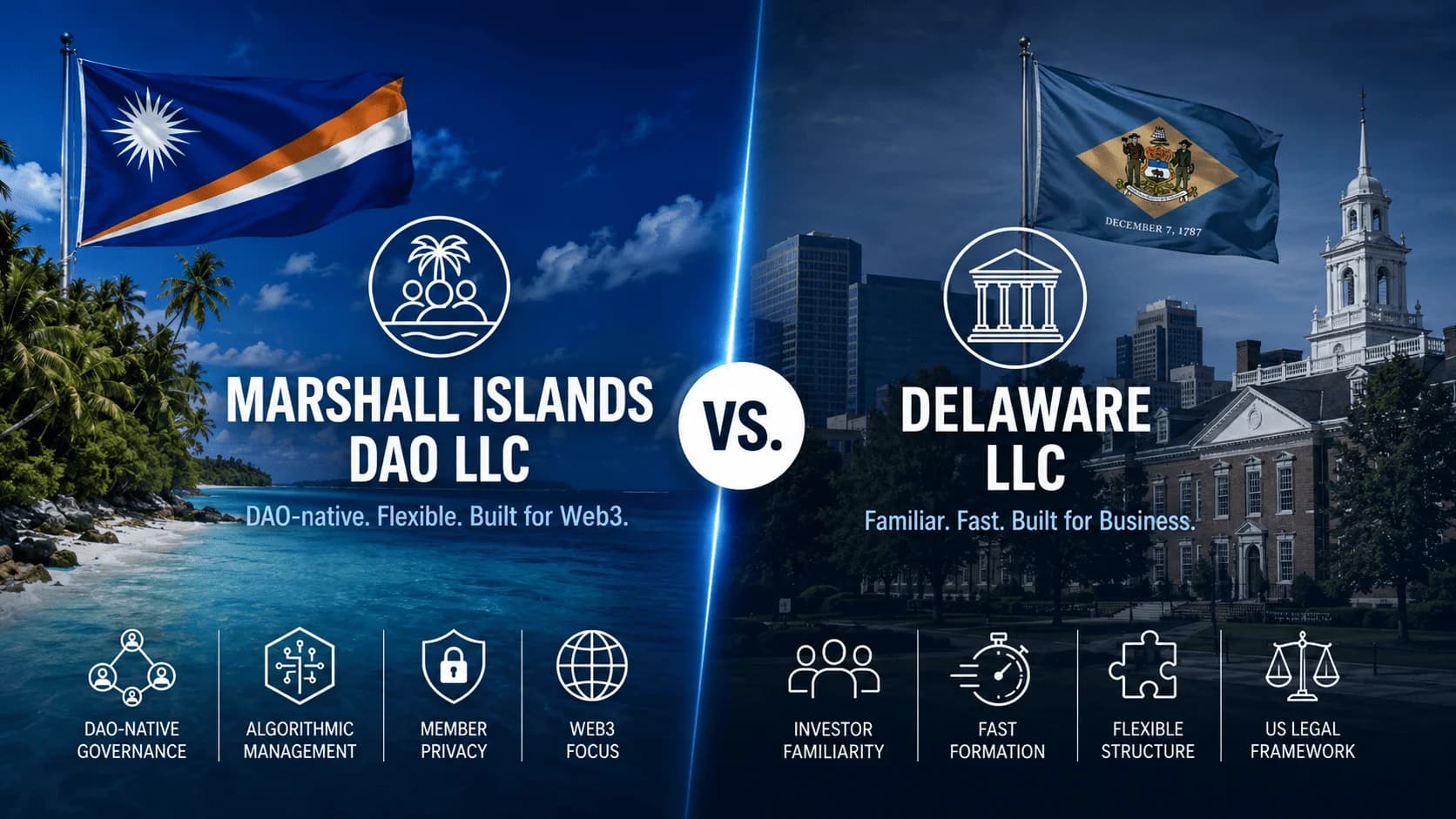
Marshall Islands DAO LLC vs. Delaware LLC: Complete Comparison
A comparison of the Marshall Islands DAO LLC and Delaware LLC, explaining how the two legal structures differ in governance models, smart contract support, tax treatment, privacy, formation costs, and suitability for Web3 projects, tokenized organizations, and traditional businesses.
The 2024 Annual Report from the Delaware Division of Corporations shows that 81.4% of all US-based IPOs in 2024 chose Delaware as their corporate home, and more than 2.1 million active business entities are registered there today. Delaware is, by every measure, the global standard for traditional business incorporation.
Key takeaways
- The Marshall Islands DAO LLC is the first DAO-specific legal entity adopted by a sovereign nation, created under the DAO Act of 2022.
- Marshall Islands DAO LLC statute explicitly authorizes manager-less, algorithmic governance, letting smart contracts serve as the sole governance mechanism.
- On the tax side, a non-profit RMI DAO LLC carries no corporate income, capital gains, or withholding taxes and has no annual tax-return requirement.
- Delaware's LLC framework was built for named members and identified managers, with no statutory concept of algorithmic management or on-chain governance authority.
- Under the RMI framework, only beneficial owners holding 25% or more of governance rights must provide KYC information.
But traditional is the key word. Delaware's LLC framework was built for businesses with named members, identified managers, and human decision-makers. It was not built for token-based membership, algorithmic governance, or pseudonymous communities making collective decisions on-chain. Most Web3 founders reach for the Delaware LLC out of habit, then discover they are trying to run a DAO inside an entity designed for a startup.
That is where the Marshall Islands DAO LLC enters the picture. Both are LLCs. Both provide limited liability and corporate personhood. But they are built around entirely different operating models, and choosing the wrong one creates legal friction that compounds over time. This article breaks down exactly how the two structures compare.
What Is a Marshall Islands DAO LLC?
The Marshall Islands DAO LLC is the first DAO-specific legal entity adopted by a sovereign nation. The Republic of the Marshall Islands enacted the DAO Act of 2022, creating a new class of LLC designed from scratch around how DAOs actually work: token-based membership, on-chain governance, algorithmic management, and no required human directors.
The structure has been refined through the DAO Act Amendment of 2023 (clear securities law treatment for non-profit governance tokens) and the DAO Regulations of 2024 (clarifying KYC thresholds and on-chain compliance standards). 300+ DAOs and web3 projects have signed up, including Pyth Network, MoonDAO, ApeCoin Governance DAO, GMX, MetaDAO, and Gnosis Guild.
If you are evaluating whether your project needs this kind of structure at all, our guide on why unincorporated DAOs are legally exposed to personal liability explains what is at stake without a legal wrapper.
Key Features of a Marshall Islands DAO LLC
- Token-based membership: General members are tracked by token holdings, not names and addresses. Most participants provide no personal information.
- Manager-less operation: Algorithmic governance is explicitly authorized by statute. Smart contracts can serve as the sole governance mechanism.
- Flexible operating agreements: Agreements can reference on-chain governance contracts directly, giving token votes formal legal authority.
- Limited liability for all members: The entity absorbs obligations; member assets are protected.
- Tax-neutral for non-profits: Zero corporate income tax, capital gains tax, or withholding tax. No mandatory annual filings for non-profit structures.
- Securities law carve-out: Non-profit governance tokens with no economic rights are explicitly not treated as securities under RMI law.
MIDAO operates as the exclusive public-private partner with the RMI government for DAO LLC registration, the only channel through which these entities can be formed.
What Is a Delaware LLC?
The Delaware LLC is the most widely used general-purpose business entity in the United States, offering flexible management structures, decades of case law, and near-universal familiarity among investors, lawyers, and financial institutions.
Delaware's LLC framework is governed by the Delaware Limited Liability Company Act, which allows for highly customizable operating agreements. It does not prescribe a single governance model, which gives founders significant flexibility. That flexibility has its limits: the framework was designed for businesses with identifiable human members and managers, not for decentralized, pseudonymous, algorithmically governed communities.
Key Features of a Delaware LLC
- Extensive case law: Delaware's Court of Chancery has produced the most comprehensive body of US corporate law. Disputes have clear precedent.
- Investor familiarity: Venture capital, institutional investors, and US financial institutions expect Delaware entities. It is the default for raising a traditional funding round.
- Flexible management: Member-managed or manager-managed structures can be tailored through the operating agreement.
- Full US regulatory jurisdiction: The SEC, CFTC, IRS, and FinCEN all have authority over Delaware entities, which is either a feature or a constraint depending on the project.
- Low formation cost: Filing fees start at $110, making it one of the cheapest entities to form anywhere.
Delaware is excellent as the operating company layer in a hybrid structure, specifically paired with an RMI DAO LLC governance layer. As a standalone structure for a decentralized protocol, it carries significant limitations.
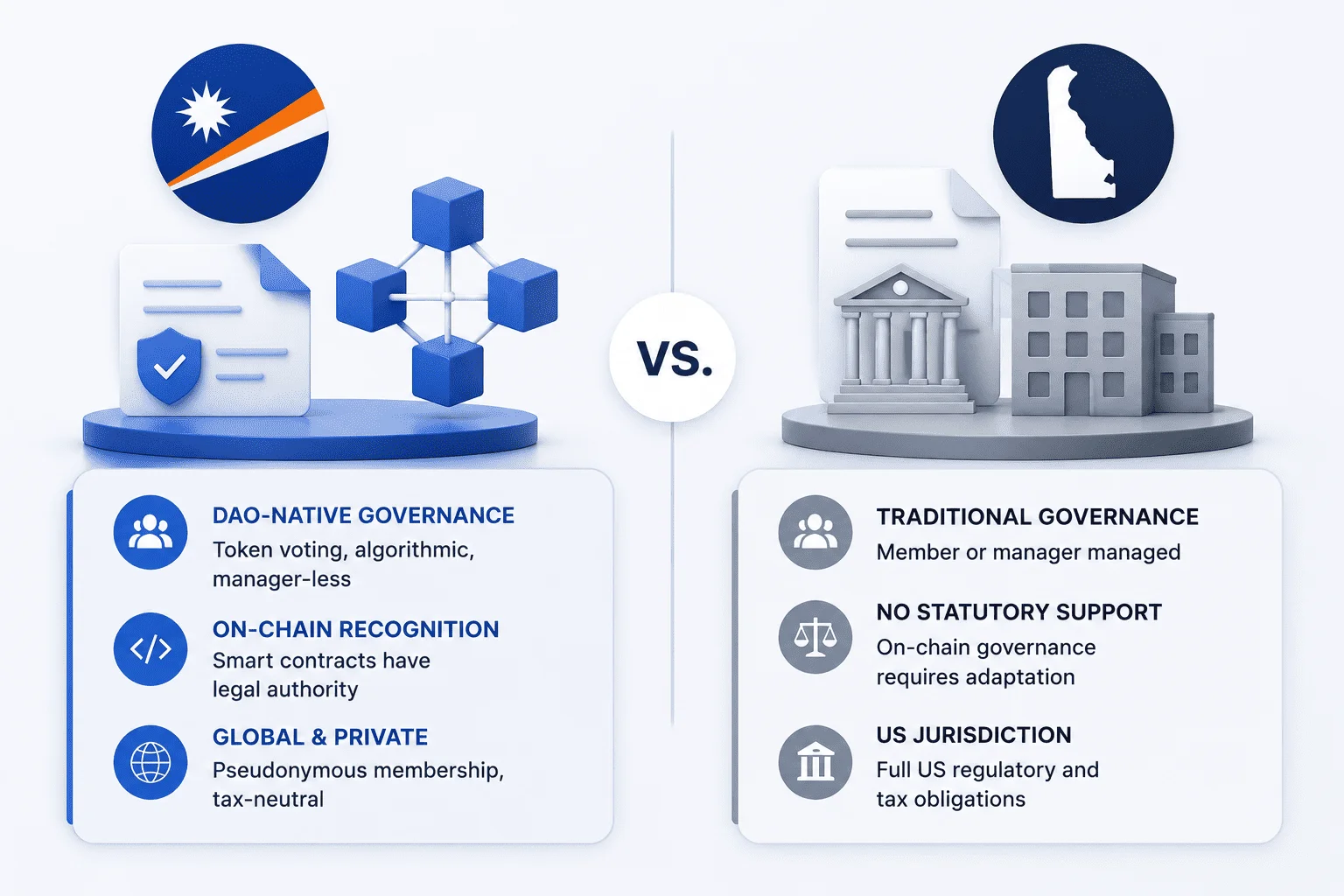
What Are the Key Differences Between a DAO LLC and a Delaware LLC?
The two structures share the LLC label and the core benefit of limited liability. Every other significant feature diverges. The right choice depends entirely on how the project actually governs itself.
Legal Framework Designed for DAOs vs. General Business Use
The Marshall Islands DAO LLC was designed for decentralized organizations from day one. The Delaware LLC was designed as a general-purpose business entity and has never been updated for DAO-specific use.
This distinction shows up immediately in documentation. A Delaware LLC operating agreement must name members, describe management authority, and specify how decisions are made by identifiable humans. An RMI DAO LLC operating agreement can simply point to an on-chain governance contract, letting the smart contract carry the legal authority. One structure matches how a DAO actually runs. The other requires significant adaptation to approximate it.
Governance and Decision-Making Structure
The Marshall Islands DAO LLC supports decentralized governance natively. Token voting, multisig execution, algorithmic management, and hybrid governance models are all explicitly supported in statute. No human manager or director is required. The community governs through whatever on-chain mechanism the operating agreement references.
The Delaware LLC defaults to member-managed or manager-managed governance, where named individuals carry legal authority over the entity's decisions. There is no statutory concept of algorithmic management, no native support for governance tokens, and no mechanism for on-chain votes to carry legal authority without additional contractual arrangements layered on top.
Attempting to run DAO governance through a Delaware LLC is possible, but it requires workarounds that create gaps between what the community does on-chain and what is legally enforceable off-chain.
For founders who are new to this space, our article on what a crypto legal wrapper is and why your project needs one explains the role of the entity layer in plain terms.
Smart Contracts and Algorithmic Operations
Under RMI law, corporate governance records and accounting can be maintained exclusively on a blockchain. An on-chain token vote constitutes a valid governance action of the legal entity. Smart contract execution is the authorization mechanism. That is not a legal interpretation; it is written into the statute.
Delaware LLC law has no equivalent provision. A Delaware LLC can transact using blockchain technology, hold crypto assets, and interact with smart contracts. But the smart contract is not the legal authority. The manager or members named in the operating agreement are. Any on-chain action still needs a human to be the legally responsible party behind it.
Liability Protection and Legal Recognition
Both structures provide the same core protection: limited liability for members, corporate personhood enabling the entity to own assets and sign contracts, and legal standing to appear in court.
The difference is in who faces disclosure obligations. Under the RMI framework, only beneficial owners holding 25% or more of governance rights must provide KYC information. General token holders provide nothing. Under Delaware LLC law, members are named in the operating agreement, and beneficial ownership reporting requirements under US law can require additional disclosure.
Both entities can hold intellectual property, crypto wallets, real-world assets, and enter into commercial agreements. For globally distributed communities, the RMI structure offers substantially more privacy without compromising legal recognition.
Tax Treatment and International Operations
The Marshall Islands is a sovereign nation not subject to US federal tax law. Non-profit RMI DAO LLCs pay zero corporate income tax, capital gains tax, or withholding tax, and have no mandatory annual tax filings. For-profit DAO LLCs pay a 3% Gross Revenue Tax on top-line revenue from products or services; it does not apply to capital gains, dividends, or invested capital.
Delaware LLCs are US entities fully subject to federal tax law, including IRS reporting requirements and applicable federal rates. For internationally distributed teams and token projects, this creates tax complexity for every participant. Unincorporated DAOs that fail to file can expose individual members to personal tax liability in their own jurisdictions.
Our DAO compliance requirements guide covers the full range of filing obligations founders need to understand before choosing a structure.
Investor and Partner Recognition
Delaware's track record with traditional investors is unmatched. 66.7% of Fortune 500 companies are incorporated in Delaware. Venture capital firms, institutional investors, and most US-based financial institutions expect a Delaware entity before engaging. For projects raising a traditional VC round, a Delaware C-Corp (not an LLC) remains the standard.
The Marshall Islands DAO LLC is the recognized standard for crypto-native governance. It is the structure Pyth Network, ApeCoin Governance, and dozens of serious DeFi protocols chose for their governance layers. Its Web3 recognition is growing rapidly. For projects whose investors are token holders rather than VC firms, the RMI structure is better aligned with how the community actually participates.
How Do the Two Structures Compare Side by Side?
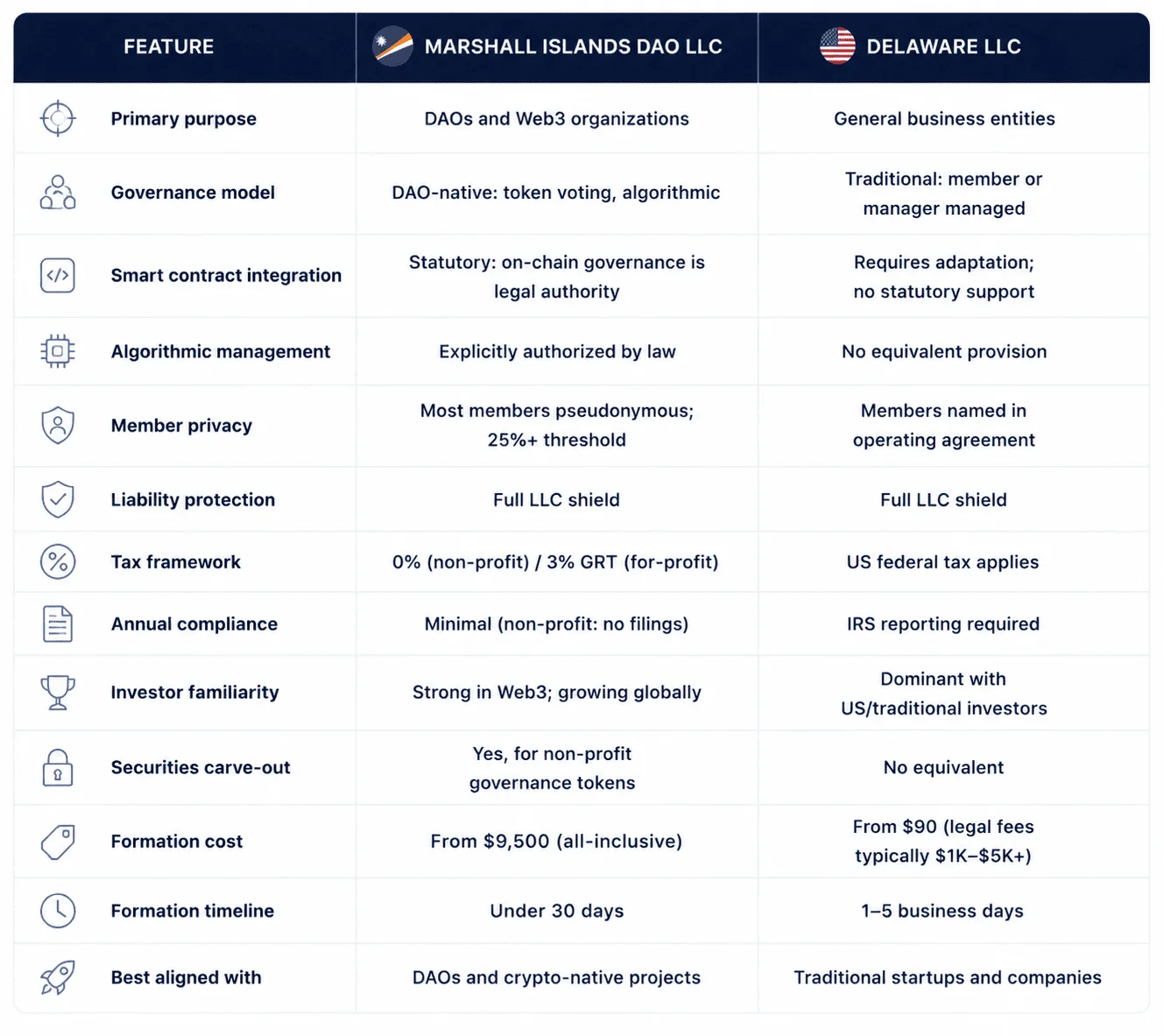
Which Structure Is Right for Your Project?
The Marshall Islands DAO LLC and the Delaware LLC are not competing alternatives for the same type of project. They are purpose-built for different operating models, and most serious Web3 projects that scale end up using both.
The most common structure MIDAO helps set up is a hybrid: a non-profit RMI DAO LLC as the governance layer, holding the treasury and intellectual property, paired with a Delaware C-Corp as the operating company for VC fundraising, team employment, and commercial contracts. Each entity does what it is best suited for.
Learn more about how hybrid DAO structures combine on-chain governance with US operating companies.
Choose the Marshall Islands DAO LLC when:
- Governance runs through token voting or smart contracts
- The community is globally distributed and pseudonymous membership matters
- Tax neutrality and minimal compliance overhead are priorities
- The non-profit securities carve-out for governance tokens is strategically valuable
Choose the Delaware LLC (or C-Corp) when:
- The project is raising a traditional VC round requiring equity issuance
- The core team needs employment agreements under US law
- Exchange contracts and institutional service agreements require a US counterparty
- The project operates primarily within the US market
Marshall Islands DAO LLC vs. Delaware LLC: Final Verdict
The single most important insight from this comparison: both are LLCs, but they are designed around fundamentally different assumptions about who governs and how.
Delaware assumes human managers making decisions documented in written agreements. The Marshall Islands DAO LLC assumes token holders voting on-chain, with smart contracts as the operative authority. Forcing a DAO into a Delaware LLC means either accepting the governance mismatch or building elaborate contractual workarounds that create gaps between on-chain reality and legal enforceability.
For crypto-native projects with decentralized governance, the RMI DAO LLC is not a substitute for the Delaware LLC. It is the structure that Delaware does not offer.
Ready to incorporate your DAO with the right structure? Start your Marshall Islands DAO LLC registration with MIDAO, the only government-authorized program for RMI DAO LLC formation, and get your entity registered in under 30 days.
Frequently Asked Questions
Can a Delaware LLC be converted into a DAO LLC structure later?
A Delaware LLC cannot be directly converted into a Marshall Islands DAO LLC, as they are entities in different sovereign jurisdictions. The typical migration path is to form a new RMI DAO LLC and transfer assets, intellectual property, and contractual relationships from the Delaware entity to the new structure. This process is manageable but adds cost and complexity, which is why choosing the right structure at formation is significantly cheaper than restructuring after the fact.
Can a Marshall Islands DAO LLC hold intellectual property and digital assets?
Yes. The RMI DAO LLC can hold trademarks, copyrights, and other IP rights, own crypto wallets as named assets of the entity, hold real-world assets, and enter into licensing agreements. Many protocols, including those registered through MIDAO, use the DAO LLC as the IP holder and license those rights to a separate operating company under a formal services agreement.
Do DAO members need to be located in the Marshall Islands to form a DAO LLC?
No. The Marshall Islands DAO LLC framework has no residency requirement for founders, members, or any governance participant. The entity does not require a local director, physical office, or any presence in the RMI. Only the registered agent (MIDAO) needs to be located in the Marshall Islands. Founding teams anywhere in the world can form and operate an RMI DAO LLC entirely remotely.