
Legal Structure for DeFi Protocols: A Complete Guide
A guide to legal structures for DeFi protocols, covering entity selection, liability protection, governance models, token compliance, IP ownership, and the best frameworks for different types of decentralized finance projects.
DeFi TVL hit an all-time high of $237 billion in Q3 2025, according to DappRadar's State of the Dapp Industry Q3 2025 report, with lending protocols, decentralized exchanges, and tokenized real-world assets collectively managing more capital than many mid-sized banks.
That scale changes the legal calculus entirely. A protocol governing $500 million in user funds operates in a fundamentally different risk environment than a hobbyist project. And yet most DeFi protocols still operate without a formal legal structure, which can leave developers, governance participants, and contributors personally exposed when something goes wrong.
This guide covers why DeFi protocols need a legal structure, what models are in active use, how to think through the key legal decisions, and how different protocol types should approach entity selection.
Why Do DeFi Protocols Need a Legal Structure?
DeFi protocols need a legal structure because the absence of one does not make them legally invisible. It can leave their participants personally exposed. When no entity exists, courts may classify the project as an unincorporated association or general partnership, creating potential personal-liability exposure for governance participants or developers.
The 2022 CFTC action against Ooki DAO resulted in a June 2023 default judgment against the DAO itself, while the 2023 Sarcuni v. bZx DAO and 2024 Samuels v. Lido DAO orders only found partnership allegations sufficient at the pleading stage. For DeFi protocols with thousands of token holders and hundreds of millions in TVL, that exposure is not theoretical.
The Legal Challenges of Operating Without an Entity
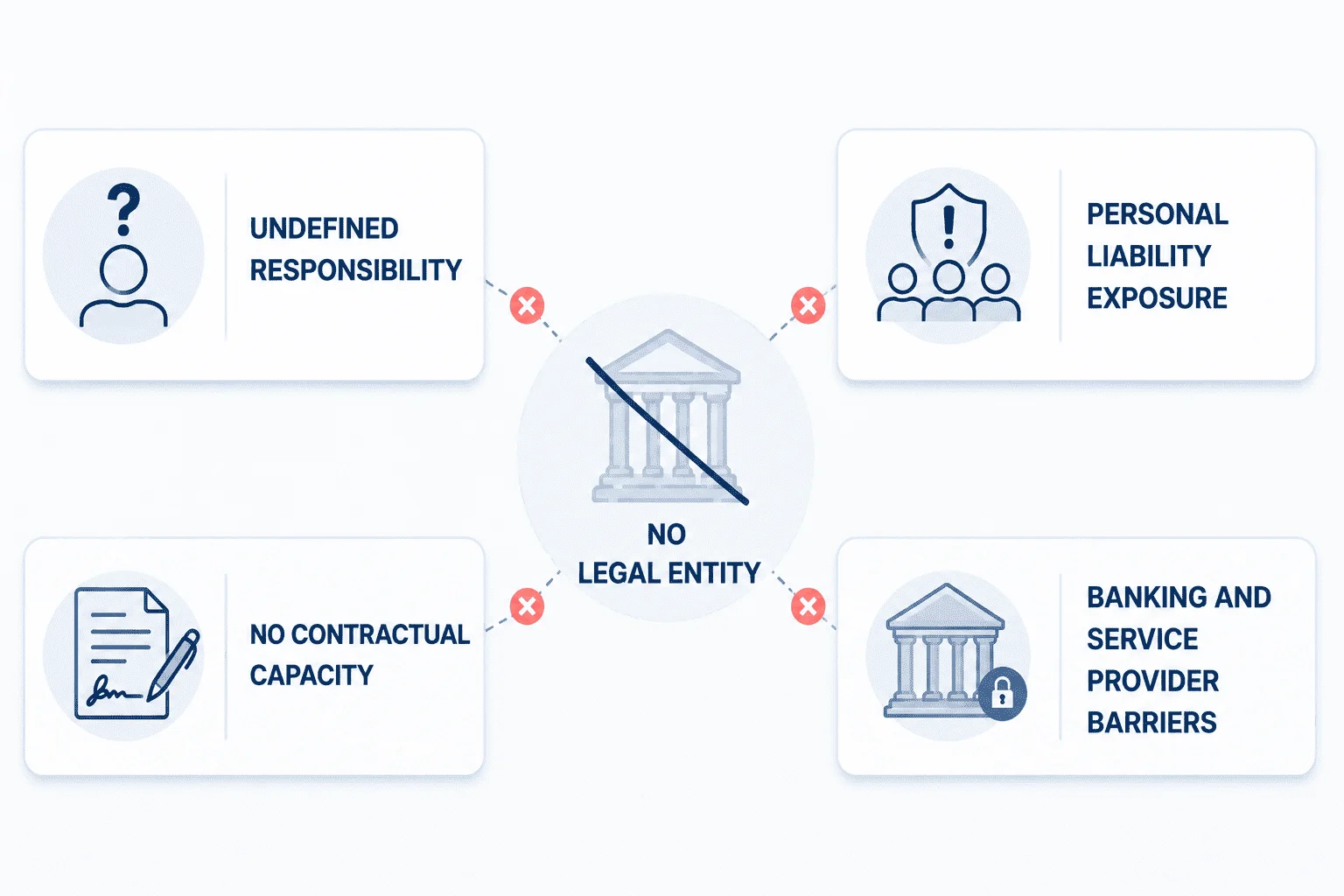
Running a DeFi protocol without a recognized legal structure creates four immediate problems:
- Undefined responsibility: No entity means no defined party responsible for protocol operations, security, or regulatory compliance. When something goes wrong, everyone who contributed is a potential defendant.
- Personal liability exposure: Developers, contributors, and governance participants can be treated as partners in an unincorporated association, exposed to joint and several liability for the protocol's actions.
- No contracts in its own name: Without a legal entity, the protocol cannot sign agreements with auditors, oracles, market makers, liquidity providers, or exchanges in its own name; individuals may sign on its behalf and assume personal risk.
- Banking and service provider barriers: Most financial institutions, custodians, and enterprise service providers require a recognized legal counterparty before engaging.
Separating the Protocol, Contributors, and Community
As DeFi protocols grow, the need to separate different layers of the organization becomes increasingly important. A protocol that conflates governance, development, treasury, and operations into a single undifferentiated community is difficult to defend legally and difficult to partner with commercially.
A properly structured DeFi protocol separates at minimum three layers: the governance layer, where token holders vote on protocol decisions; the treasury layer, which holds and deploys the protocol's assets; and the operational layer, which may involve a development company providing services under a formal agreement with the governance entity.
Legal Recognition Without Centralizing the Protocol
Incorporating a DeFi protocol does not require centralizing its governance. The Marshall Islands DAO LLC, for instance, explicitly supports algorithmic management and on-chain governance as the legal authority, with no requirement for human directors or managers. The operating agreement references smart contracts directly, so community votes carry legal weight without a board of directors filtering or overriding them.
Legal structure provides the interface between on-chain governance and the real world, not a replacement for it.
For more context on how this works in practice, see our guide on what a crypto legal wrapper is and why your DeFi project needs one.
What Legal Structure Models Do DeFi Protocols Use?
The three most common legal structures used by DeFi protocols today are DAO LLCs, foundations, and hybrid structures combining a governance entity with an operating company. Each suits a different type of protocol at a different stage.
Traditional LLC Structures
Standard LLCs, including Delaware LLCs, offer limited liability protection and contractual capacity at low formation cost. They work reasonably well for early-stage protocols where a small team needs an entity for signing agreements and holding IP.
The limitation for DeFi is structural. Standard LLCs require named members or managers, have no native framework for token-based governance, and must adapt existing provisions to approximate on-chain decision-making. When governance evolves, the legal documents must be amended separately. The gap between on-chain reality and legal documentation creates friction that compounds as the protocol grows.
Foundation Structures
Foundations, including Cayman Foundation Companies and Swiss Stiftungs, have been used by major DeFi protocols including Uniswap, Compound, and Aave. They are well-suited for:
- Supporting protocol development and ecosystem grants
- Managing community resources and treasury over the long term
- Coordinating partnerships with institutional counterparties
- Providing a recognized legal entity for regulatory engagement
The core limitation is the governance board. Foundations require directors with fiduciary duties who retain ultimate legal authority over the entity's decisions. Community token votes are influential but not legally binding on the directors. For protocols where community governance is the operational model rather than an advisory mechanism, this is a meaningful constraint.
DAO Legal Structures
DAO-specific entities, built from the ground up for decentralized organizations, are the most purpose-aligned legal structure for DeFi protocols with active on-chain governance.
The Marshall Islands DAO LLC is the leading example. Under the RMI DAO Act of 2022, the LLC supports token-based membership, algorithmic management, and smart contract governance as the operative legal authority. No directors or human managers are required. The operating agreement points to on-chain contracts, and community decisions carry formal legal weight.
Key features for DeFi protocols:
- Governance tokens with no economic rights are explicitly not treated as securities under RMI statute (2023 Amendment)
- Series DAO LLC capability allows sub-protocols or investment pools to maintain segregated assets and liabilities
- Non-profit structures pay zero corporate income, capital gains, or withholding tax
- 300+ DAOs and web3 projects have signed up, including Pyth Network, GMX, ApeCoin Governance DAO, and MoonDAO
What Are the Key Legal Considerations When Structuring a DeFi Protocol?
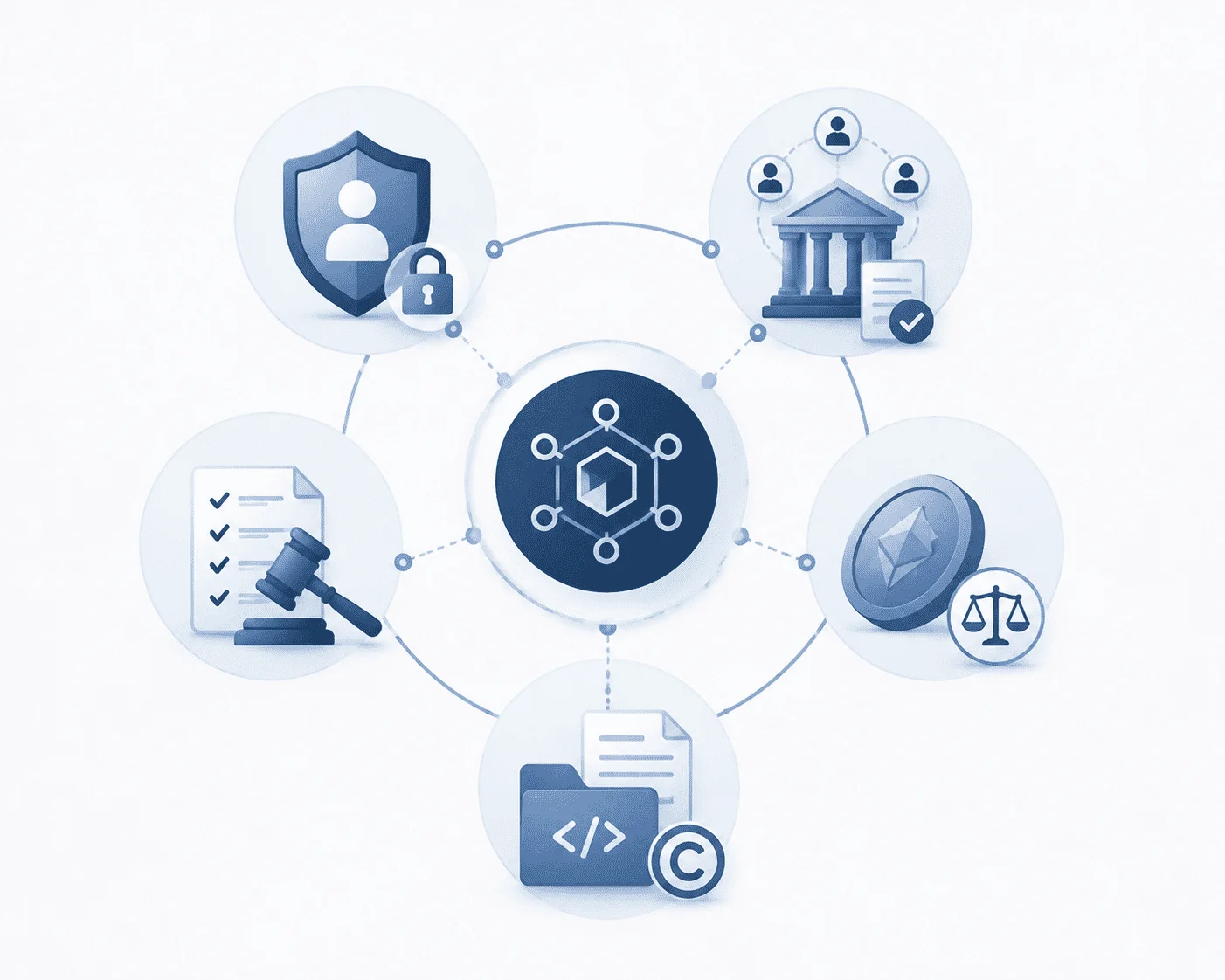
Structuring a DeFi protocol requires decisions in five areas: liability allocation, governance design, token treatment, IP ownership, and compliance. Each decision interacts with the others, and getting the sequence wrong creates expensive problems to fix later.
Liability Protection for Developers and Contributors
A legal entity creates a defined boundary between the protocol's obligations and the personal assets of the people who built it. Without that boundary, every security incident, regulatory action, or user dispute potentially implicates the individuals involved.
The RMI DAO LLC additionally provides explicit statutory protection against liability for the use of open-source software, a relevant protection for protocol teams whose code is forked, modified, or deployed by third parties without the team's involvement.
Governance and Decision-Making Authority
On-chain governance and legal documentation must be aligned, not parallel systems that can contradict each other. The most common governance compliance failure in DeFi is an operating agreement that describes governance one way while the smart contracts execute it differently.
Under the RMI DAO LLC framework, operating agreements reference smart contracts directly. Protocol upgrades, treasury decisions, and governance mechanism changes executed on-chain carry legal authority under the operating agreement. This alignment eliminates the need to amend legal documents every time governance evolves.
Our DAO compliance requirements guide covers the full documentation requirements founders should address at formation.
Token Ownership and Regulatory Considerations
Token design is one of the most consequential compliance decisions a DeFi protocol makes. The difference between a governance token with no economic rights and a token linked to protocol revenue can determine whether the token is classified as a security in relevant jurisdictions.
Non-profit RMI DAO LLCs carry the only statutory securities carve-out available in a purpose-built DAO jurisdiction: governance tokens with no economic rights are explicitly not securities under RMI law. For protocols where revenue distribution is part of the model, a for-profit structure with appropriate securities law analysis for each target jurisdiction is the correct path.
See our article on token issuance and securities law compliance for a full breakdown.
Intellectual Property and Protocol Ownership
Protocol IP, including code, trademarks, documentation, and technology assets, must have a defined legal owner. Without a legal entity, ownership, trademark registration and licensing fall to individual contributors, which fragments the rights and makes them harder to enforce or license to operating partners.
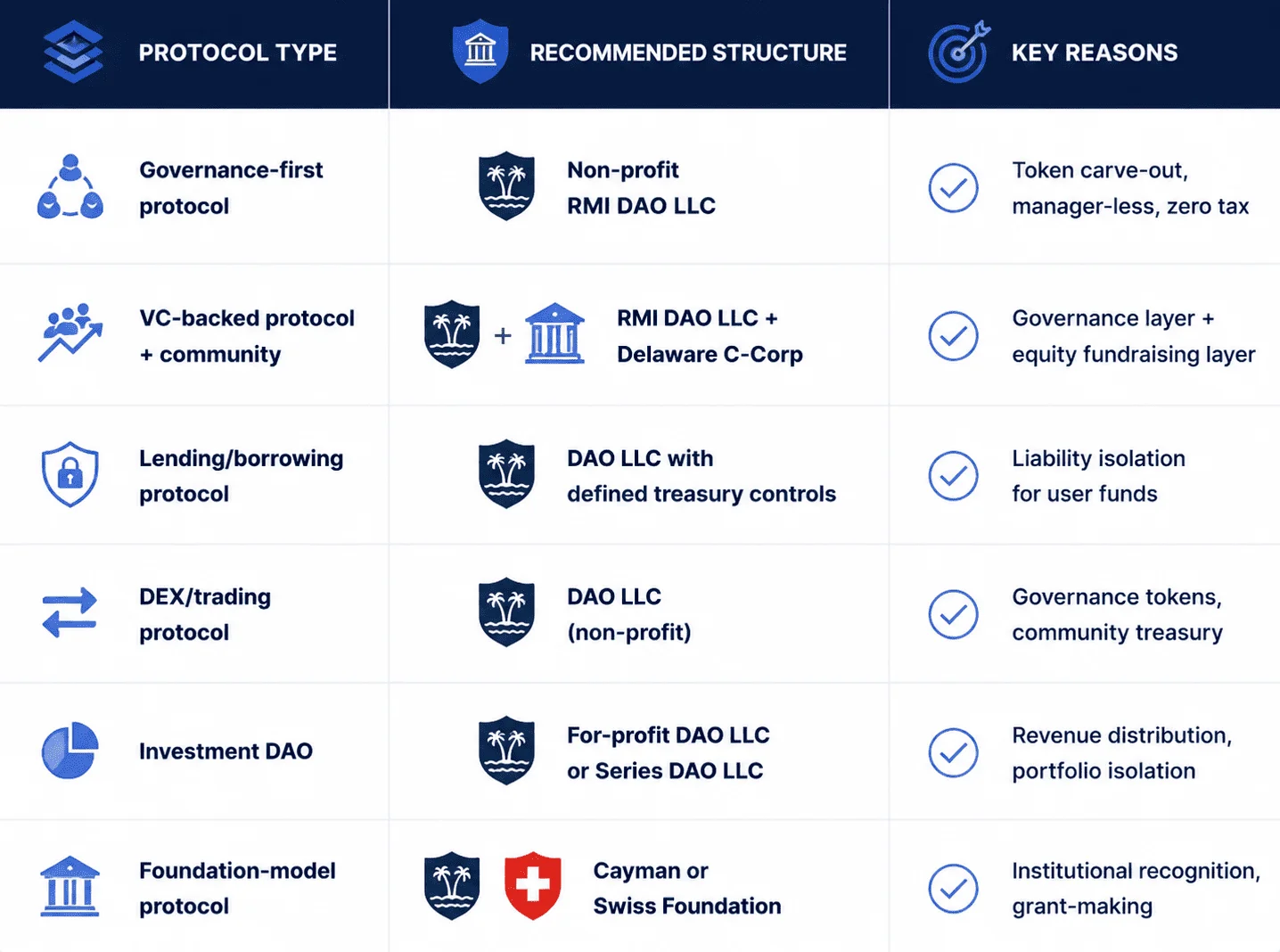
The RMI DAO LLC can hold all protocol-related IP directly. The most common structure pairs the DAO LLC as the IP holder with a Delaware C-Corp as the operating company, with a formal IP license between them. This protects the community's assets while giving the operating team a commercial entity for VC fundraising and exchange contracts.
How Should Different Types of DeFi Protocols Structure Themselves?
Lending and Borrowing Protocols
Lending protocols face heightened liability exposure because they manage user funds directly. If a smart contract bug causes user losses, the question of who is responsible will be asked of every identifiable person connected to the protocol.
An RMI DAO LLC provides entity-level liability protection, with the DAO itself absorbing the legal claim rather than its contributors. The Series DAO LLC structure is particularly useful for lending protocols with multiple asset pools: each pool can be structured as a separate series with legally segregated assets.
Decentralized Exchanges and Trading Protocols
DEX protocols interact with market infrastructure, liquidity providers, and user funds in ways that attract regulatory attention. GMX, one of the largest decentralized perpetuals exchanges, uses the RMI DAO LLC for its governance entity, providing a legal home for treasury management and community governance without imposing a centralized management layer.
DEX protocols that engage with regulated financial counterparties, institutional market makers, or centralized exchange partnerships need a legal entity to sign those agreements. The DAO LLC functions as the counterparty while preserving the community's governance authority over protocol decisions.
Protocols With Token-Based Communities
For protocols where governance-driven decision-making is central to the value proposition, the legal structure must match that model:
- The governance entity should hold the treasury and IP
- Community token votes should carry formal legal authority, not advisory weight
- The operating agreement should reference on-chain governance mechanisms directly
- Treasury controls should be documented with defined approval thresholds
Protocols like Pyth Network and MetaDAO used exactly this pattern. Their operating agreements reference on-chain governance contracts, giving smart contract execution the weight of a valid organizational action under the RMI DAO LLC framework.
The Bottom Line on DeFi Protocol Legal Structure
The single most important insight for DeFi founders: legal structure is not compliance overhead. It is the foundation that determines what your protocol can do and who is protected when something goes wrong.
The right structure depends on the protocol's governance model, token design, and operational requirements. Non-profit RMI DAO LLCs are the purpose-built answer for community-governed protocols with governance tokens. Foundation structures suit institutional stewardship models. Hybrid structures combining an RMI DAO LLC with a Delaware C-Corp serve protocols that need both community governance and commercial capital.
Addressing structure before launch is significantly cheaper than restructuring under regulatory pressure.
Ready to give your DeFi protocol a legal structure that matches how it governs? Start your RMI DAO LLC registration with MIDAO, the only government-authorized program for Marshall Islands DAO LLCs, and get your protocol's governance layer incorporated in under 30 days.
Frequently Asked Questions
Can a DeFi protocol operate without creating a legal entity?
Technically yes, but with significant personal liability risk for the people involved. Without a legal entity, courts may classify the protocol as an unincorporated association or general partnership, potentially exposing developers, contributors, and active governance participants to the protocol's legal obligations. The Ooki enforcement action and the private bZx and Lido cases show that decentralization does not by itself prevent legal claims.
How does a legal structure affect the decentralization level of a DeFi protocol?
It depends on the structure chosen. Traditional LLCs and foundations require named managers or directors who retain legal authority over the entity, which does create a centralization layer even if community governance continues on-chain. Purpose-built structures like the RMI DAO LLC explicitly support manager-less operation, where smart contracts and token voting are the legal governance authority, with no human directors required. The right structure preserves rather than undermines decentralization.
Who owns a DeFi protocol's intellectual property if no legal entity exists?
Without a legal entity, protocol IP cannot be owned in the protocol's name and may be split among individual contributors. Code produced by contributors may belong to individual developers under default copyright rules, trademarks cannot be registered in the protocol's own name, and fragmented ownership makes those rights harder to enforce. A legal entity resolves this by providing a single owner that can hold, register, and license all protocol-related IP, protecting the community's assets and enabling formal commercial relationships.