
How to Give Your NFT Project a Legal Entity
A guide to creating a legal entity for an NFT project, covering IP ownership, liability protection, entity selection, DAO LLC structures, asset transfers, and governance frameworks for long-term ecosystem growth.
The NFT Market Report by Market Research Future, 2025, values the global NFT market at $79.36 billion in 2025, projected to reach $908 billion by 2035, growing at a compound annual rate of 27.6%. That is no longer a speculative asset class. It is a maturing digital economy with real revenue, real IP, and real legal exposure.
And yet most NFT projects operate without a formal legal structure. A smart contract can launch a collection, mint tokens, and distribute royalties without anyone signing a document. But when the project grows, partnerships emerge, merchandise is licensed, and community treasury reaches meaningful value, the absence of a legal entity becomes a liability in the most literal sense. Every collaborator who contributed is personally exposed. No one legally owns the IP. And there is no entity to sign the contracts that would let the project grow.
This guide explains how to give your NFT project a legal identity: what to put in the entity, which structure to choose, how to transfer assets, and what happens when you do not.
Why Does Your NFT Project Need a Legal Entity?
An NFT project needs a legal entity because a smart contract is not a legal person. It can execute code, but it cannot own a trademark, sign a licensing agreement, open a bank account, or absorb liability on behalf of the people who deployed it. Without a legal entity, all of those responsibilities fall to whoever is identifiable behind the project.
The consequences are practical, not abstract. When a major platform wants to partner with your project, they need a counterparty to sign the agreement. When a licensing deal emerges for merchandise or gaming integration, there needs to be a rights holder. When a collector dispute arises, someone has to be accountable. Without an entity, that someone is you personally.
Moving Beyond an Anonymous Blockchain Project
The difference between an NFT collection and a legally recognized organization is significant. A collection deployed through a smart contract is a set of on-chain records. A legal entity is a recognized person under the law, capable of owning property, entering agreements, and having disputes resolved formally.
Successful NFT projects consistently reach a point where on-chain infrastructure is not enough. MoonDAO, for example, raised $8.3 million through token sales, purchased a Blue Origin seat for a community-selected astronaut, and incorporated as a non-profit RMI DAO LLC. The entity lets them sign contracts with aerospace companies, hold intellectual property, and operate bank accounts, all while keeping governance entirely in the hands of the community on-chain.
For a full picture of what operating without this kind of structure actually risks, see our article on why unincorporated projects are legally exposed to personal liability.
Creating a Legal Owner for Your NFT Ecosystem
Without a legal entity, your NFT project's most valuable assets have no recognized owner. Under US copyright law, copyright belongs to the human creator by default. Trademarks must be registered to a named party. Websites, platform accounts, and domain names are held personally by whoever registered them.
A legal entity resolves all of this. The entity becomes the owner and holder of:
- Artwork, character designs, and creative IP across the collection
- Trademarks for the project name, logo, and visual identity
- Websites, social media accounts, and marketplace storefronts
- Community treasury and on-chain assets
- Licensing rights for derivatives, merchandise, and gaming integrations
When the entity owns these assets, they are protected, transferable, and enforceable in court. When no entity owns them, enforcement is impractical and disputes over ownership between founding team members are legally complex.
Protecting Contributors and Community Members
Operating an NFT project without a legal entity means every active contributor is personally exposed to the project's legal obligations. If the project is sued for IP infringement, copyright violation, or breach of an informal agreement, individuals who contributed code, art, or community management can be named as defendants.
Our article on what happens when a project gets sued without a legal entity covers the enforcement cases that define this risk.
A legal entity creates a defined boundary. The entity absorbs legal claims. The contributors' personal assets are protected by limited liability. This protection requires a properly formed entity, not just a shared wallet or informal arrangement.
How to Give Your NFT Project a Legal Entity: Step by Step
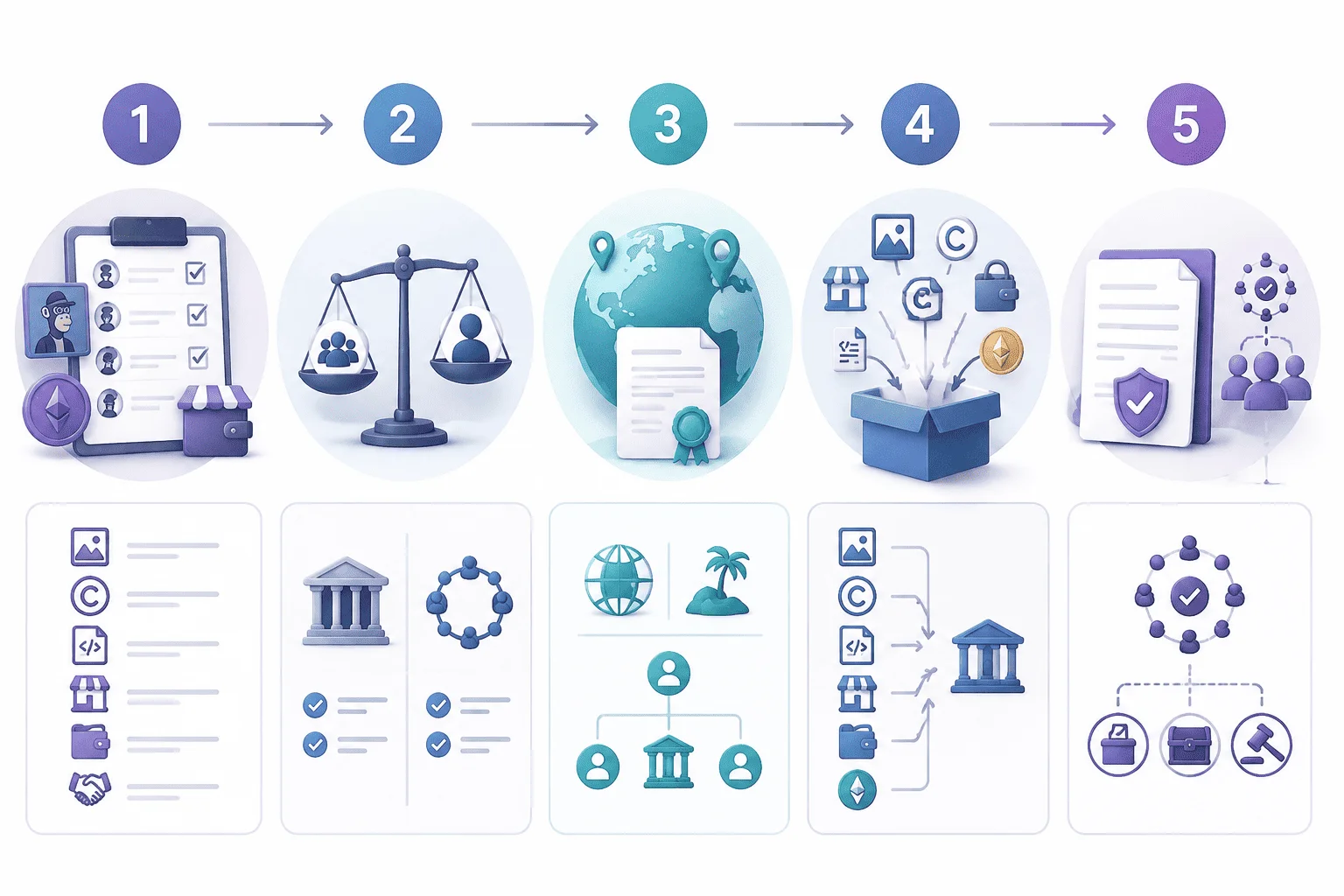
Five concrete steps take an NFT project from an on-chain collection to a legally recognized organization. Each step builds on the previous one, and skipping any creates gaps that are more expensive to fix retroactively than to address at formation.
- Define what the legal entity will own and manage. Before choosing a structure, map the assets that should belong to the entity: artwork and IP rights, smart contract ownership, NFT marketplace accounts, community treasury, and all partnerships and commercial agreements. This inventory defines the scope of the transfer and ensures nothing is left behind.
- Choose a legal structure for your NFT project. A traditional LLC works for creator-controlled projects where a small team wants liability protection and contractual capacity. A DAO LLC, specifically the Marshall Islands DAO LLC, is more appropriate for community-driven projects where NFT holders participate in governance, vote on treasury decisions, and have a meaningful role in the project's direction. Choose the structure that matches how the project actually operates. If you are new to this concept, our guide on what a crypto legal wrapper is and why your project needs one explains the foundations clearly.
- Select a jurisdiction and register the entity. For globally distributed NFT communities, offshore jurisdictions like the Marshall Islands offer tax neutrality, no physical presence requirements, and a purpose-built framework for token-based organizations. Formation through MIDAO's government-authorized program typically completes in under 30 days, with no local directors required. For US-centric projects with traditional VC, a Delaware LLC or C-Corp remains a common choice, though it carries full US tax and regulatory exposure.
- Transfer NFT project assets to the entity. IP assignment transfers copyright and trademark ownership from individual creators to the LLC. Platform accounts and marketplace storefronts should be updated to reflect the entity as the registered operator. Smart contract ownership or upgrade authority should be documented in the operating agreement. Treasury wallets become assets of the entity. These transfers should be documented formally, not just acknowledged informally.
- Establish governance and operating rules in the founding documents. The operating agreement defines who makes decisions, how, and what thresholds apply. For community-driven NFT projects, this includes community voting mechanisms, contributor responsibilities, treasury management authority, and dispute resolution procedures. Under the RMI DAO LLC framework, the operating agreement can reference on-chain governance contracts directly, so community votes carry formal legal authority without a separate board vote to validate them.
Why DAO LLC Structures Work Well for NFT Projects
The Marshall Islands DAO LLC is purpose-built for exactly the kind of organization that many successful NFT projects become: community-governed, treasury-managing, IP-holding entities that operate primarily on-chain.
How DAO LLCs Connect NFT Communities With Legal Recognition
A DAO LLC provides the same legal benefits as a traditional LLC, including limited liability, corporate personhood, and contractual capacity, while natively supporting how NFT communities actually function.
Key features that align with NFT project needs:
- Token-based membership: NFT holders or governance token holders are recognized as members without needing to provide personal information in most cases
- On-chain governance: Voting by holder community carries formal legal authority under the operating agreement
- No required directors: The community governs through its own mechanisms, not through a board with override authority
- IP ownership: The entity holds trademarks, copyright assignments, and licensing rights for the full collection
- Tax-neutral for non-profits: Zero corporate income tax, capital gains tax, or withholding tax on the treasury
When an NFT Project Functions Like a DAO
Many NFT projects already operate like DAOs without the legal structure to match. Holder communities vote on treasury allocations, contribute to ecosystem development, govern royalty policies, and decide on licensing partnerships. When the community functions like a governing body, the legal structure should reflect that.
The RMI DAO LLC operating agreement can be structured to give NFT holder votes formal legal weight, define treasury spending thresholds that require community approval, and document the contributor roles and responsibilities that already exist informally. The legal structure makes the community's real governance enforceable rather than merely customary.
Our DAO compliance requirements guide covers how to document governance correctly from the start.
Supporting Long-Term NFT Ecosystem Growth
A legal entity is what allows an NFT project to expand beyond its original collection. From licensing to gaming integrations, memberships, physical merchandise, and digital economies, all require a legal counterparty. The entity provides that counterparty while protecting the community's assets and the IP that gives the brand its value.
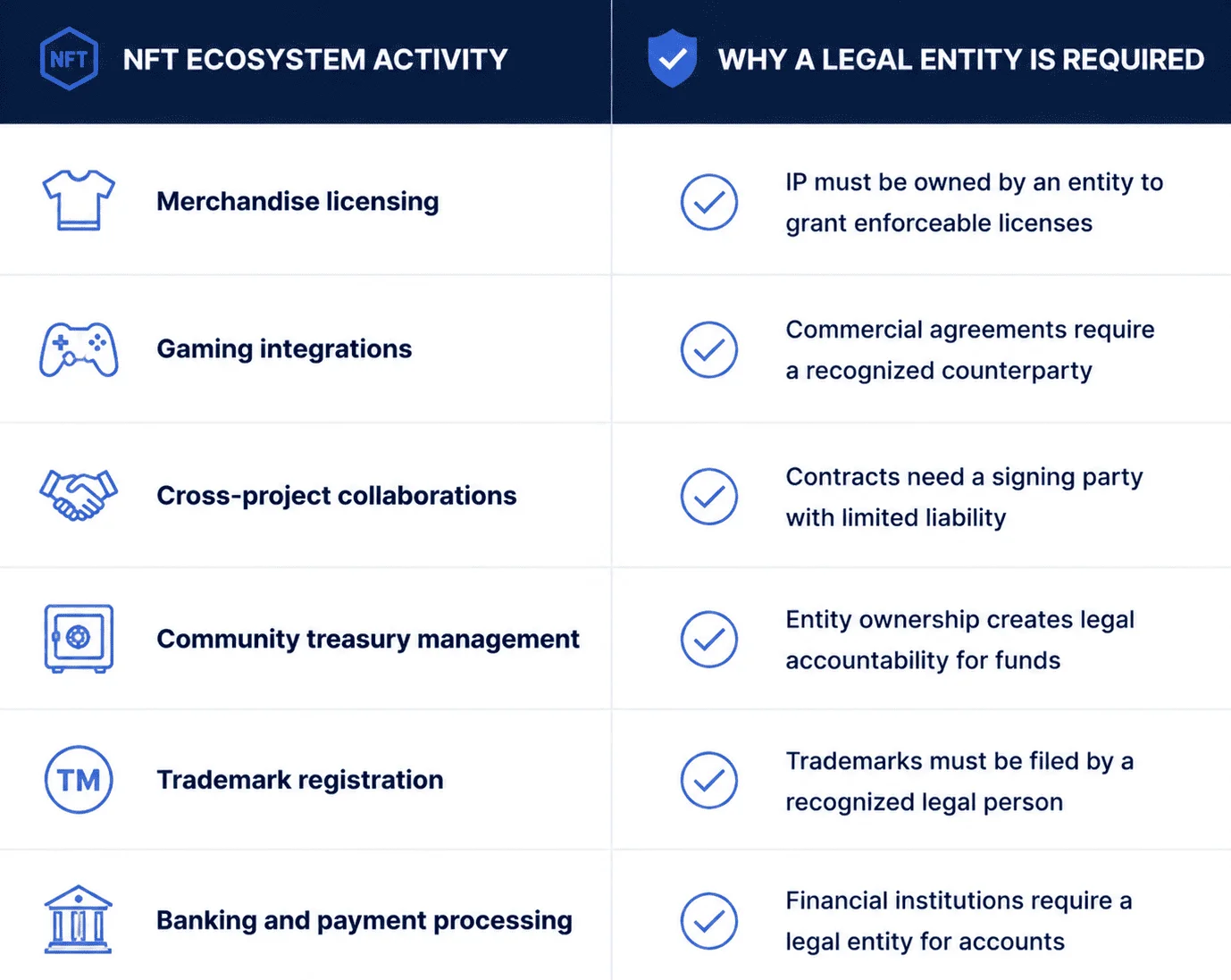
Projects that address legal structure early can pursue all of these opportunities cleanly. Projects that address it after growth is already underway face a more complex transfer process, potential disputes over existing IP, and contracts that need to be renegotiated to name the new entity as counterparty.
Your NFT's IP Is Only as Safe as the Entity Behind It
The strongest insight from this guide: the IP your NFT project creates today is worth nothing without a defined legal owner to protect and enforce it. A smart contract can mint a token, but it cannot register a trademark, sign a licensing deal, or enforce rights against an infringer.
A legal entity gives the project a home that exists in both the on-chain and off-chain world. It protects founders and contributors from personal liability, creates a recognized owner for every asset the project generates, and provides the contractual capacity needed for every commercial opportunity that follows a successful launch.
Ready to give your NFT project a legal identity?
Start your RMI DAO LLC registration with MIDAO, the only government-authorized program for Marshall Islands DAO LLCs, and get your entity in place in under 30 days.
Frequently Asked Questions
Can an NFT project create a legal entity after the collection has already launched?
Yes, and many successful projects do exactly this. The process involves forming the entity and then transferring existing assets into it: IP assignments for artwork and trademarks, updating platform accounts to reflect the entity as operator, and documenting smart contract authority in the operating agreement. It is more involved than incorporating before launch, but entirely manageable with proper legal counsel. The sooner it happens after launch, the fewer assets need retroactive transfer.
Who should own the NFT project's intellectual property after incorporation?
The legal entity should own all project-related IP, including original artwork, character designs, the project name and logo, and any derivative rights. Founding creators should execute formal IP assignment agreements transferring ownership to the entity at formation. This protects the IP from disputes between team members, makes enforcement possible, and allows the entity to issue enforceable licenses to partners and collaborators.
Can NFT holders become members of the legal entity behind the project?
Under the Marshall Islands DAO LLC framework, yes. The RMI DAO LLC explicitly supports token-based membership, where NFT or governance token holders are recognized as general members of the entity. Only beneficial owners controlling 25% or more of governance rights complete KYC, keeping identification requirements proportionate to governance influence. The threshold is a guide; the official guidance sets the detail. This structure allows the community's on-chain governance to carry formal legal authority without requiring every holder to register as a named member.