
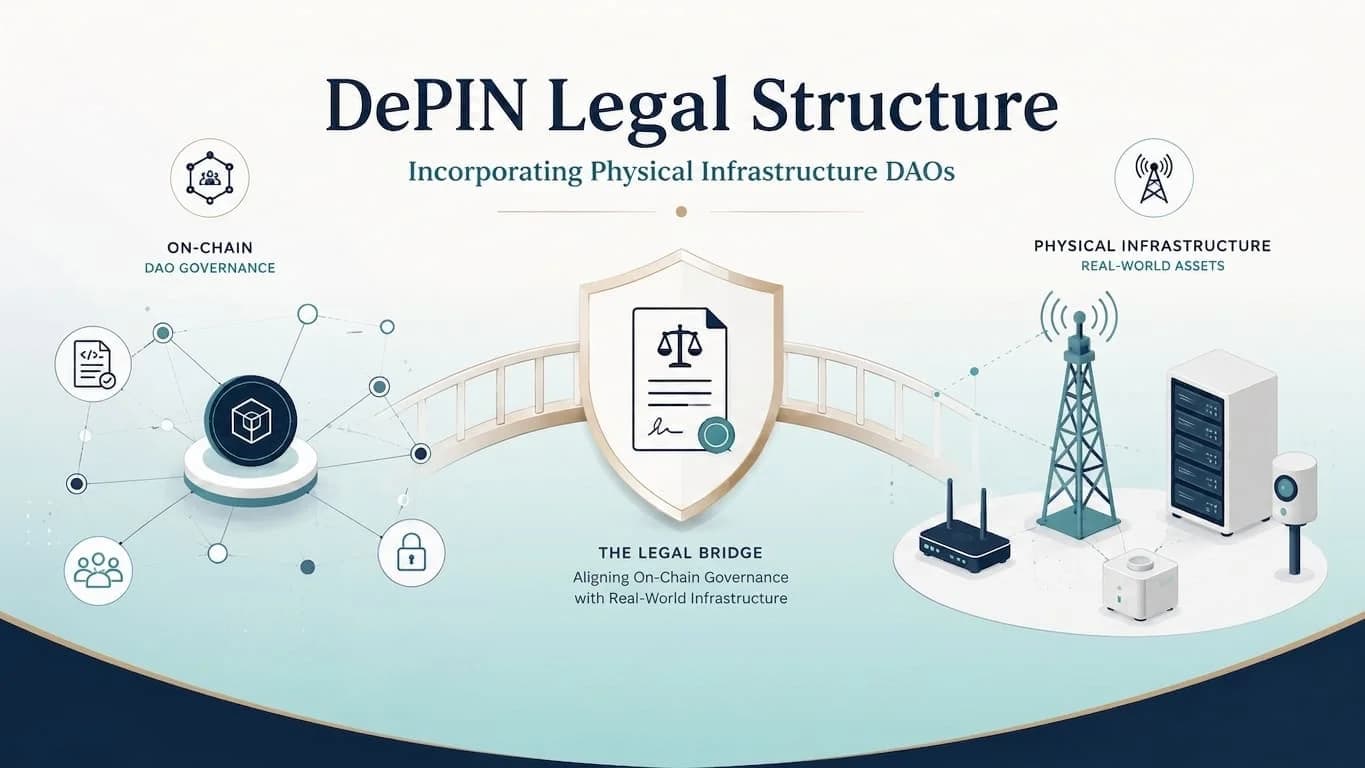
DePIN Legal Structure: Incorporating Physical Infrastructure DAOs
Everything founders need to know about structuring a DePIN project legally, including entity formation, real-world asset management, governance design, and scaling decentralized infrastructure.
Messari's State of DePIN 2025 report documents a sector that has matured from speculative experiments into real, revenue-generating infrastructure businesses, with an estimated $72 million in on-chain revenue in FY2025 and leading networks trading at 10-25x revenue multiples. DePIN has crossed the threshold from interesting experiment to operating business. And operating businesses have legal obligations.
That is the gap most DePIN projects have not addressed. A network can distribute token rewards, deploy hardware across dozens of countries, and sign agreements with enterprise clients, all while operating with no legal entity, no defined owner, and no clear answer to the question of who is responsible when something goes wrong. As networks grow and real money flows, that gap becomes a liability.
This article explains what makes DePIN projects legally distinct, what happens without a structure, and how to design the right DePIN legal entity for a physical infrastructure network at any stage.
What Makes DePIN Projects Legally Different From Traditional DAOs?
DePIN projects operate across two environments simultaneously, and most legal structures were designed for only one of them. A traditional DAO governs software and tokens. A DePIN project does all of that and also deploys hardware, manages physical infrastructure, contracts with vendors, and delivers services to real-world users.
The Combination of Digital Governance and Physical Operations
A DePIN project has two distinct operational layers that must both be supported by the legal structure.
The blockchain layer includes:
- Token issuance and distribution
- Governance mechanisms and protocol upgrades
- Smart contract-based reward distribution
- Network incentives and participation rules
The physical layer includes:
- Hardware procurement and deployment
- Infrastructure leases and operator agreements
- Service delivery to customers
- Vendor contracts and supplier relationships
- Insurance and regulatory compliance for physical assets
Traditional DAO structures, including most foundation and LLC models, were designed for the blockchain layer. They were not designed to simultaneously hold physical assets, sign operator agreements, or accept liability for infrastructure-related disputes. A DePIN project that incorporates a governance-only structure will find that the structure does not address half of what the network actually does.
Real-World Activities That Require a Legal Entity
The moment a DePIN project interacts with the physical world, it creates legal relationships that require a defined legal party. These are not theoretical future events. They happen at the earliest stages of network development.
Specific activities that require a legal entity behind them:
- Purchasing or leasing hardware on behalf of the network
- Contracting with infrastructure operators and node providers
- Paying contributors and service providers under formal agreements
- Entering supplier relationships for components or services
- Holding intellectual property for network protocols and software
- Managing revenue generated from enterprise or consumer network usage
Without an entity, these activities are carried out by individuals, who can end up personally exposed for the outcome.
What Happens If a DePIN Project Operates Without a Legal Entity?
Operating a DePIN project without a legal entity is not a neutral choice. It is a decision that can leave identifiable individuals carrying the legal risk.
Founder and Contributor Liability Risks
Without incorporation, a decentralized network may be classified as an unincorporated association or general partnership, potentially exposing governance participants to personal liability for the organization's obligations. For a DePIN project, this exposure extends to the physical world in ways that purely on-chain projects do not face.
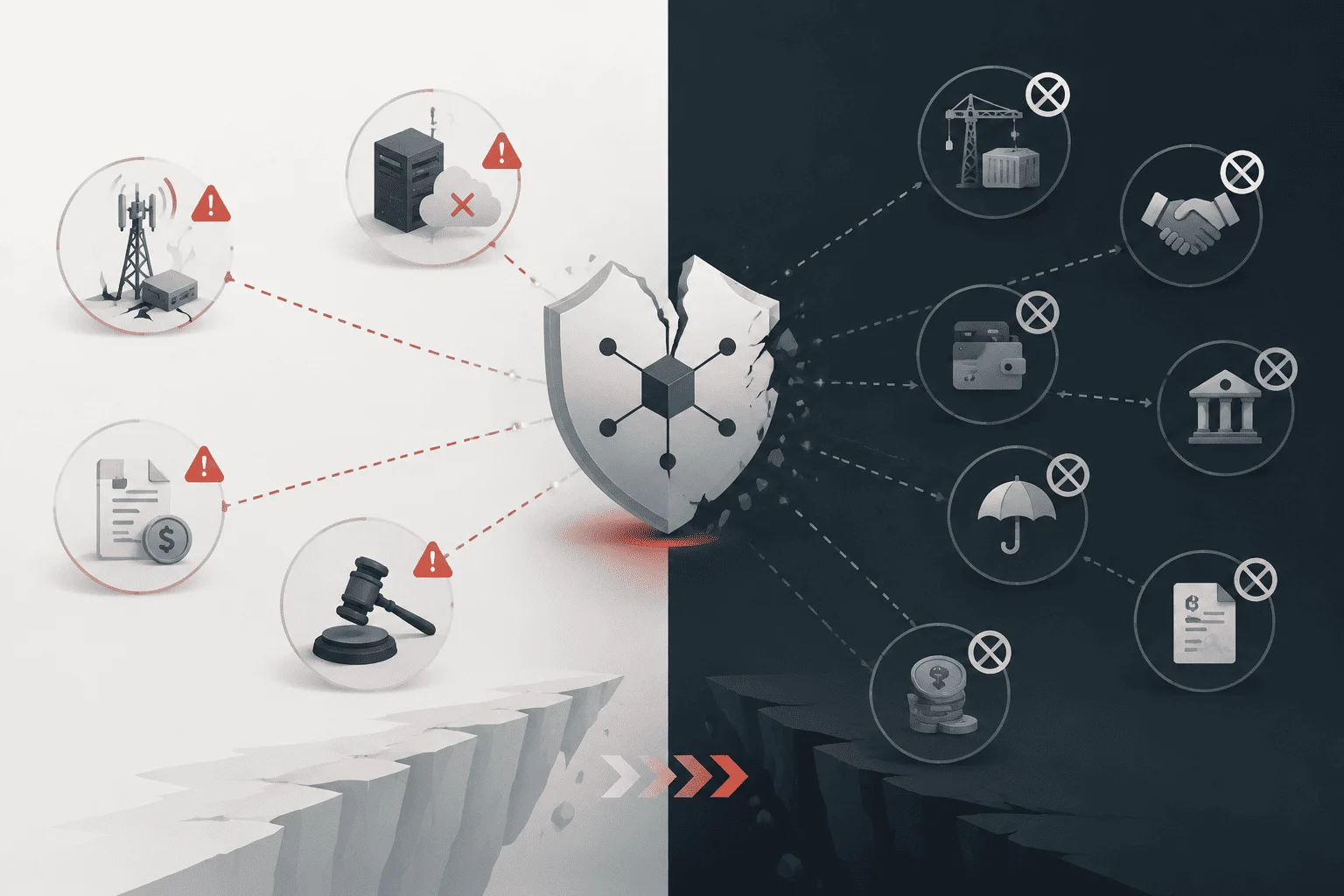
DePIN-specific liability scenarios without a legal entity:
- A hardware operator damages third-party property; the network's founders are personally named in the claim
- A service disruption causes enterprise customer losses; there is no entity to absorb the dispute
- A node provider alleges unpaid compensation; individual contributors are personally exposed
- Infrastructure-related regulatory violations result in enforcement action against identifiable participants
The association theory accepted in CFTC v. Ooki DAO illustrates a legal risk for on-chain protocols, but the court did not decide whether governance participants are personally liable. Governance participation may create personal-liability exposure, and DePIN projects have more ways to create liability than software-only protocols.
Our article on what happens when a project gets sued without a legal entity walks through exactly how that enforcement plays out in practice.
Operational Problems Without a Corporate Structure
Beyond personal liability, operating without an entity creates practical problems that grow with network scale. These are not compliance concerns for later. They are operational blockers that appear as soon as the network tries to engage with the physical world.
Without a legal entity, a DePIN project may struggle to:
- Own physical assets or infrastructure in the network's name
- Negotiate enterprise partnerships with a recognized counterparty
- Open bank accounts or payment processing accounts for the treasury
- Establish clear ownership of network-generated revenue
- Obtain insurance for infrastructure or operator relationships
- Execute vendor agreements in its own name
Every one of these limitations becomes more costly to resolve as the network grows. Retroactively creating a legal structure after a network has thousands of participants, unclear IP ownership, and informal vendor relationships is significantly more complex than incorporating at the right stage.
See our guide on why unincorporated projects are legally exposed to personal liability for a full picture of what that exposure looks like before a structure is in place.
What DePIN Legal Structure Does a Physical Infrastructure Network Need?
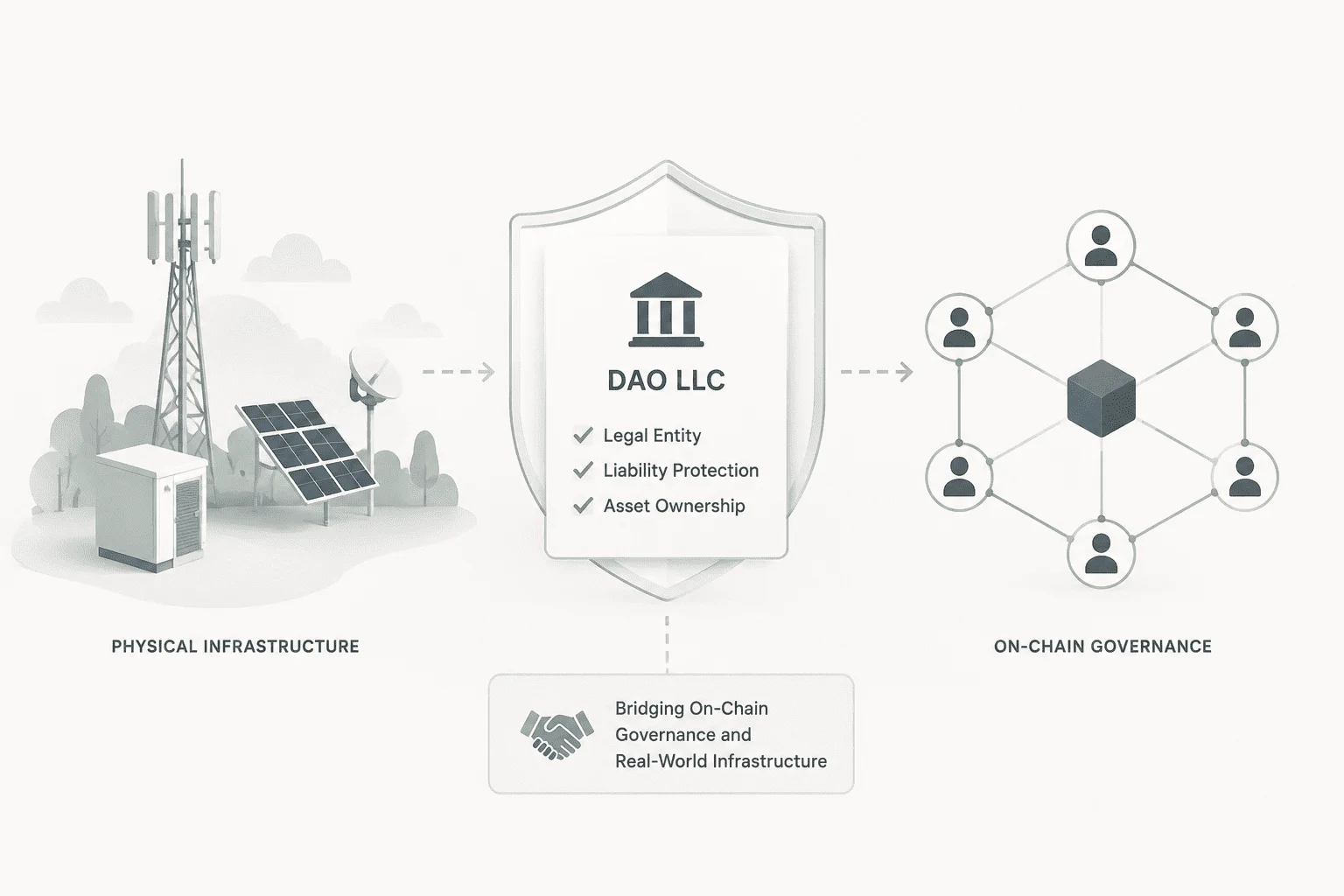
A DePIN project needs a legal structure that bridges on-chain governance and physical-world operations, not one that addresses only one layer. The right structure depends on the network's scale and whether the governance and operational functions should be separated.
The Role of a DAO LLC as a DePIN Legal Wrapper
A DAO LLC provides the core legal capabilities a DePIN network needs from its governance layer:
- Limited liability protection: Members and token holders are not personally liable for the entity's obligations
- Corporate personhood: The entity can own assets, sign contracts, and appear in court
- Contractual capacity: Hardware agreements, vendor contracts, and enterprise partnerships are signed by the entity
- Asset ownership: Physical infrastructure, IP, and treasury can all be held by the LLC
- Decentralized governance recognition: Token-based governance and smart contract authority are valid under the RMI DAO LLC statute
The DAO LLC designation does not require the project to have traditional DAO governance. It is a legal structure available to any tokenized organization, including infrastructure networks that use tokens for incentives but do not yet have formal community governance.
If you are new to the concept, our guide on what a crypto legal wrapper is and why your infrastructure project needs one explains how these structures work in plain terms. The structure supports the network's legal needs regardless of how mature the governance model is.
Governance Layer vs. Infrastructure Operations Layer
Most DePIN projects that reach meaningful scale benefit from separating governance and operations into two entities. The right model depends on where the network is in its development.
Single Entity Model (early stage): One DAO LLC handles everything: token governance, treasury management, infrastructure ownership, and network decisions. This works for smaller or pre-revenue DePIN projects that need a legal home without the overhead of two entities.
DAO LLC plus Operating Company Model (growth stage):
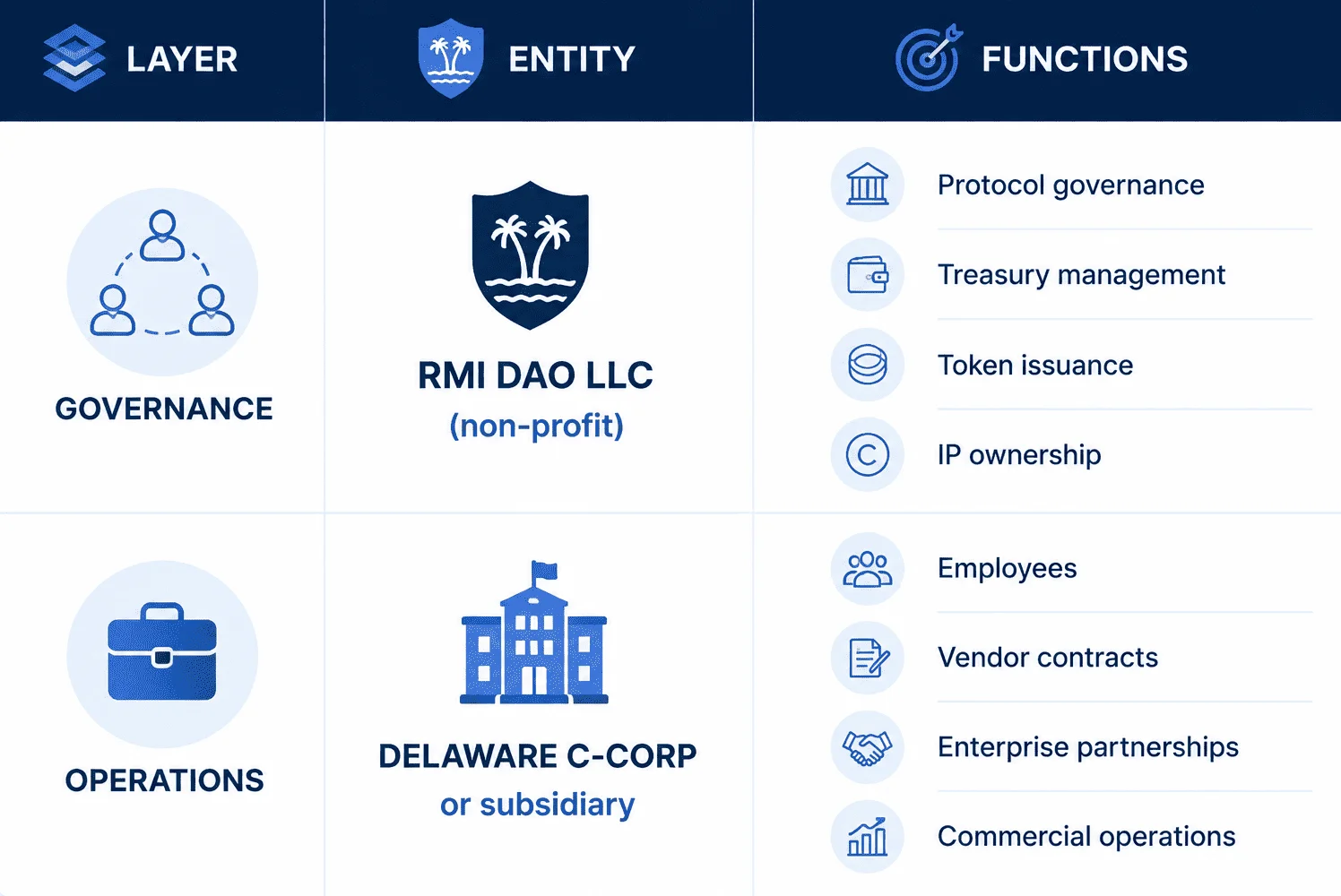
The DAO LLC governs the protocol and holds the treasury. The operating company manages the day-to-day physical operations, employs staff, negotiates commercial agreements, and handles compliance for regulated activities. The two entities are connected by formal service agreements and IP licenses.
This separation protects the community's governance layer from operational liability while giving the operational team a familiar commercial structure for enterprise relationships. It is the same pattern used by DeFi protocols at scale and works equally well for infrastructure networks.
Why Does the Marshall Islands DAO LLC Fit DePIN Projects?
The Marshall Islands DAO LLC is the most complete legal structure currently available for DePIN projects because it was built for exactly the combination of token governance and real-world operations that DePIN networks require.
Legal Recognition of Token-Based Governance
Under the RMI DAO Act of 2022 and its subsequent amendments, the DAO LLC explicitly supports:
- Membership tracked through tokens rather than named member registries
- Governance through blockchain-based mechanisms and smart contracts
- Algorithmic management as the legal authority, with no human directors required
- On-chain records maintained exclusively on a blockchain as valid corporate records
For DePIN projects, this means network participants can govern hardware upgrades, vote on incentive mechanisms, and decide on infrastructure decisions through the same on-chain mechanisms they use today, and those decisions carry formal legal authority.
Manager-Less and Algorithmic Governance
DePIN protocols rely on automated systems that should not require human approval for every operational decision. Smart contracts distribute rewards, enforce contribution rules, and manage network parameters without human intervention. The legal structure should match that operating model.
The RMI DAO LLC explicitly authorizes algorithmic governance. The operating agreement can designate smart contracts as the operational authority for defined categories of decisions, while reserving significant decisions for governance votes. This structure does not require a named manager to authorize routine network operations, which aligns with how DePIN protocols actually function.
Liability Protection for Physical Infrastructure Networks
The entity, not its participants, is the legal counterparty in every physical-world relationship. When a hardware operator dispute occurs, the DAO LLC is the defendant. When an infrastructure agreement is breached, the LLC is the party to the claim. When regulatory inquiries arrive, there is an entity with a registered agent to respond.
This protection extends to all categories of DePIN participants:
- Founders: protected from personal liability for network obligations
- Core contributors: separated from the entity's commercial and operational risks
- Token holders: not personally exposed for governance participation
- Infrastructure operators: clear contractual relationships with a recognized entity
For a DePIN network with hardware deployed across multiple countries, this liability separation is not optional. It is the basic legal infrastructure the network needs to scale.
Our guide on DAO compliance requirements for DePIN and Web3 projects covers the full compliance obligations that accompany this structure.
Structure First, Scale Second: Why DePIN Networks Must Incorporate Early
The single strongest insight from this guide: legal structure becomes dramatically harder to implement after a DePIN network has thousands of participants, unclear asset ownership, and informal vendor relationships. The complexity of retroactive incorporation grows with every hardware device deployed, every operator agreement executed informally, and every month of treasury accumulation without defined ownership.
The right time to establish a DePIN legal entity is before the network needs it in a dispute. The second-best time is now, while the structure is still clean to implement. A non-profit RMI DAO LLC handles the governance layer immediately and provides the legal foundation to add an operating company for physical operations as the network scales.
Ready to give your DePIN network a legal foundation?
Start your RMI DAO LLC registration with MIDAO, the only government-authorized program for Marshall Islands DAO LLCs, and get your governance layer incorporated in under 30 days.
Frequently Asked Questions
Can a DePIN project use a DAO LLC if it does not have token governance yet?
Yes. The DAO LLC is a legal structure available to any tokenized organization, not only to projects with active community governance. Early-stage DePIN projects can use the RMI DAO LLC as a legal entity for hardware agreements, IP ownership, and treasury management before full token governance is implemented. The operating agreement can be structured to reflect the current governance model and updated as the network matures.
Who owns physical infrastructure in a DePIN DAO LLC structure?
The DAO LLC owns the infrastructure in its own name as a legal entity, separating ownership from the personal assets of founders and contributors. For equipment deployed by individual operators or node providers, ownership depends on the specific agreements: the DAO LLC might own the hardware and contract with operators to deploy it, or operators might own their own hardware and contract with the DAO LLC for network participation. Both models require formal agreements between the entity and operators to define the ownership and liability relationship clearly.
Does a DePIN project need separate entities for governance and infrastructure operations?
Not at the earliest stage. A single DAO LLC can handle governance, treasury, and infrastructure operations for a smaller or pre-revenue DePIN project. As the network grows and commercial relationships become more complex, separating the governance layer (DAO LLC) from the operations layer (operating company) provides cleaner liability isolation and gives the operational team a more familiar commercial structure for enterprise partnerships, employment, and vendor agreements. Most DePIN projects that reach meaningful scale end up using the two-entity model.