

RWA Tokenization Legal Structure: The Definitive Guide
An overview of the legal frameworks behind real-world asset tokenization, covering SPVs, funds, LLCs, and DAO LLCs, and explaining how different structures define ownership, governance, and compliance for tokenized assets.
The tokenized real-world asset market reached over $30 billion by mid-2026, up more than 420% since the start of 2025, according to Chainalysis's June 2026 analysis of tokenized RWAs and on-chain commodities, with growth accelerating sharply after the passage of new regulatory frameworks in 2025. Private credit, tokenized Treasuries, and on-chain commodities now form the backbone of an asset class that has crossed from experimental pilot to institutional infrastructure.
That scale creates a specific legal problem. Tokenizing a real-world asset is not the same as creating a blockchain token. The token is the easy part. The hard part is building the legal structure that connects the token to the underlying asset, defines what rights it actually represents, and gives investors, regulators, and counterparties a framework they can rely on.
This guide covers what a correct RWA tokenization legal structure looks like, why each element is necessary, which entity types serve which projects, and where the Marshall Islands DAO LLC fits into the picture.
What Is an RWA Tokenization Legal Structure?
An RWA tokenization legal structure is the legal architecture that connects a real-world asset to the blockchain token that represents it. Without that architecture, a token is just a smart contract entry. With it, the token represents enforceable rights: ownership, revenue, debt claims, or governance authority over a real asset.
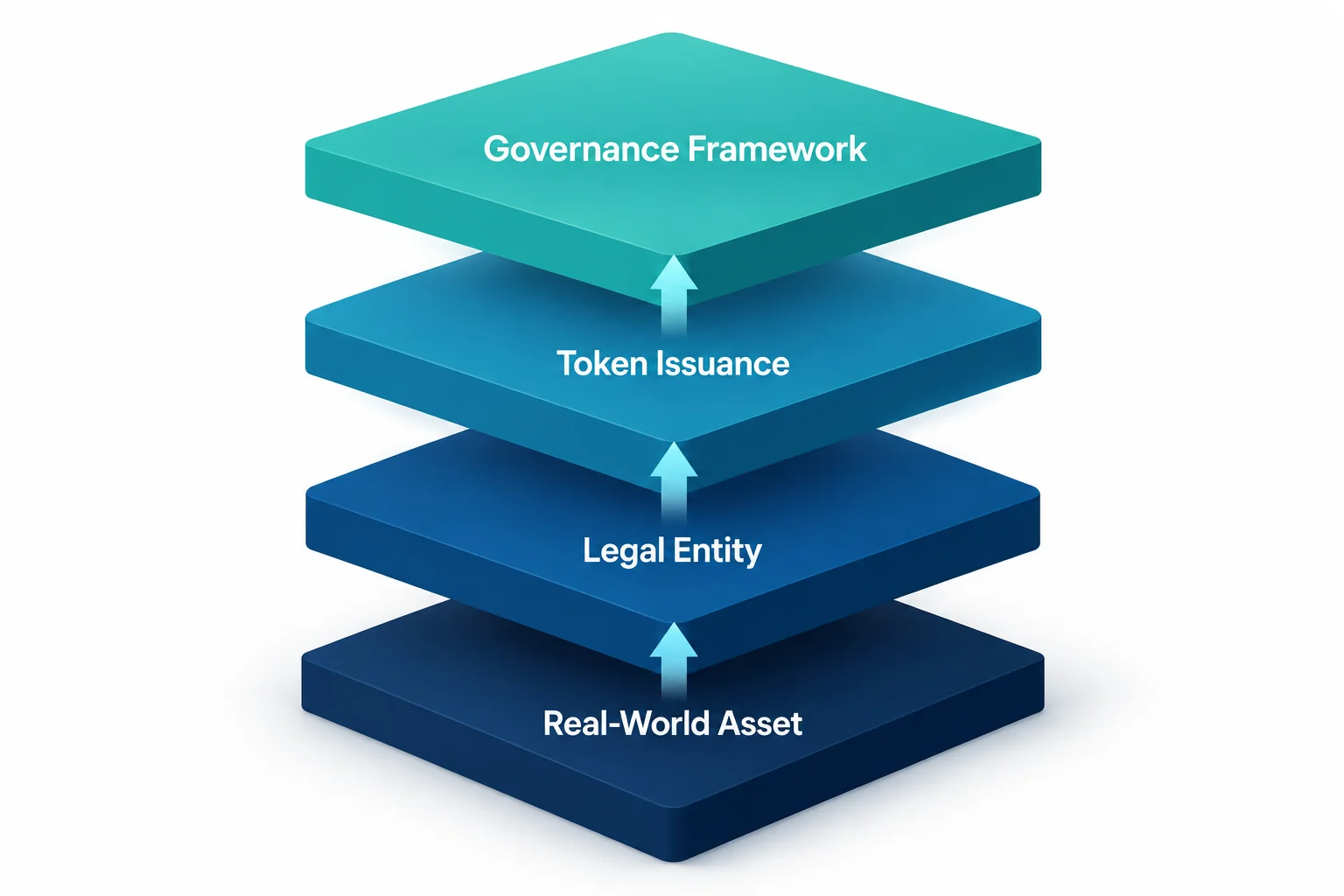
The standard architecture flows in four layers:
- Underlying asset: Real estate, private credit, commodities, infrastructure, or IP that exists in the physical or financial world
- Legal entity: An SPV, fund, LLC, or foundation that holds or manages the asset and creates the legal relationship between the asset and the token
- Token issuance: Tokens issued by or through the legal entity that represent defined rights to token holders
- Governance framework: Rules for how decisions are made, who has authority, and how token holders participate
The legal entity is the critical layer. It determines what the token actually represents. An entity that owns real estate can issue tokens representing fractional ownership. An entity that manages a debt portfolio can issue tokens representing debt claims. An entity with pure governance rights can issue governance tokens with no economic attachment. The structure of the entity defines the substance of the token.
Why Do RWA Projects Need a Legal Entity?
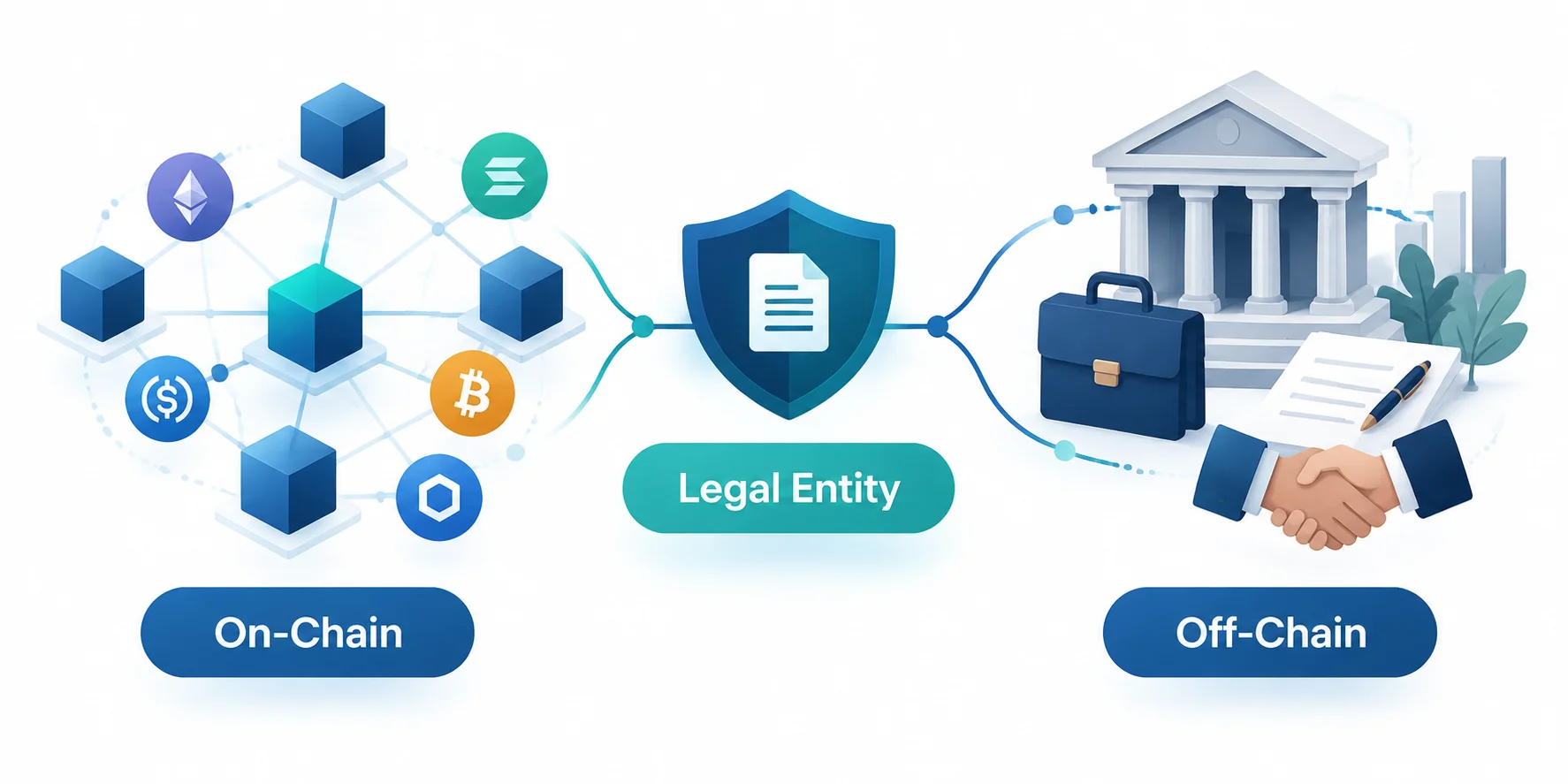
Every RWA project needs a legal entity because real-world assets require a recognized legal person to own them, manage them, and be responsible for them. A smart contract cannot hold title to property, sign a loan agreement, or appear in court. Without an entity in the middle, there is no legal connection between the token and the thing it is supposed to represent.
For a broader understanding of how legal wrappers function across different Web3 project types, see our guide on what a crypto legal wrapper is and why your project needs one.
Asset Ownership and Control
The legal entity is the owner of record for the underlying asset. This determines who signs contracts related to the asset, who receives income generated by the asset, and who has standing to resolve disputes involving it.
For a real estate tokenization project, the entity holds the property deed. For a private credit fund, the entity is the lender of record. For a tokenized commodity, the entity owns or controls the custody relationship. Without a legal entity occupying this role, there is no defined legal owner, and the token's claim to represent anything is not enforceable.
Liability Protection for Participants
Without an entity, founders, developers, and governance participants potentially carry personal liability for every claim related to the asset: tenant disputes, loan defaults, custodian failures, and regulatory actions. Tokenized asset projects involve real financial relationships, and the people behind them need legal separation between project obligations and personal assets.
A properly structured legal entity absorbs those claims. The entity is the counterparty. Its participants are shielded by limited liability. For RWA projects that manage significant capital, this protection is not optional.
Our article on what happens when a project gets sued without a legal entity explains how that exposure plays out in real enforcement cases.
Working With Traditional Institutions
RWA projects interact with a category of counterparties that pure on-chain protocols often avoid: custodians, banks, asset managers, title companies, and institutional investors. All of these parties require a recognized legal entity before engaging.
A legal entity provides the credibility and operational capability to engage with traditional financial infrastructure. Without one, an RWA project cannot open escrow accounts, engage regulated custodians, receive wire transfers for asset purchases, or enter into the commercial agreements that real-world assets require.
What Are the Key Elements of an RWA Tokenization Structure?
A complete RWA tokenization structure has four components that must be designed together, because the design of each affects the legal character of the others.
The Underlying Asset
Every RWA project begins with defining the asset and its legal status: who owns it, how it is valued, where it is held, what jurisdiction governs it, and who manages it on an ongoing basis. These questions determine the type of entity needed, the token structure appropriate for the rights being conveyed, and the regulatory framework that applies.
Different asset classes create different legal requirements. Real estate tokenization requires title, deed, and property management agreements. Private credit tokenization requires loan documentation and borrower agreements. Commodity tokenization requires custody and delivery mechanisms. The legal structure must match the asset's specific requirements.
The Asset-Holding Entity
Most RWA projects use an entity specifically dedicated to holding or managing the asset, creating a clean legal boundary between the asset and everything else. Common options include:
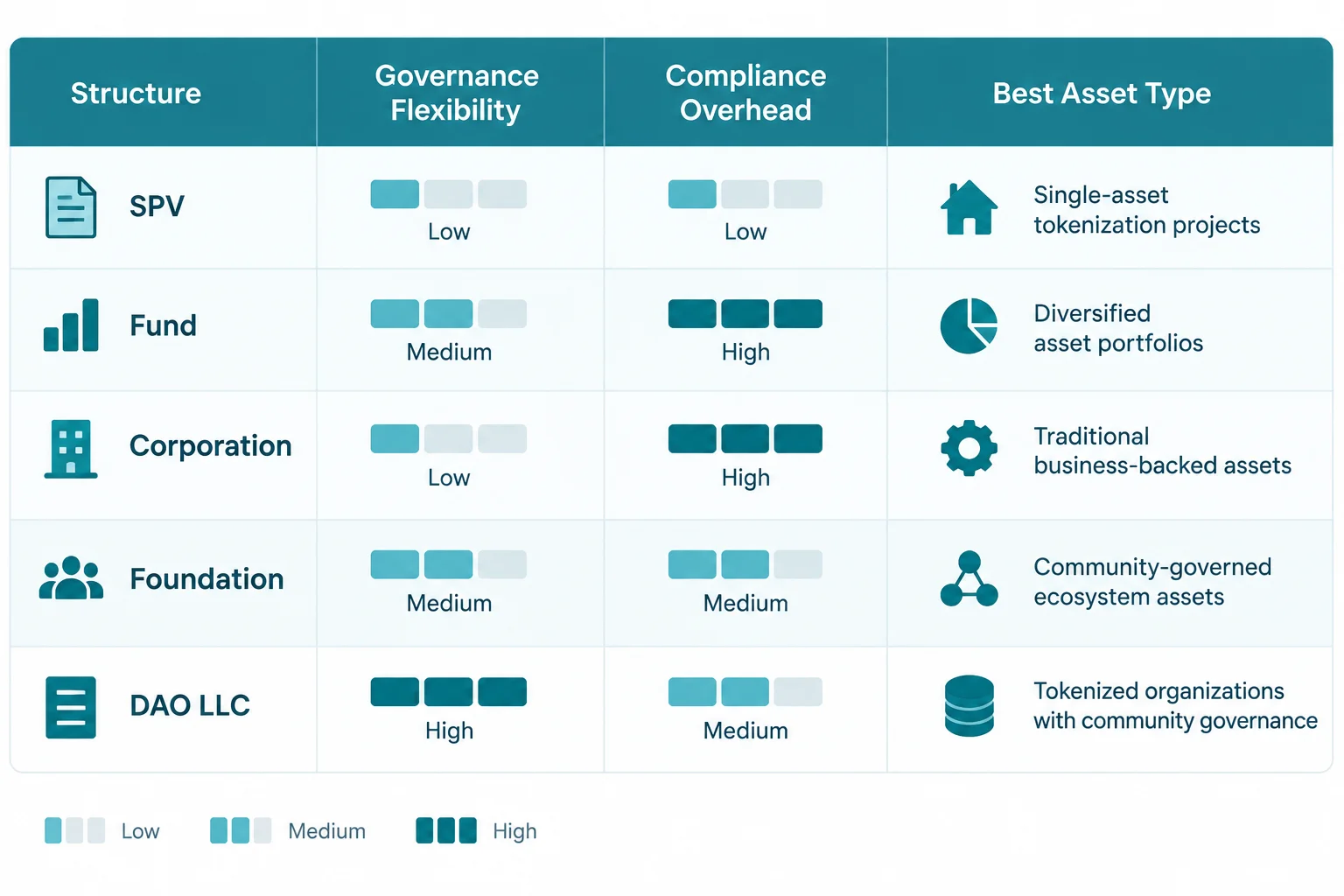
- Special Purpose Vehicles (SPVs): Purpose-limited entities holding a single asset or defined asset portfolio, keeping liability isolated to that asset
- Investment funds: Regulated fund structures for diversified asset portfolios with investor protections and reporting requirements
- LLCs and DAO LLCs: Flexible entities for tokenized organizations managing assets with community or token-based governance
- Foundations: Long-term stewardship structures for asset pools with defined purposes
The choice depends on asset type, investor profile, governance model, and regulatory requirements in target jurisdictions.
The Token Structure
Tokens in RWA projects can represent fundamentally different legal rights, and the token structure must match the legal documentation exactly. Misalignment between what the token smart contract says and what the legal documents say creates unenforceable rights.
Common token types and the rights they represent:
- Ownership tokens: Fractional ownership interest in the underlying asset, conveying property rights
- Debt tokens: Claims against the entity representing loan principal and interest
- Revenue-sharing tokens: Participation in revenue generated by the asset without ownership
- Governance tokens: Decision-making rights over the entity or protocol without economic claims
Each type carries different legal, tax, and securities law implications. A revenue-sharing token is more likely to be treated as a security than a pure governance token. An ownership token requires specific property law compliance for the asset's jurisdiction.
For a detailed breakdown of how token design intersects with securities law, see our guide on token issuance and how to stay compliant with crypto securities law.
Governance and Decision-Making
Governance design determines who has authority over the asset and the entity after the token launch. Options range from traditional centralized management to fully on-chain token voting:
- Traditional management: named directors or managers with fiduciary duties
- Multisig execution: threshold-based approvals for defined decisions
- Token voting: community decisions weighted by token holdings
- Smart contract-based governance: algorithmic execution of defined decision categories
Some legal structures support on-chain governance models directly. The Marshall Islands DAO LLC explicitly recognizes smart contracts as legal governance authority and supports token-based membership, making it the strongest available structure for RWA projects that want community governance without a centralized management layer.
How to Choose the Right Legal Entity for RWA Tokenization
There is no universal structure for RWA tokenization. The right entity depends on the asset type, investor profile, governance model, and regulatory requirements of the target market.
Steps to select the right structure:
- Define what the token represents. Ownership, debt, revenue-sharing, and governance each require different entity structures and create different regulatory exposure.
- Identify the regulatory framework in each target jurisdiction. Where are token holders located? Which securities laws apply? Does the structure require licensing?
- Assess governance requirements. Will the project be community-governed? Does on-chain voting need legal authority? Is a centralized management layer acceptable?
- Match entity type to asset class. Real estate SPVs have different requirements than private credit funds. The entity must be legally appropriate for the specific asset.
- Evaluate compliance overhead. Annual costs, audit requirements, and mandatory reporting vary significantly across structures and jurisdictions.
How Can a DAO LLC Support RWA Tokenization?
The Marshall Islands DAO LLC was built for tokenized organizations, and RWA projects that need flexible community governance alongside real asset management are precisely the use case it addresses.
What the RMI DAO LLC Provides
The RMI DAO LLC provides core legal capabilities that most RWA governance structures require:
- Legal personhood: The entity can hold assets, sign contracts, and appear in court in its own name
- Limited liability: Members and token holders are not personally exposed to entity-level obligations
- Token-based membership: Holders are recognized as members without requiring personal identity disclosure below the 25% governance threshold
- On-chain governance: Token voting and smart contracts carry formal legal authority under the operating agreement
- Asset ownership: The entity can hold real estate, financial assets, IP, and other RWAs directly
For-profit RMI DAO LLCs pay a 3% Gross Revenue Tax on revenue generated outside the Marshall Islands, excluding capital gains and dividends, which covers RWA projects where token holders receive a share of asset revenue or distributions. For projects where governance tokens carry no economic rights and serve purely to direct protocol decisions, the non-profit structure eliminates entity-level tax entirely and provides an explicit statutory carve-out making those tokens not securities under RMI law.
What the RMI DAO LLC Does Not Replace
The RMI DAO LLC is the governance and coordination layer. It does not replace jurisdiction-specific compliance requirements for the underlying assets. A real estate SPV still needs to comply with property law in the asset's jurisdiction. A private credit fund still needs to meet investor protection standards in relevant markets.
The RMI DAO LLC sits above the asset-level compliance structure, not inside it. Projects typically use the DAO LLC as the governance entity, with separately structured SPVs or fund entities holding individual assets underneath.
For a complete overview of how the RMI compares to other offshore jurisdictions for asset-holding structures, see our ranked guide to the best crypto-friendly jurisdictions in 2026.
From Token to Asset: Why Legal Structure Is the Bridge
A token without legal infrastructure is not an RWA. It is a digital representation of a claim that may or may not be enforceable. The legal structure is what converts a smart contract entry into a real right.
Real-world assets exist in legal systems, not just blockchain networks. The legal entity is the bridge between the two. It holds the asset, creates the relationship between the asset and the token, and gives token holders rights they can actually exercise in the real world. Projects that build that bridge correctly can scale from pilot to institutional adoption. Projects that skip it cannot.
For tokenized organizations managing real-world assets with community governance, the RMI DAO LLC provides a purpose-built legal foundation designed for exactly this use case.
Ready to structure your RWA tokenization project correctly? Book a consultation with the MIDAO team to explore the right legal wrapper for your tokenized asset project and get expert guidance on structure, jurisdiction, and token design.
Frequently Asked Questions
Can an RWA token represent direct ownership of a physical asset?
Yes, but only if the legal structure is designed to convey ownership rights. The token itself does not create ownership. The entity holding the asset must be structured so that token holders have a recognized legal interest, through equity ownership, trust beneficiary status, or a contractual right tied to the asset. Without the correct underlying legal structure, a token is a representation of a claim, not evidence of ownership.
Do RWA projects need a separate legal entity for every tokenized asset?
Not always. SPVs are typically used for individual assets to isolate liability. A single fund entity can hold multiple assets if the governance and investment structure permits it. DAO LLCs with Series capability can create legally separate sub-entities under one parent, each holding a distinct asset with segregated liability. The right answer depends on risk isolation requirements, investor expectations, and the regulatory treatment of the assets involved.
How are token holders protected if the asset-holding company faces legal issues?
Token holders' protection depends entirely on how the legal structure was designed. In a properly structured SPV or DAO LLC, the entity absorbs the legal claim, and token holders' exposure is limited to the value of their token interest. Without a legal entity, token holders have no formal protection and may face claims directly. The specific protections available depend on the entity type, jurisdiction, and the rights defined in the token's legal documentation.