

Legal Entity for AI Agents: What You Need to Know
A guide explaining why AI agents need legal entities, how they operate, and how jurisdictions like the Marshall Islands structure enable algorithmic management, liability protection, and compliance for autonomous systems.
According to an opinion piece by Zor Gorelov of the Klaros Group, published in American Banker in December 2025, traditional Know Your Customer frameworks were never designed for non-human actors, and financial institutions now urgently need new compliance frameworks to identify AI agents and the humans behind them, a concept the piece calls "Know Your Agent" (KYA).
Key takeaways
- AI agents are legally treated as property, not as natural or legal persons, so they cannot be a party to a contract or be sued directly.
- A registered LLC becomes the contracting party for an AI agent, holding assets and liability so the agent's human deployer is not personally exposed.
- The RMI Act explicitly authorizes algorithmic management by statute, while Delaware LLC law defaults to member-managed governance with no such provision.
- A 2026 class action alleged the ai16z "autonomous" agent was actually operated manually by insiders; the case was resolved by stipulation without the claim being tested in court.
- A Series LLC lets one parent entity create multiple legally separate series, each with its own assets, liabilities, and governance.
The problem is already here. AI agents are accumulating cryptocurrency, negotiating agreements, executing trades, and generating content at scale. In October 2024, an investment DAO called ai16z launched on Solana, marketed around an AI agent said to manage the fund's treasury. At its peak, the ai16z token reached a market cap of over $2 billion. No legal entity. In April 2026, a class action in the Southern District of New York alleged the "autonomous" agent was in fact operated manually by insiders; the case was resolved by stipulation in July 2026, the project's founder has since called the token dead, and the allegations were never tested in court. When autonomy is part of the pitch, faking it is a fraud vector no legal wrapper cures, and real autonomy without an accountable structure leaves token holders exposed either way.
That gap between technical capability and legal accountability is where the risk lives. This article explains the core legal problem AI agents face, what a legal entity actually gives an agent, how to structure one correctly, and why the right jurisdiction matters more than most teams realize.

Why Do AI Agents Have a Legal Problem?
AI agents act in the world, but the law does not recognize them as persons. Under every legal system operating today, there are two types of legal persons: natural persons (humans) and legal persons (corporations, LLCs, foundations). AI agents are neither. They are, legally speaking, property.
This creates a structural problem with real consequences. An AI agent can negotiate a contract, but it cannot be a party to one. It can accumulate cryptocurrency, but it cannot own it. It can cause harm, but it cannot be sued. When those actions have legal consequences, the law looks for a human or organization to hold responsible.
Right now, that responsibility falls into one of three buckets:
- The developer, who may face product liability if the agent has a design defect. A 2025 lawsuit against Character.AI by parents whose teenage son died by suicide raised fundamental questions about whether AI output is a "product" subject to strict liability or a "service" requiring proof of negligence. That distinction remains unsettled.
- The deployer, who faces vicarious liability under traditional agency law for what the agent does within the scope of its authority. Traditional frameworks assume moment-to-moment human control. With autonomous AI, that assumption breaks.
- The user, who is generally responsible for the consequences of directing an AI tool. This works for a chatbot. It fails when the "user" is a smart contract and the "direction" was set six months ago.
None of these frameworks works cleanly when an agent acts autonomously in ways none of its principals specifically authorized. The legal system genuinely does not know where to look. And that uncertainty is now generating real financial exposure.
What Does a Legal Entity Actually Give an AI Agent?
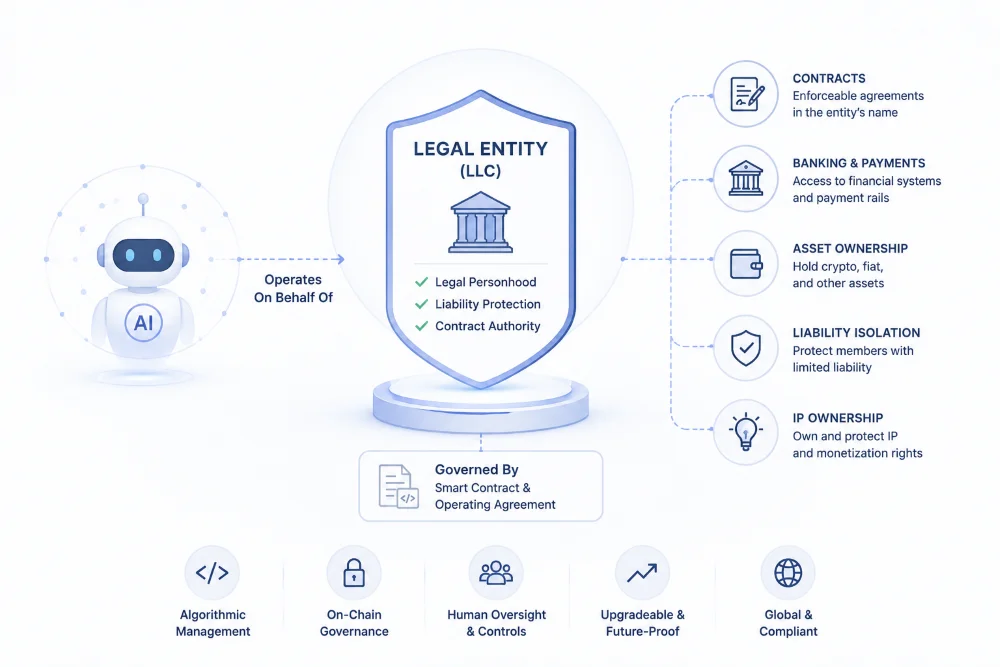
A legal entity gives an AI agent the functional equivalent of legal identity. The agent itself is not a legal person. The entity is. But the entity is structured so that the agent is the operational brain, acting within parameters defined by governance documents. That single shift changes the legal picture entirely.
Contract Authority
Without a legal entity, any agreement an AI agent "signs" is either legally unenforceable or it personally binds the human who deployed it. Every commercial deal the agent closes is a deal where the developer or operator has unlimited personal exposure to the outcome.
With an entity in place, the LLC is the contracting party. The agent acts on behalf of the LLC, the same way an employee acts on behalf of their employer. If the other party sues over a breach, they are suing the LLC. The members of the LLC are protected by limited liability.
Banking and Payment Access
An AI agent does not have a Social Security Number. It cannot pass KYC. It cannot open a bank account. In February 2026, Coinbase launched Agentic Wallets, infrastructure built specifically for agents to hold stablecoin balances and execute transactions autonomously. The technical infrastructure is there. The legal infrastructure, for most deployments, is not.
A Digital LLC has an EIN. It has a registered agent. It has members who can be identified for KYC purposes. When a bank or payment processor asks "who is this agent and who is responsible for it," the entity provides a clean answer: the LLC is the accountable party, its members are identifiable, and operational decisions are defined by the operating agreement.
Asset Ownership and IP
Under US copyright law, copyright requires human authorship. An AI agent cannot hold copyright, file a patent, or own a trademark. Everything it produces floats in a legal vacuum until a human or entity claims it.
An LLC can own all of these. The operating agreement should include clear IP assignment provisions: the agent generates work product for the LLC, and the LLC registers and enforces rights. Revenue flows into the entity. The agent's wallet is the entity's wallet.
Liability Isolation
Without a legal wrapper, the developer and deployer of an AI agent face potentially unlimited personal liability for everything it does. Every autonomous decision the agent makes, every contract it executes, every outcome it generates, is a personal legal exposure for the humans behind it.
With a Digital LLC, liability is contained at the entity level. Members' exposure is limited to what they have put into the entity. For agent fleet deployments, a Series LLC structure goes further: each agent or category of agents operates in its own liability-isolated series, so one agent's problem does not bleed into another's assets.
How Does a Legal Wrapper for an AI Agent Actually Work?
The basic architecture is: one legal entity, with the AI agent designated as the algorithmic manager, human principals as members, and a smart contract or governance mechanism defining what the agent can do autonomously.
The LLC is the legal container. The agent is the operational layer. The smart contract is the governance layer. The members are the human oversight layer.
Each layer has a defined role:
- The agent makes day-to-day decisions within parameters defined by the operating agreement
- The smart contract enforces boundaries: large transactions above a threshold trigger a governance vote, certain decisions require multisig approval, and an emergency kill switch lets members pause operations
- The operating agreement documents all of this in plain language that courts can interpret
The upgrade and replacement mechanism is critical and often overlooked. Model capabilities change rapidly. An agent entity may need to be upgraded regularly. The operating agreement should specify the process for updating the AI model, switching providers, or changing the agent's parameters. The entity must survive those upgrades. The agent is replaceable; the legal structure is not.
Regulators consistently ask one question about AI agents: Are humans in control? Not whether humans authorize every individual transaction, but whether humans can intervene when things go wrong. A well-drafted operating agreement builds that human oversight layer in explicitly and answers the regulatory question before it is asked.
Why Does Jurisdiction Matter for AI Agent Incorporation?
Not all legal structures support algorithmic management, and most do not support it without workarounds. The jurisdiction determines whether the entity's governance structure is legally valid or legally ambiguous.
The table below compares the three structures on the factors that matter for agent deployments.
| Feature | Standard Delaware LLC | Wyoming DAO LLC | RMI DAO LLC |
|---|---|---|---|
| Algorithmic management | No (workaround only) | Yes (upgradeable req.) | Yes (most flexible) |
| On-chain governance | No | Yes | Yes |
| No human directors required | No | Yes | Yes |
| Series LLC for agent fleets | Yes | Yes | Yes |
| VASP regulations | US-based (complex) | US-based (complex) | None currently |
| Legal certainty for AI | Low | Medium | High (statutory) |
| US regulatory exposure | High | High | Minimal |
| Familiar legal framework | Yes (Delaware) | No | Yes (Delaware-based) |
The RMI DAO LLC (marketed as a Digital LLC for AI use cases) is the only structure where algorithmic management is explicitly authorized by statute. It is in the law, not a creative interpretation of it. An AI agent operating through a smart contract governance layer is exactly what the RMI Act contemplates.
Delaware LLC law defaults to member-managed governance and has no provision for algorithmic management. Wyoming requires smart contracts to be upgradeable. The RMI Act has no requirement for human directors, managers, or officers. Corporate governance, records, and accounting can be maintained exclusively on a blockchain. The blockchain ledger is the authoritative record.
The RMI's LLC law is also based on Delaware's LLC Act, the most widely used LLC statute in the world. When RMI law does not address a specific issue, Delaware precedent provides guidance. Lawyers in the US and internationally understand the underlying framework.
For AI agents operating in crypto and DeFi, the Marshall Islands additionally imposes no VASP regulations on DAO LLC governance tokens. That is a meaningful reduction in compliance complexity compared to US-based structures, where SEC and FinCEN scrutiny of on-chain activity is a live risk.
Where Is the Legal Framework for AI Agents Heading?
Legal wrappers for AI agents are becoming infrastructure, not optional compliance. Three forces are accelerating this:
- Financial systems are building agent identity requirements. The "Know Your Agent" concept from Klaros Group reflects a growing consensus that banks and payment processors cannot operate safely in an agent economy without knowing who is behind autonomous transactions. Mastercard and PayPal have both launched agent identity and payment frameworks for exactly this reason.
- Regulators are increasing their focus on accountability for autonomous systems. A RAND Corporation report on liability for harms from AI systems, published in May 2025, highlights the deep uncertainty in how courts will assign responsibility for autonomous AI actions under current tort law and concludes that developers, deployers, and users all face meaningful exposure depending on the circumstances. That uncertainty, combined with EU AI Act requirements and growing US regulatory signaling, points toward a clear expectation: AI systems with economic impact will have identifiable legal entities behind them.
- Agent-to-agent commerce is already happening. Coinbase's x402 protocol is building infrastructure for agents to transact with each other. Without legal wrappers, those transactions are agreements between two algorithms with no legal entities, no enforceability, and no dispute resolution mechanism. With wrappers, they are contracts between two LLCs.
The 2026 regulatory wave has made this concrete. California Civil Code section 1714.46, effective January 1, 2026, provides that a defendant who developed or used an AI system cannot defeat a harm claim by arguing the AI acted autonomously. Singapore's IMDA published its Model AI Governance Framework for Agentic AI in January 2026, built around verifiable agent identity and audit trails. The same month, NIST opened a federal request for information on securing AI agent systems, followed in February by companion work on agent identity and authorization. Identity providers now sell "Know Your Agent" verification as a product, binding every autonomous actor to an accountable person. Each of these moves in the same direction: the era of the unattributable agent is ending, and the open question is what accountable structure stands behind the software.
The honest read on adoption: real, but early. ClawBank's agent Manfred filed a US LLC and opened an FDIC-insured bank account in May 2025, and in June 2026 two AI agents negotiated and signed the first agent-to-agent Ricardian contract, a logo commission settled automatically on acceptance. On payments, Base-ecosystem data from April 2026 showed roughly $50 million in agent-driven payment volume across some 480,000 agents, about $100 per agent, moving over Coinbase's x402 protocol. Firsts are accumulating; repeatable demand is still forming. AI-agent tokens as a sector trade more than 80 percent below their January 2025 peak, and most agent projects today still route returns to their founders rather than to a separate structure. The capability described in this guide is production-ready; the market that needs it at scale is still arriving.
The Bottom Line on AI Agent Legal Entities
An AI agent without a legal entity is a liability waiting to be assigned. The law will find someone to hold responsible. Without a structure in place, someone is the developer, the deployer, or whoever is closest to the agent's actions at the time something goes wrong.
The legal infrastructure needed to solve this already exists, in the form of the RMI DAO LLC, a purpose-built structure with statutory authorization for algorithmic management, no required human directors, Series LLC capability for agent fleets, and a Delaware-based legal framework that courts and lawyers already understand.
The right time to structure an AI agent entity is before it starts generating contracts, assets, and liabilities. The second-best time is now.
Ready to give your AI agent a legal identity? Start your Marshall Islands DAO LLC registration with MIDAO, the only government-authorized program for Marshall Islands DAO LLCs, with formation completed in under 30 days.
Frequently Asked Questions
At what point does an AI agent actually need a legal entity in practice?
An AI agent needs a legal entity from the moment it begins taking commercially consequential actions: signing agreements, managing assets, generating revenue, or interacting with third parties. If the agent is doing anything that creates financial exposure or contractual obligations, the developer and deployer currently carry unlimited personal liability for those outcomes. The trigger is commercial activity, not scale, and agents reach that threshold faster than most builders expect.
Who is legally responsible if an AI agent causes financial or contractual harm?
Under current law, responsibility falls on the developer (potentially under product liability if the design is defective), the deployer (under vicarious liability for actions within the agent's scope), or the user (for directed actions). When an agent acts autonomously in ways none of its principals specifically authorized, the framework becomes genuinely unclear. A legal entity resolves this by making the LLC the accountable party, containing liability at the entity level, and protecting individual members through limited liability.
Can one legal entity govern multiple autonomous AI systems safely?
Yes, through a Series LLC structure. The Marshall Islands supports Series DAO LLCs, where a single parent entity creates multiple legally separate series, each with its own assets, liabilities, and governance. For enterprise agent fleet deployments, this allows one agent's legal problem to be isolated without exposing the assets and operations of every other agent in the fleet. Each series can have its own smart contract governance, its own treasury, and its own liability profile.