
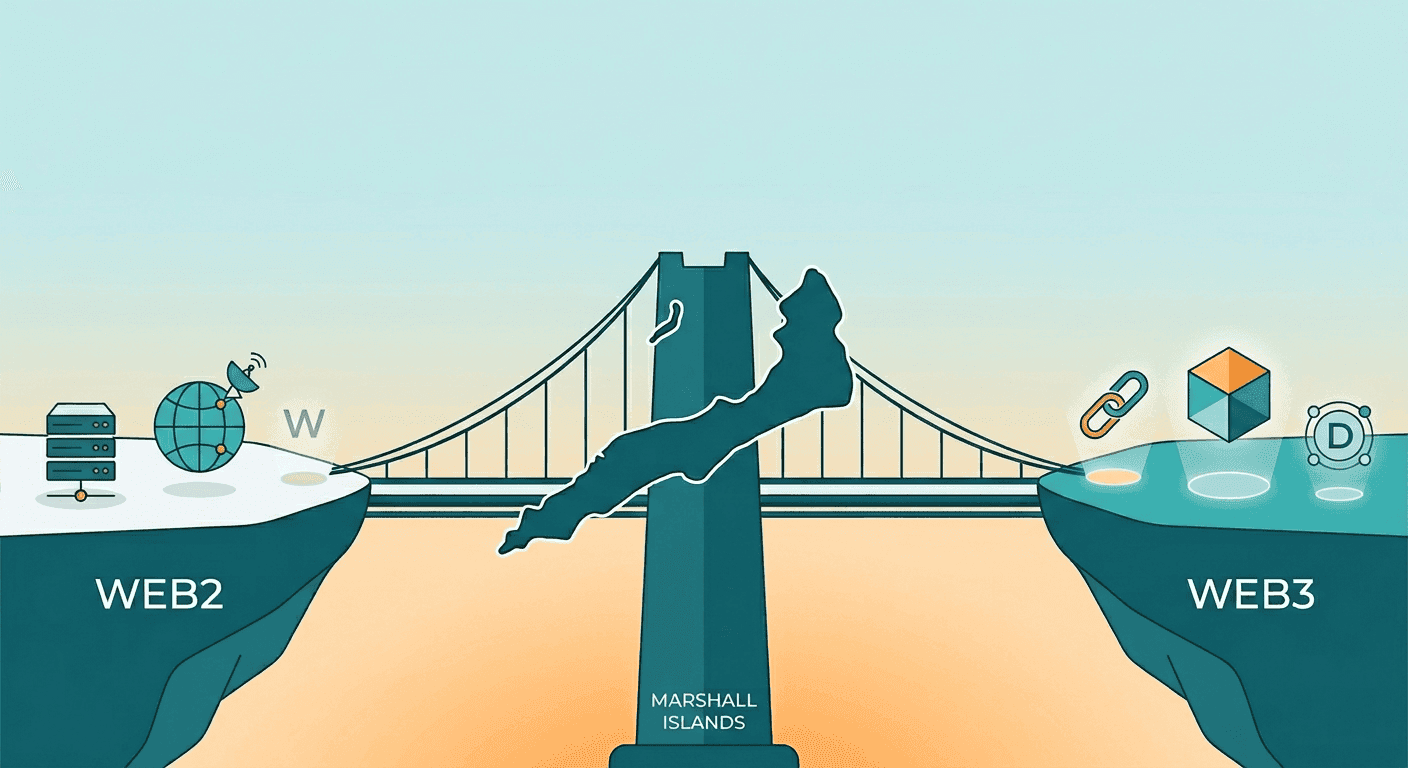
Bridging Web2 and Web3: How the Marshall Islands Enable Hybrid Entities
The Marshall Islands offers a unique DAO LLC structure that bridges Web2 and Web3, providing decentralized projects with a legal framework that supports both worlds.
The emergence of decentralized autonomous organizations (DAOs) and Web3 projects has opened new frontiers in organizational design. However, most legal systems worldwide still rely on traditional centralized structures that do not mesh well with decentralized networks. This creates a significant roadblock for many DAOs seeking legitimacy and practical functionality.
Key takeaways
- Most legal systems require boards, paper records, and named members, which conflict with how DAOs actually operate.
- A Marshall Islands DAO LLC is a limited liability company adjusted to recognize on-chain records and omit board requirements.
- A recognized legal entity lets a DAO open bank accounts, receive fiat payments, and sign contracts with vendors.
- DAO LLCs are used by Web3 projects that do not identify as DAOs, often alongside entities in other jurisdictions.
Bridging Web2 and Web3 requires more than good intentions from regulators. It requires purpose-built legal structures that understand both worlds. The Marshall Islands has taken that challenge seriously.
An illuminating discussion unfolded about crypto innovation in this Pacific island nation on the Network State Podcast. Host Balaji Srinivasan conversed with Marshall Islands Minister Joe Bejang, Senator David Paul, and Adam Miller, Founder of MIDAO, on how customized legal structures bridge Web2 and Web3. Their perspectives form the core of this article, which explores the regulatory stance that sets the Marshall Islands apart.
As Adam Miller explains:
"One way of thinking about what we do is that it's a legal bridge between Web2 and Web3. It's for Web3 projects that need to connect to the traditional world, the Web2 world."
By building on the well-established LLC structure but modifying key aspects to accommodate DAO attributes, the Marshall Islands has created an accessible on-ramp for Web3 projects to gain real-world recognition.
Overcoming Legal Limitations for DAOs
Most existing legal systems try to force DAOs into frameworks designed for traditional top-down companies. This inevitably undermines the core value proposition of DAOs by requiring centralized governance bodies like boards of directors.
Why Banks and Regulators Have Been Slow to Accept DAOs
As Senator David Paul from the Marshall Islands comments:
"The banking sector has always been opposed to anything related to crypto. Once crypto or digital currencies become a dominant force, they will actually render these banks redundant because, in my opinion, the idea of digital currencies is peer-to-peer, so they will cut out the middleman, which is the banks."
The reluctance to accept decentralized organizational structures also comes from regulators and policymakers in many countries. Concerns around security, accountability, and control result in reactions to ban or restrict the operation of DAOs rather than craft regulations suited to this new paradigm.
The most common barriers DAOs face when trying to operate legally in traditional jurisdictions include:
- Requirements to disclose member names and physical addresses
- Mandatory boards of directors or officer structures
- Paper or PDF record-keeping obligations, even when all records exist on a public blockchain
- No legal recognition of governance tokens as membership interests
But as Minister Joe Bejang explains, the Marshall Islands recognizes that DAOs represent the future of economic coordination:
"We see it as a perfect opportunity to explore and look into the future to obtain a steady stream of revenue for RMI. So, we're in full support of the government of the Marshall Islands."

Crafting Business-Friendly DAO Legal Structures
To create a space where DAOs can integrate into mainstream business operations rather than exist in legal grey zones, the Marshall Islands has developed customized DAO LLC structures.
These build directly on the widely used LLC framework that offers liability protections and flexible profit-sharing mechanisms suitable for DAOs. Meaningful adjustments have been made to LLC regulations in the Marshall Islands to accommodate DAO attributes like decentralized governance and digital operations.
As Adam Miller outlines:
"These DAO LLCs are limited liability companies that just have slightly different treatment under the law in all the ways that really matter to Web3, like not having a board, not having to keep paper records, and things like that."
Balancing Decentralization With Real-World Functionality
Whereas forcing a DAO into a traditional LLC would undermine critical elements of decentralization to satisfy regulations designed for a different time, the Marshall Islands strikes the right balance. Default decentralized operation is enabled while still providing the accountability and legitimacy needed to integrate DAOs into mainstream commercial and financial systems.
Miller explains the rationale behind this approach:
"We want these DAOs to have all the same benefits, to be able to open a bank account and an exchange account. A lot of our DAOs are doing things like opening bank accounts because they might want to sponsor an event that doesn't take crypto or get paid by a sponsor that only has fiat currency."
This is precisely what bridging Web2 and Web3 looks like in practice. Not replacing one system with the other, but allowing them to coexist under a single legal structure.
A Flexible Solution for Web3 Projects Beyond DAOs
In addition to allowing DAOs themselves to incorporate in the Marshall Islands, customized DAO LLCs can serve as a jurisdictional base for a wide range of Web3 projects.
The structure's flexibility permits both centralized and decentralized elements to coexist under the same overarching legal entity. This allows developers to build with the right components in the right places.
As Adam Miller notes:
"DAO LLCs are not just for DAOs. Not everyone loves the term 'DAO,' and many crypto projects have multiple entities. You might have an entity in the US, the BVI, and the Marshall Islands. So, any Web3 project can usually take advantage of a DAO LLC as part of its ecosystem."
How the Marshall Islands Compares to Other Jurisdictions
Among the most commonly used jurisdictions for Web3 entities, the Marshall Islands stand out for the combination of features it offers. It is the only jurisdiction listed here that provides a purpose-built DAO LLC structure, does not require a board of directors, and formally recognizes on-chain records, all without the federal regulatory risk that projects incorporating in Wyoming must navigate.
By contrast, the Cayman Islands, the British Virgin Islands, and Switzerland still require boards of directors and do not recognize on-chain records, making them poorly suited to natively decentralized projects. Wyoming deserves credit as a trailblazer in the US context, but federal regulatory exposure remains a real consideration for projects operating there.
The Marshall Islands delivers a neutral ground where Web3 and Web2 components can come together without compromise. Regulatory systems around the world have generally not fostered this kind of flexibility, and instead try to constrain experimental designs like DAOs. A progressive jurisdiction recognizes that new technologies require rules fitted to their unique characteristics rather than forcing them into what came before.
Moving Beyond Anti-Crypto Banking Limitations
Despite the business-friendly legal conditions for DAOs and Web3 projects in the Marshall Islands, limitations around banking and financial services still present challenges.
What Changes When a DAO Has a Legally Recognized Entity
The absence of crypto-specialized banking partners makes it difficult for DAOs to integrate fiat currency transactions directly. This can create friction with sponsors, vendors, or partners who still rely on legacy financial systems.
However, DAO LLCs incorporated in the Marshall Islands can open accounts with banks elsewhere in the world that engage with cryptocurrency users. The legitimacy and compliance that come with Marshallese incorporation smooth the process considerably. Specifically, having a registered DAO LLC helps with:
- Opening bank accounts in jurisdictions that accept crypto-linked entities
- Getting paid by sponsors or partners who only transact in fiat currency
- Entering into contracts with vendors who require a recognized legal entity
Over time, as Adam Miller notes, regulated crypto-friendly banks are likely to emerge locally under specialized digital asset frameworks now in development:
"I could speak to this because we've had this conversation with the banking commissioner in the Marshall Islands, and they're open to it, but first, they're looking to us to help them draft the regulations under which that type of activity would occur."
This showcases the Marshall Islands' commitment to continuously adapt to each new phase of crypto-finance, just as they have already done with decentralized organizational structures.
Blazing a Trail for Web3 and Web2 Integration
While crypto still faces an uphill battle to find acceptance in most countries, the Marshall Islands stands apart. Through targeted legal innovations around entity structures for DAOs and digital asset banking, barriers are being dissolved.
This allows next-generation projects to gain practical functionality without compromising their core principles. Mass adoption depends enormously on crypto's ability to work alongside real-world commercial and financial frameworks while still retaining its distinctive characteristics.
The Marshall Islands paved the way for this Web3 and Web2 integration in a jurisdiction that is respected around the globe. As more countries follow suit, the first-mover advantage the Marshall Islands holds becomes increasingly valuable.
For Web3 projects across decentralized finance, blockchain platforms, and beyond, a specialized DAO LLC in this Pacific jurisdiction remains one of the most practical and legally sound options available today.
Learn More About Bridging Web2 and Web3 Through Legal Structure
The "Just DAO It" podcast features Adam Miller working through the nuances of legally structuring Web3 organizations across in-depth episodes spanning two full seasons:
The MIDAO blog also covers legally structuring DAOs and blockchain organizations across jurisdictions, with practical guidance for projects at any stage.